Curtis Wilson – författare
Visar alla böcker från författaren Curtis Wilson. Handla med fri frakt och snabb leverans.
6 produkter
6 produkter
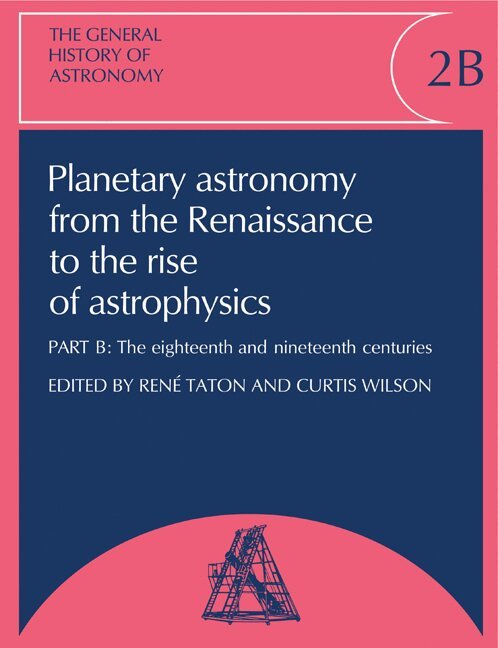
The General History of Astronomy: Volume 2, Planetary Astronomy from the Renaissance to the Rise of Astrophysics
Häftad, Engelska, 2009
766 kr
Skickas inom 7-10 vardagar
Part B of Planetary Astronomy from the Renaissance to the Rise of Astrophysics is the sequel to Part A and continues the history of celestial mechanics and observational discovery through the eighteenth and nineteenth centuries. Twelve different authors have contributed their expertise in some eighteen chapters, each of them intended to be accessible to the interested layman. An initial section deals with stages in the reception of Newton's inverse square law as exact. In the remainder of the book a large place is given to the development of the mathematical theory of celestial mechanics from Clairaut and Euler to LeVerrier, Newcomb, Hill and Poincaré - a topic rarely treated, at once synoptically and in some detail. Lists of further reading provide entrée to the literature of these several topics.
1 393 kr
Tillfälligt slut
For long it has been accepted that Kepler ’proved’ three empirical laws of planetary motion, and that Newton depended upon these in ’establishing’ his law of universal gravitation. As Professor Wilson demonstrates, the truth is more complicated - but more interesting. The question of observational evidence therefore forms the theme of this volume. The first articles trace the evolution of Kepler’s ideas and reconstruct the steps in his journey. Their conclusion is that observational error inevitably prevented any satisfactory direct verification of Kepler’s first law so, as Kepler himself recognised, his results rested upon hypothesis. The final articles present a similar study of Newton’s thoughts on gravitation and planetary motion: again, as Newton left it, the theory he propounded can be considered no more or less than a hypothesis. In between Professor Wilson examines the attitudes of mid-17th-century astronomers to Kepler’s ideas, and in particular, the achievements of Jeremiah Horrocks: he died in 1640, at the age of only twenty-two, but his improvements in Keplerian astronomy were of great importance for Newton’s future work.
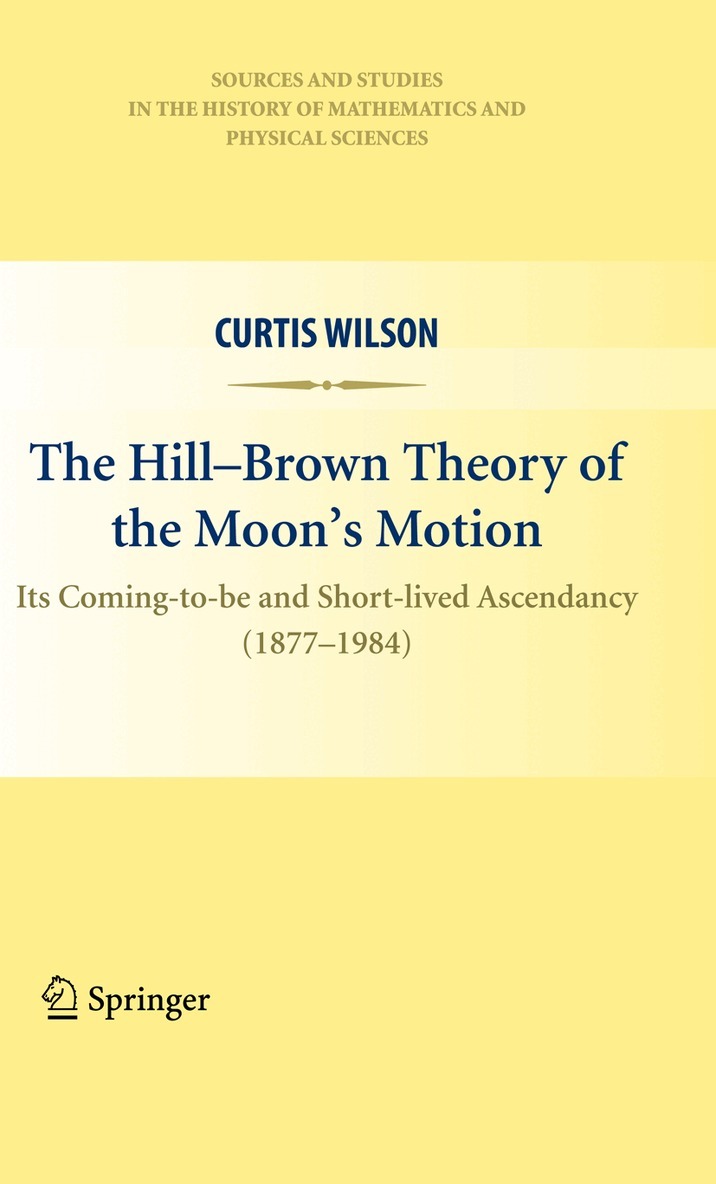
Hill-Brown Theory of the Moon’s Motion
Its Coming-to-be and Short-lived Ascendancy (1877-1984)
Inbunden, Engelska, 2010
1 062 kr
Skickas inom 10-15 vardagar
The Hill–Brown theory of the Moon’s motion was constructed in the years from 1877 to 1908, and adopted as the basis for the lunar ephemerides in the nautical almanacs of the US, UK, Germany, France, and Spain beginning in 1923. At that time and for some decades afterward, it was the most accurate lunar theory ever constructed. Its accuracy was due, rst, to a novel choice of “intermediary orbit” or rst approxi- tion, more nearly closing in on the Moon’s actual motion than any elliptical orbit ever could, and secondly to the care and discernment and stick-to-it-ive-ness with which the further approximations (“perturbations” to this initial orbit) had been computed and assembled so as yield a nal theory approximating the Moon’s path in real space with an accuracy of a hundredth of an arc-second or better. The method by which the Hill–Brown lunar theory was developed held the potentiality for still greater accuracy. The intermediary orbit of the Hill–Brown theory may be described as a periodic solution of a simpli ed three-body problem, with numerical parameters carried to 15 decimal places. George William Hill, a young American mathematician working for the U. S. Nautical Almanac Of ce, had proposed it, and computed the numerical parameters to their 15 places. A self-effacing loner, he had in his privately pursued studies come to see that the contemporary attempts at predicting the Moon’s motion were guaranteed to fail in achieving a lunar ephemeris of the accuracy desired.
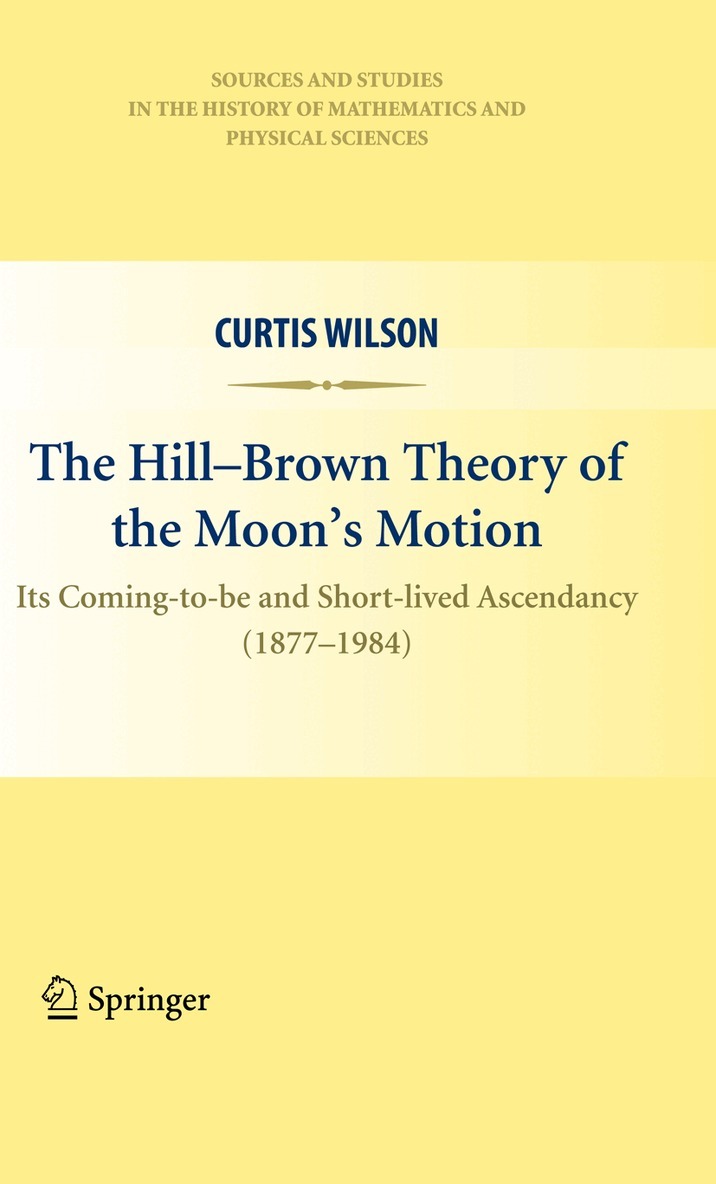
Hill-Brown Theory of the Moon’s Motion
Its Coming-to-be and Short-lived Ascendancy (1877-1984)
Häftad, Engelska, 2012
1 062 kr
Skickas inom 10-15 vardagar
The Hill–Brown theory of the Moon’s motion was constructed in the years from 1877 to 1908, and adopted as the basis for the lunar ephemerides in the nautical almanacs of the US, UK, Germany, France, and Spain beginning in 1923. At that time and for some decades afterward, it was the most accurate lunar theory ever constructed. Its accuracy was due, rst, to a novel choice of “intermediary orbit” or rst approxi- tion, more nearly closing in on the Moon’s actual motion than any elliptical orbit ever could, and secondly to the care and discernment and stick-to-it-ive-ness with which the further approximations (“perturbations” to this initial orbit) had been computed and assembled so as yield a nal theory approximating the Moon’s path in real space with an accuracy of a hundredth of an arc-second or better. The method by which the Hill–Brown lunar theory was developed held the potentiality for still greater accuracy. The intermediary orbit of the Hill–Brown theory may be described as a periodic solution of a simpli ed three-body problem, with numerical parameters carried to 15 decimal places. George William Hill, a young American mathematician working for the U. S. Nautical Almanac Of ce, had proposed it, and computed the numerical parameters to their 15 places. A self-effacing loner, he had in his privately pursued studies come to see that the contemporary attempts at predicting the Moon’s motion were guaranteed to fail in achieving a lunar ephemeris of the accuracy desired.
154 kr
Skickas inom 5-8 vardagar
339 kr
Skickas inom 5-8 vardagar