• Fri frakt över 249 kr
  • •
  • Snabba leveranser
  • •
  • Billiga böcker
Kundservice

Du är på sajten för privatpersoner.

Företag, bibliotek eller offentlig verksamhet?

Du handlar på classic.bokus.com, där alla dina funktioner finns intakta.
Till classic.bokus.com
Bokus logotyp. Gå till startsidan.
  • Erbjudanden
  • Nyheter
  • Student
  • Topplistor
  • Barn & ungdom
  • Bokus Play
  • E-böcker
  • Pocketböcker
  • Spel & pussel

10% studentrabatt med kod TERM26

Sidfot

Mina sidor

    Hjälp

    • Kundservice
    • Vanliga frågor och svar
    • Frakt och leverans
    • Retur vid ångerrätt
    • Reklamera vara
    • Betalning
    • Köpvillkor
    • Allmänna villkor
    • Information om webbplatsens tillgänglighet

    Om Bokus

    • Om oss
    • Pressrum
    • För studenter
    • För företag
    • För bibliotek och offentlig verksamhet
    • För leverantörer
    • Hållbarhet

    Populärt

    • Aktuella erbjudanden
    • Presentkort
    • Studentlitteratur
    • Nya böcker
    • Topplistor
    • Signerade böcker
    • Engelska böcker

    Inspiration

    • Boktips
    • BookTok
    • Populära bokserier
    • Barnbokskaraktärer
    • Populära författare
    Logotyp för Bokus
    Följ oss på Facebook (extern länk)Följ oss på Instagram (extern länk)Följ oss på YouTube (extern länk)Följ oss på TikTok (extern länk)
    bokus @ CookiesAnpassa cookiesIntegritetspolicyKöpvillkor
    Till Citymail hemsida (extern länk)Till Budbee hemsida (extern länk)Till Postnord hemsida (extern länk)Till Schenker hemsida (extern länk)Till Early Bird hemsida (extern länk)Till Walleys hemsida (extern länk)
    1. Naturvetenskap och teknik
    2. Matematik och naturvetenskap
    3. Astronomi

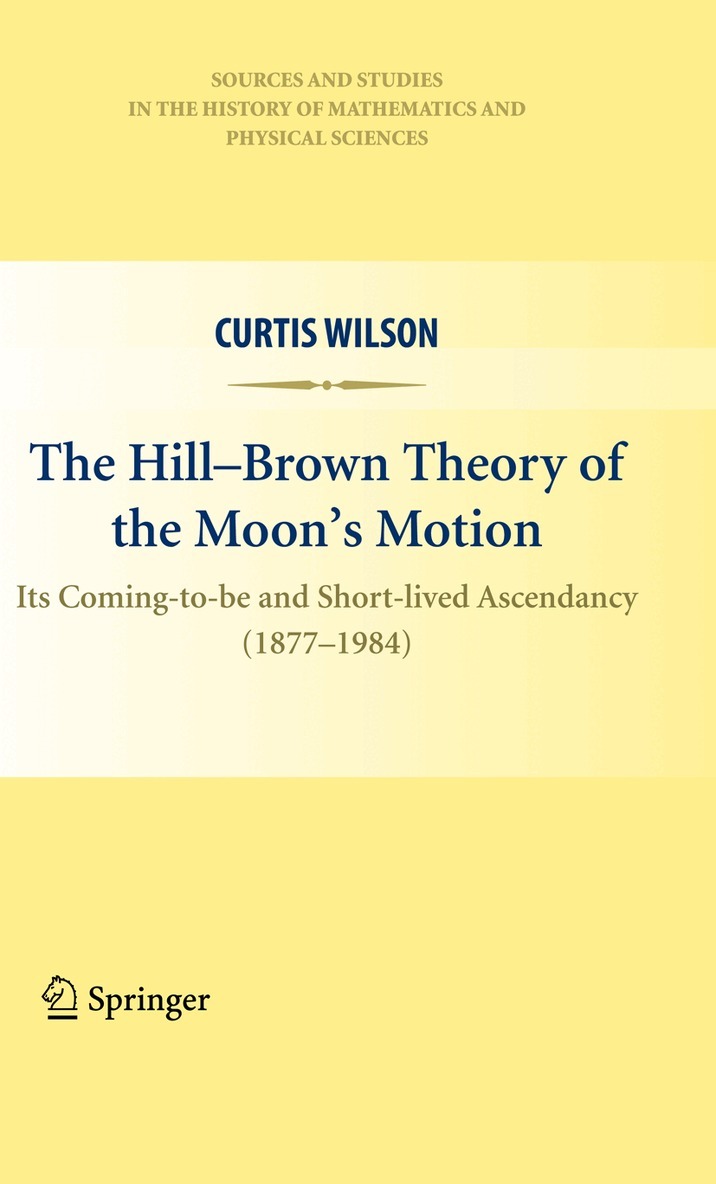
    Hill-Brown Theory of the Moon’s Motion

    Its Coming-to-be and Short-lived Ascendancy (1877-1984)

    AvCurtis Wilson

    Häftad, Engelska, 2012

    Del i serien Sources and Studies in the History of Mathematics and Physical Sciences

    1 092 kr

    Beställningsvara. Skickas inom 10-15 vardagar. Fri frakt över 249 kr.

    Fler format och utgåvor

    Inbunden

    1 092 kr

    E-bok

    1 413 kr

    Beskrivning

    The Hill–Brown theory of the Moon’s motion was constructed in the years from 1877 to 1908, and adopted as the basis for the lunar ephemerides in the nautical almanacs of the US, UK, Germany, France, and Spain beginning in 1923. At that time and for some decades afterward, it was the most accurate lunar theory ever constructed. Its accuracy was due, rst, to a novel choice of “intermediary orbit” or rst approxi- tion, more nearly closing in on the Moon’s actual motion than any elliptical orbit ever could, and secondly to the care and discernment and stick-to-it-ive-ness with which the further approximations (“perturbations” to this initial orbit) had been computed and assembled so as yield a nal theory approximating the Moon’s path in real space with an accuracy of a hundredth of an arc-second or better. The method by which the Hill–Brown lunar theory was developed held the potentiality for still greater accuracy. The intermediary orbit of the Hill–Brown theory may be described as a periodic solution of a simpli ed three-body problem, with numerical parameters carried to 15 decimal places. George William Hill, a young American mathematician working for the U. S. Nautical Almanac Of ce, had proposed it, and computed the numerical parameters to their 15 places. A self-effacing loner, he had in his privately pursued studies come to see that the contemporary attempts at predicting the Moon’s motion were guaranteed to fail in achieving a lunar ephemeris of the accuracy desired.

    Produktinformation

    • Utgivningsdatum:2012-09-05
    • Mått:155 x 235 x 19 mm
    • Vikt:517 g
    • Format:Häftad
    • Språk:Engelska
    • Serie:Sources and Studies in the History of Mathematics and Physical Sciences
    • Antal sidor:323
    • Förlag:Springer-Verlag New York Inc.
    • ISBN:9781461426141

    Utforska kategorier

    • Astronomi inom Naturvetenskap och teknik
    • Fysik inom Naturvetenskap och teknik
    • Naturvetenskapens filosofi inom Naturvetenskap och teknik

    Recensioner i media

    From the reviews: "This is the second book on historical aspects of lunar theory to have been published by Springer within a twelve-month period. ... the text is largely accessible without specialist knowledge of its central themes. ... this text is mainly one for specialists. ... the history of lunar theory introduces many fascinating ideas, and it refers very many creative mathematicians and astronomers." (Peter Ruane, The Mathematical Association of America, August, 2010) "This excellent book is a cornerstone in the history of astronomy. It deals with the Hill-Brown theory of the Moon's motion between 1877 and 1984. ... This lively written book contains many biographical notes and well-founded historical comments, and thus can be recommended to amateurs in astronomy and science history, and to instructors and scholars interested in the rapid development of astronomy and physics." (Johannes Viktor Feitzinger, Zentralblatt MATH, Vol. 1202, 2011)

    Innehållsförteckning

    • Hill Lays the Foundation (1877–1878).- George William Hill, Mathematician.- Lunar Theory from the 1740s to the 1870s – A Sketch.- Hill on the Motion of the Lunar Perigee.- Hill’s Variation Curve.- Early Assessments of Hill’s Lunar Theory.- Brown Completes the Theory (1892–1908), and Constructs Tables (1908–1919).- E. W. Brown, Celestial Mechanician.- First Papers and a Book.- Initiatives Inspired by John Couch Adams’ Papers.- Further Preliminaries to the Systematic Development.- Brown’s Lunar Treatise: Theory of the Motion of the Moon; Containing a New Calculation of the Expressions for the Coordinates of the Moon in Terms of the Time.- A Solution-Procedure Without Approximations.- The “Main Problem” Solved.- Correcting for the Idealizations: The Remaining Inequalities.- Direct Planetary Perturbations of the Moon (The Adams Prize Paper).- Indirect Planetary Perturbations of the Moon.- The Effect of the Figures of the Earth and Moon.- Perturbations of Order (?R)2.- The Tables.- Determining the Values of the Arbitrary Constants.- Ernest W. Brown as Theorist and Computer.- Revolutionary Developments in Time-Measurement,Computing, and Data-Collection.- Tidal Acceleration, Fluctuations, and the Earth’s Variable Rotation, to 1939.- The Quest for a Uniform Time: From Ephemeris Time to Atomic Time.- 1984: The Hill–Brown Theory is Replaced as the Basis of the Lunar Ephemerides.- The Mathematical and Philosophical Interest in an Analytic Solution of the Lunar Problem.