D. Baeriswyl - Böcker
Visar alla böcker från författaren D. Baeriswyl. Handla med fri frakt och snabb leverans.
3 produkter
3 produkter
2 100 kr
Skickas inom 10-15 vardagar
In the slightly more than thirty years since its formulation, the Hubbard model has become a central component of modern many-body physics. It provides a paradigm for strongly correlated, interacting electronic systems and offers insights not only into the general underlying mathematical structure of many-body systems but also into the experimental behavior of many novel electronic materials. In condensed matter physics, the Hubbard model represents the simplest theoret ical framework for describing interacting electrons in a crystal lattice. Containing only two explicit parameters - the ratio ("Ujt") between the Coulomb repulsion and the kinetic energy of the electrons, and the filling (p) of the available electronic band - and one implicit parameter - the structure of the underlying lattice - it appears nonetheless capable of capturing behavior ranging from metallic to insulating and from magnetism to superconductivity. Introduced originally as a model of magnetism of transition met als, the Hubbard model has seen a spectacular recent renaissance in connection with possible applications to high-Tc superconductivity, for which particular emphasis has been placed on the phase diagram of the two-dimensional variant of the model. In mathematical physics, the Hubbard model has also had an essential role. The solution by Lieb and Wu of the one-dimensional Hubbard model by Bethe Ansatz provided the stimulus for a broad and continuing effort to study "solvable" many-body models. In higher dimensions, there have been important but isolated exact results (e. g. , N agoaka's Theorem).
1 577 kr
Skickas inom 10-15 vardagar
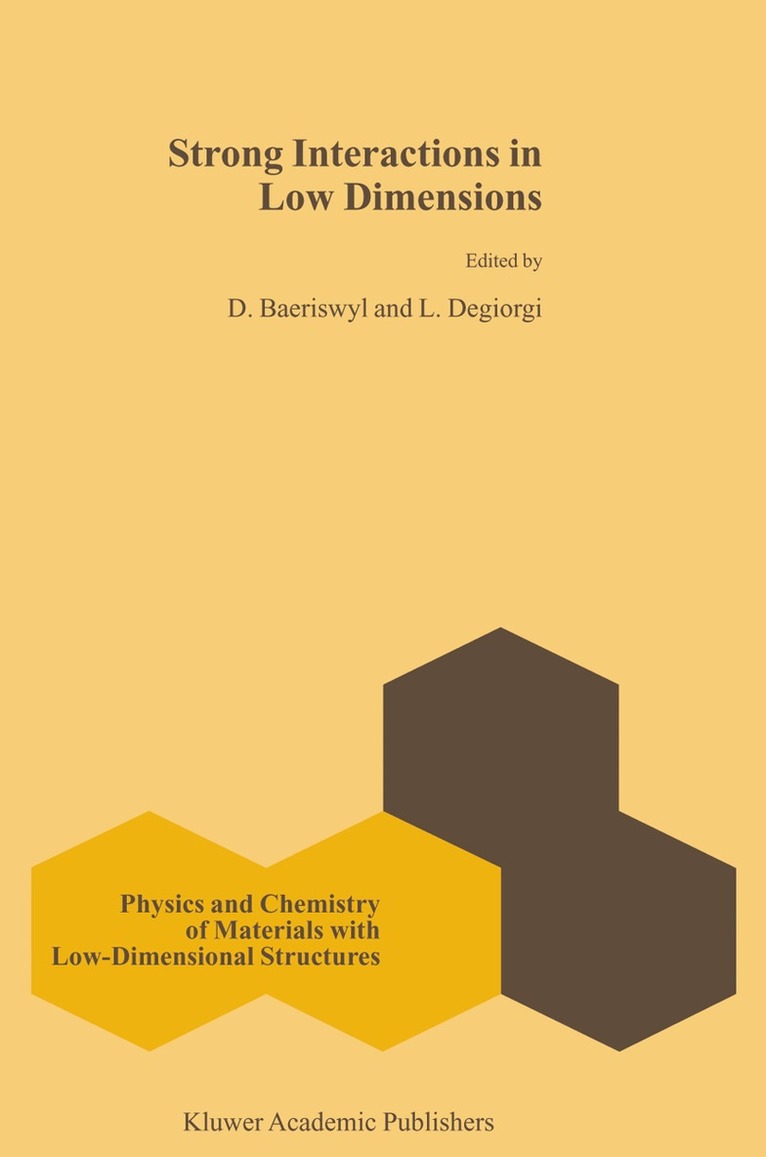
This book provides an attempt to convey the colorful facets of condensed matter systems with reduced dimensionality. Some of the specific features predicted for interacting one-dimensional electron systems, such as charge- and spin-density waves, have been observed in many quasi-one-dimensional materials. The two-dimensional world is even richer: besides d-wave superconductivity and the Quantum Hall Effect - perhaps the most spectacular phases explored during the last two decades - many collective charge and spin states have captured the interest of researchers, such as charge stripes or spontaneously generated circulating currents.Recent years have witnessed important progress in material preparation, measurement techniques and theoretical methods. Today larger and better samples, higher flux for neutron beams, advanced light sources, better resolution in electron spectroscopy, new computational algorithms, and the development of field-theoretical approaches allow an in-depth analysis of the complex many-body behaviour of low-dimensional materials. The epoch when simple mean-field arguments were sufficient for describing the gross features observed experimentally is definitely over.The Editors' aim is to thoroughly explain a number of selected topics: the application of dynamical probes, such as neutron scattering, optical absorption and photoemission, as well as transport studies, both electrical and thermal. Some of the more theoretical chapters are directly relevant for experiments, such as optical spectroscopy, transport in one-dimensional models, and the phenomenology of charge inhomogeneities in layered materials, while others discuss more general topics and methods, for example the concept of a Luttinger liquid and bosonization, or duality transformations, both promising tools for treating strongly interacting many-body systems.
1 577 kr
Skickas inom 10-15 vardagar
This book provides an attempt to convey the colorful facets of condensed matter systems with reduced dimensionality. Some of the specific features predicted for interacting one-dimensional electron systems, such as charge- and spin-density waves, have been observed in many quasi-one-dimensional materials. The two-dimensional world is even richer: besides d-wave superconductivity and the Quantum Hall Effect - perhaps the most spectacular phases explored during the last two decades - many collective charge and spin states have captured the interest of researchers, such as charge stripes or spontaneously generated circulating currents.Recent years have witnessed important progress in material preparation, measurement techniques and theoretical methods. Today larger and better samples, higher flux for neutron beams, advanced light sources, better resolution in electron spectroscopy, new computational algorithms, and the development of field-theoretical approaches allow an in-depth analysis of the complex many-body behaviour of low-dimensional materials. The epoch when simple mean-field arguments were sufficient for describing the gross features observed experimentally is definitely over.The Editors' aim is to thoroughly explain a number of selected topics: the application of dynamical probes, such as neutron scattering, optical absorption and photoemission, as well as transport studies, both electrical and thermal. Some of the more theoretical chapters are directly relevant for experiments, such as optical spectroscopy, transport in one-dimensional models, and the phenomenology of charge inhomogeneities in layered materials, while others discuss more general topics and methods, for example the concept of a Luttinger liquid and bosonization, or duality transformations, both promising tools for treating strongly interacting many-body systems.