Dana Kovarsky - Böcker
Visar alla böcker från författaren Dana Kovarsky. Handla med fri frakt och snabb leverans.
4 produkter
4 produkter
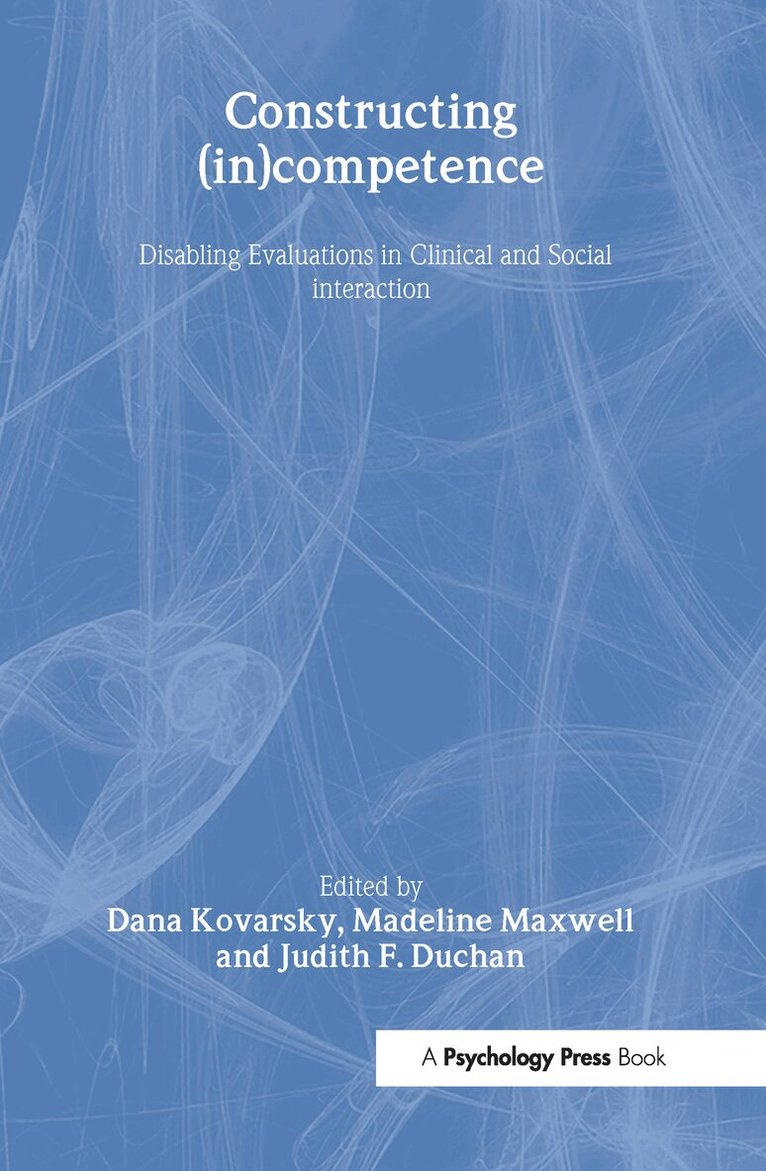
Constructing (in)competence
Disabling Evaluations in Clinical and Social interaction
Inbunden, Engelska, 1999
2 541 kr
Skickas inom 5-8 vardagar
Competence and incompetence are constructs that emerge in the social milieu of everyday life. Individuals are continually making and revising judgments about each other's abilities as they interact. The flexible, situated view of competence conveyed by the research of the authors in this volume is a departure from the way that competence is usually thought about in the fields of communication disabilities and education. In the social constructivist view, competence is not a fixed mass, residing within an individual, or a fixed judgment, defined externally. Rather, it is variable, sensitive to what is going on in the here and now, and coconstructed by those present. Constructions of competence are tied to evaluations implicit in the communication of the participants as well as to explicit evaluations of how things are going.The authors address the social construction of competence in a variety of situations: engaging in therapy for communication and other disorders, working and living with people with disabilities, speaking a second language, living with deafness, and giving and receiving instruction. Their studies focus on adults and children, including those with disabilities (aphasia, traumatic brain injury, augmentative systems users), as they go about managing their lives and identities. They examine the all-important context in which participants make competence judgments, assess the impact of implicit judgments and formal diagnoses, and look at the types of evaluations made during interaction.This book makes an argument all helping professionals need to hear: institutional, clinical, and social practices promoting judgments must be changed to practices that are more positive and empowering.
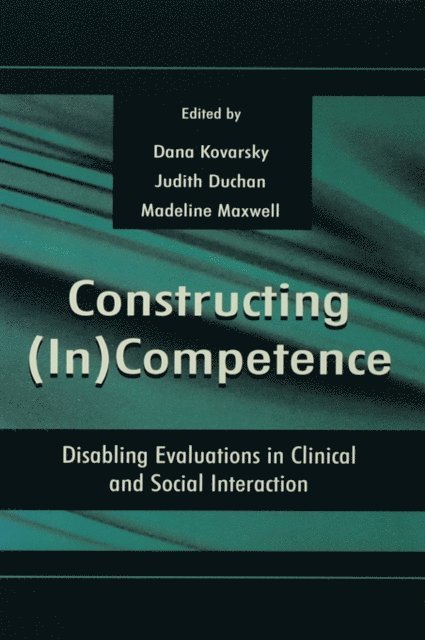
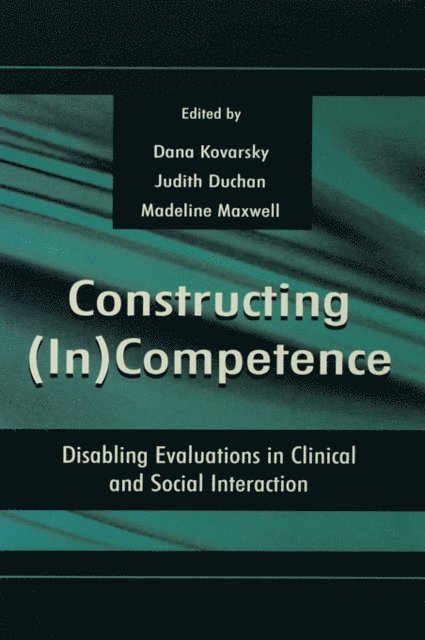
Constructing (in)competence
Disabling Evaluations in Clinical and Social interaction
Häftad, Engelska, 1999
901 kr
Skickas inom 10-15 vardagar
Competence and incompetence are constructs that emerge in the social milieu of everyday life. Individuals are continually making and revising judgments about each other's abilities as they interact. The flexible, situated view of competence conveyed by the research of the authors in this volume is a departure from the way that competence is usually thought about in the fields of communication disabilities and education. In the social constructivist view, competence is not a fixed mass, residing within an individual, or a fixed judgment, defined externally. Rather, it is variable, sensitive to what is going on in the here and now, and coconstructed by those present. Constructions of competence are tied to evaluations implicit in the communication of the participants as well as to explicit evaluations of how things are going.The authors address the social construction of competence in a variety of situations: engaging in therapy for communication and other disorders, working and living with people with disabilities, speaking a second language, living with deafness, and giving and receiving instruction. Their studies focus on adults and children, including those with disabilities (aphasia, traumatic brain injury, augmentative systems users), as they go about managing their lives and identities. They examine the all-important context in which participants make competence judgments, assess the impact of implicit judgments and formal diagnoses, and look at the types of evaluations made during interaction.This book makes an argument all helping professionals need to hear: institutional, clinical, and social practices promoting judgments must be changed to practices that are more positive and empowering.
2 623 kr
Skickas inom 5-8 vardagar
This book is about the doing and experiencing of diagnosis in everyday life. Diagnoses are revealed as interactive negotiations rather than as the assigning of diagnostic labels. The authors demonstrate, through detailed discourse analyses, how the diagnostic process depends on power and accountability as expressed through the talk of those engaged in the diagnostic process. The authors also show that diagnostic decisions are not only made by professional experts trained in the art and science of diagnosis, but they can also be made by anyone trying to figure out the nature of everyday problems. Finally, diagnostic reasoning is found to extend beyond typical diagnostic situations, occurring in unexpected places such as written letters of recommendation and talk about the nature of communication. Together, the chapters in this book demonstrate how diagnosis is a communication practice deeply rooted in our culture. The book is interdisciplinary and unusually broad in its focus. The authors come from different experiential scholarly backgrounds. Each of them takes a different look at the impact and nature of the diagnostic process. The diagnoses discussed include autism, Alzheimer’s disease, speech and language disorders, and menopause. The focus is not only on the here and now of the diagnostic interaction, but also on how diagnoses and diagnostic processes change over time. The book can serve as an undergraduate or graduate text for courses offered in various disciplines, including communication, sociology, anthropology, communication disorders, audiology, linguistics, medicine, and disability studies.
776 kr
Skickas inom 5-8 vardagar
This book is about the doing and experiencing of diagnosis in everyday life. Diagnoses are revealed as interactive negotiations rather than as the assigning of diagnostic labels. The authors demonstrate, through detailed discourse analyses, how the diagnostic process depends on power and accountability as expressed through the talk of those engaged in the diagnostic process. The authors also show that diagnostic decisions are not only made by professional experts trained in the art and science of diagnosis, but they can also be made by anyone trying to figure out the nature of everyday problems. Finally, diagnostic reasoning is found to extend beyond typical diagnostic situations, occurring in unexpected places such as written letters of recommendation and talk about the nature of communication. Together, the chapters in this book demonstrate how diagnosis is a communication practice deeply rooted in our culture. The book is interdisciplinary and unusually broad in its focus. The authors come from different experiential scholarly backgrounds. Each of them takes a different look at the impact and nature of the diagnostic process. The diagnoses discussed include autism, Alzheimer's disease, speech and language disorders, and menopause. The focus is not only on the here and now of the diagnostic interaction, but also on how diagnoses and diagnostic processes change over time. The book can serve as an undergraduate or graduate text for courses offered in various disciplines, including communication, sociology, anthropology, communication disorders, audiology, linguistics, medicine, and disability studies.