Dana Mackenzie – författare
Visar alla böcker från författaren Dana Mackenzie. Handla med fri frakt och snabb leverans.
11 produkter
11 produkter
141 kr
Skickas inom 5-8 vardagar
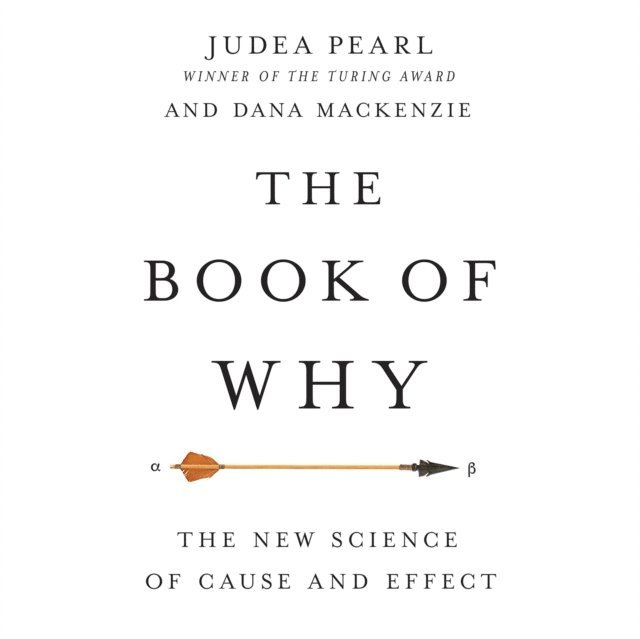
The hugely influential book on how the understanding of causality revolutionized science and the world, by the pioneer of artificial intelligence'Wonderful ... illuminating and fun to read' Daniel Kahneman, Nobel Prize-winner and author of Thinking, Fast and Slow'Correlation does not imply causation.' For decades, this mantra was invoked by scientists in order to avoid taking positions as to whether one thing caused another, such as smoking and cancer, or carbon dioxide and global warming. But today, that taboo is dead. The causal revolution, sparked by world-renowned computer scientist Judea Pearl and his colleagues, has cut through a century of confusion and placed cause and effect on a firm scientific basis. Now, Pearl and science journalist Dana Mackenzie explain causal thinking to general readers for the first time, showing how it allows us to explore the world that is and the worlds that could have been. It is the essence of human and artificial intelligence. And just as Pearl's discoveries have enabled machines to think better, The Book of Why explains how we too can think better.'Pearl's accomplishments over the last 30 years have provided the theoretical basis for progress in artificial intelligence and have redefined the term "thinking machine"' Vint Cerf
368 kr
Skickas inom 3-6 vardagar
263 kr
Kommande
A captivating account of how a one-time mathematician cracked a two-thousand-year-old problem and rediscovered the joys of mathematics in the processMaster Sun’s problem—first posed by Sun Bin, a Chinese military strategist and supposed descendent of Sun Tzu, the legendary author of The Art of War—is an ancient strategy question whose elegant simplicity conceals a fiendishly difficult mathematical puzzle. The problem was largely ignored for two thousand years until a college friend of Dana Mackenzie revived it—and in doing so, rekindled Mackenzie’s passion for mathematics.Master Sun’s Problem is Mackenzie’s entertaining account of how, to his own amazement, he solved this tantalizing problem. Mackenzie, a former math professor turned science writer, describes every unexpected twist and turn, and provides advice, explanations, and plenty of examples for math lovers of all ages who want to try their own hand at discovering something new. Along the way, he traces the history of the problem and busts some myths about math and mathematicians, and reveals how the solution received a vital assist from ordinary people—the readers of The New York Times.An eloquent meditation on the nature and practice of mathematics, Master Sun’s Problem is a story of the uncommon pleasures of mathematical exploration and a unique testament to the power of collaboration and tenacious curiosity.
286 kr
Skickas inom 5-8 vardagar
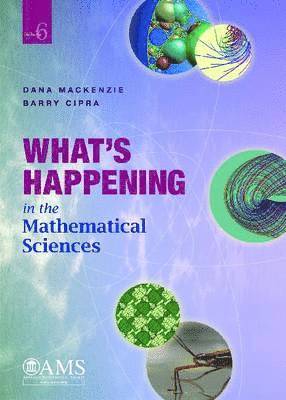
The ""AMS"" series ""What's Happening in the Mathematical Sciences"" distills the amazingly rich brew of current research in mathematics down to a few choice samples. This volume leads off with an update on the Poincare Conjecture, a hundred-year-old problem that has apparently been solved by Grigory Perelman of St. Petersburg, Russia. So what did topologists do when the oldest and most famous problem about closed manifolds was vanquished? As the second chapter describes, they confronted a suite of problems concerning the 'ends' of open manifolds...and solved those, too. Not to be outdone, number theorists accomplished several unexpected feats in the first five years of the new century, from computing a trillion digits of pi to finding arbitrarily long equally-spaced sequences of prime numbers.Undergraduates made key discoveries, as explained in the chapters on Venn diagrams and primality testing. In applied mathematics, the Navier-Stokes equations of fluid mechanics continued to stir up interest. One team proved new theorems about the long-term evolution of vortices, while others explored the surprising ways that insects use vortices to move around. The random jittering of Brownian motion became a little less mysterious. Finally, an old and trusted algorithm of computer science had its trustworthiness explained in a novel way. Barry Cipra explains these new developments in his wry and witty style, familiar to readers of Volumes 1-5, and is joined in this volume by Dana Mackenzie. Volume 6 of ""What's Happening"" will convey to all readers - from mathematical novices to experts - the beauty and wonder that is mathematics.
312 kr
Skickas inom 11-20 vardagar
Since 1993, the AMS has been publishing ""What's Happening in the Mathematical Sciences"", a series of lively and highly readable accounts of the latest developments in mathematics. This seventh volume describes some genuine surprises, such as the recent discovery that coin tosses are inherently unfair; a mathematical theory of invisibility that was soon followed by the creation of a prototype 'invisibility cloak'; and, an ultra-efficient approach to image sensing that led to the development of a single-pixel camera. The past few years have also seen deep results on some classical mathematics problems. For example, this volume describes a proof of the Sato-Tate Conjecture in number theory and a major advance in the Minimal Model Program of algebraic geometry. The computation of the character table of the exceptional Lie group $E_8$ brings 'the most beautiful structure in mathematics' to public attention, and proves that human persistence is just as important as gigabytes of RAM. The amazing story of the Archimedes Palimpsest shows how the modern tools of high-energy physics uncovered the centuries-old secrets of the mathematical writings of Archimedes. Dana Mackenzie, a science writer specializing in mathematics, makes each of these topics accessible to all readers, with a style that is friendly and at the same time attentive to the nuances that make mathematics fascinating. Anyone with an interest in mathematics, from high school teachers and college students to engineers and computer scientists, will find something of interest here. The stories are well told and the mathematics is compelling.
286 kr
Skickas inom 5-8 vardagar
What's Happening in the Mathematical Sciences is a collection of articles highlighting some of the most recent developments in mathematics. These include important achievements in pure mathematics, as well as its fascinating applications.On the pure mathematics side, ``Prime Clusters and Gaps: Out-Experting the Experts'' talks about new insights into the distribution of prime numbers, the perpetual source of new problems, and new results. Recently, several mathematicians (including Yitang Zhang and James Maynard) significantly improved our knowledge of the distribution of prime numbers. Advances in the so-called Kadison-Singer problem and its applications in signal processing algorithms used to analyze and synthesize signals are described in ``The Kadison-Singer Problem: A Fine Balance''. ``Quod Erat Demonstrandum'' presents two examples of perseverance in mathematicians' pursuit of truth using, in particular, computers to verify their arguments. And ``Following in Sherlock Holmes' Bike Tracks'' shows how an episode in one of Sir Arthur Conan Doyle's stories about Sherlock Holmes naturally led to very interesting problems and results in the theory of completely integrable systems.On the applied side, ``Climate Past, Present, and Future'' shows the importance of mathematics in the study of climate change and global warming phenomena. Mathematical models help researchers to understand the past, present, and future changes of climate, and to analyze their consequences. ``The Truth Shall Set Your Fee'' talks about algorithms of information exchange in cyberspace. Economists have known for a long time that trust is a cornerstone of commerce, and this becomes even more important nowadays when a lot of transactions, big and small, are done over the Internet. Recent efforts of theoretical computer scientists led to the development of so-called ``rational protocols'' for information exchange, where the parties in the information exchange process find that lies do not pay off.Over the last 100 years many professional mathematicians and devoted amateurs contributed to the problem of finding polygons that can tile the plane, e.g., used as floor tiles in large rooms and walls. Despite all of these efforts, the search is not yet complete, as the very recent discovery of a new plane-tiling pentagon shows in ``A Pentagonal Search Pays Off''. Mathematics can benefit coaches and players in some of the most popular team sports as shown in ``The Brave New World of Sports Analytics''. The increased ability to collect and process statistics, big data, or ``analytics'' has completely changed the world of sports analytics. The use of modern methods of statistical modeling allows coaches and players to create much more detailed game plans as well as create many new ways of measuring a player's value. Finally, ``Origami: Unfolding the Future'' talks about the ancient Japanese paper-folding art and origami's unexpected connections to a variety of areas including mathematics, technology, and education.
286 kr
Skickas inom 5-8 vardagar
As always, What's Happening in the Mathematical Sciences presents a selection of topics in mathematics that have attracted particular attention in recent years. This volume is dominated by an event that shook the world in 2020 and 2021, the coronavirus (or COVID-19) pandemic. While the world turned to politicians and physicians for guidance, mathematicians played a key role in the background, forecasting the epidemic and providing rational frameworks for making decisions. The first three chapters of this book highlight several of their contributions, ranging from advising governors and city councils to predicting the effect of vaccines to identifying possibly dangerous ""escape variants"" that could re-infect people who already had the disease.In recent years, scientists have sounded louder and louder alarms about another global threat: climate change. Climatologists predict that the frequency of hurricanes and waves of extreme heat will change. But to even define an ""extreme"" or a ""change"", let alone to predict the direction of change, is not a climate problem: it's a math problem. Mathematicians have been developing new techniques, and reviving old ones, to help climate modelers make such assessments.In a more light-hearted vein, Descartes' ""Homework"" describes how a famous mathematician's blunder led to the discovery of new properties of foam-like structures called Apollonian packings. ""Square Pegs and Squiggly Holes"" shows that square pegs fit virtually any kind of hole, not just circular ones. ""Much Ado About Zero"" explains how difficult problems about eigenvalues of matrices can sometimes be answered by playing a simple game that involves coloring dots on a grid or a graph.Finally, ""Dancing on the Edge of the Impossible"" provides a progress report on one of the oldest and still most important challenges in number theory: to devise an effective algorithm for finding all of the rational-number points on an algebraic curve. In the great majority of cases, number theorists know that the number of solutions is finite, yet they cannot tell when they have found the last one. However, two recently proposed methods show potential for breaking the impasse.
339 kr
Skickas inom 5-8 vardagar
The What’s Happening in the Mathematical Sciences series presents a selection of recent discoveries and exciting fields of research in mathematics, explained in depth but in a slow-paced, reader-friendly way.In the first few months of 2023, artificial “brains” like ChatGPT and GPT-4 were constantly in the news, and they have already turned into big business. One chapter in this book, “Deep Learning: Part Math, Part Alchemy”, explains how math disentangles hype from reality and explains some of the remarkable advances of machine learning. Meanwhile, “Organizing the Chaos Inside the Brain” explores animal brains, and describes how biologists can apply chaos theory to simulate the wanderings of a fly from firing data on neurons within its brain.This issue of What's Happening also includes many treats for readers who like pure math—especially those who are interested in geometry. In recent months and years, there have been unexpected discoveries in tiling (“One Stone to Rule Them All”), sphere-packing in more than three dimensions (“A Fascination of Spheres”) and the reconstruction of three-dimensional scenes from two-dimensional images (“Multi-View Geometry: E Pluribus Unum”). The chapter “How to Draw an Alternate Universe” will, as promised, open a door to a completely different, non-Euclidean universe—or several of them. Shakespeare’s words, “something rich and strange”, only begin to describe them.In “How Mathematicians Unearthed the Stubborn Secrets of Fano Varieties”, readers will learn about one of the building blocks of algebraic geometry, the branch of geometry that deals with surfaces defined by polynomial equations. The chapter “Missing One Digit” addresses a seemingly elementary problem in number theory: how many prime numbers do not have a “7” in them? The answer is easy to guess—but hard to prove. “Fluid Flow: Two Paths to a Singularity” discusses another guess that is hard to prove: can fluids in an enclosed region develop “singularities” akin to a breaking wave? Computer evidence is mounting that they can—including some evidence from machine learning algorithms. (Which brings us full circle back to the “Deep Learning” chapter.)Dana Mackenzie has written for the What's Happening series since Volume 6, published in 2006. In this volume he is joined by Leila Sloman, whose name will be familiar to many readers from her work for Quanta Magazine.
275 kr
Kommande
211 kr
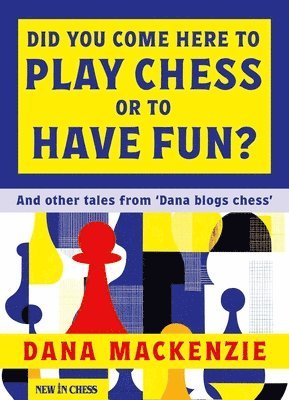
Did You Come Here To Play Chess Or To Have Fun?
And other tales from 'Dana blogs chess'
Häftad, Engelska, 2025
217 kr
Skickas