Daniel J. Nicholson - Böcker
Visar alla böcker från författaren Daniel J. Nicholson. Handla med fri frakt och snabb leverans.
3 produkter
3 produkter
1 304 kr
Skickas inom 5-8 vardagar
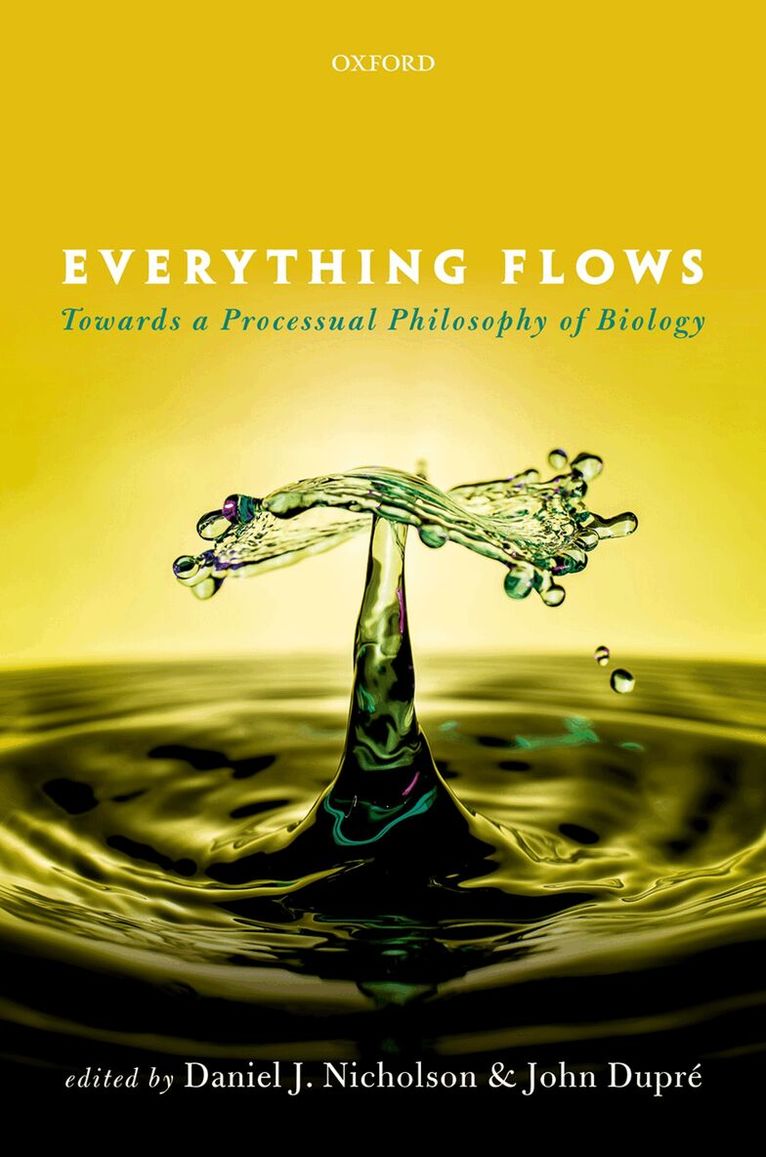
This is an open access title available under the terms of a CC BY-NC-ND 4.0 International licence. It is free to read at Oxford Scholarship Online and offered as a free PDF download from OUP and selected open access locations. Everything Flows explores the metaphysical thesis that the living world is not made up of substantial particles or things, as has often been supposed, but is rather constituted by processes. The biological domain is organised as an interdependent hierarchy of processes, which are stabilized and actively maintained at different timescales. Even entities that intuitively appear to be paradigms of things, such as organisms, are actually better understood as processes. Unlike previous attempts to articulate processual views of biology, which have tended to use Alfred North Whitehead's panpsychist metaphysics as a foundation, this book takes a naturalistic approach to metaphysics. It submits that the main motivations for replacing an ontology of substances with one of processes are to be found in the empirical findings of science. Biology provides compelling reasons for thinking that the living realm is fundamentally dynamic, and that the existence of things is always conditional on the existence of processes. The phenomenon of life cries out for theories that prioritise processes over things, and it suggests that the central explanandum of biology is not change but rather stability, or more precisely, stability attained through constant change. This edited volume brings together philosophers of science and metaphysicians interested in exploring the prospects of a processual philosophy of biology. The contributors draw on an extremely wide range of biological case studies, and employ a process perspective to cast new light on a number of traditional philosophical problems, such as identity, persistence, and individuality.
234 kr
Skickas inom 7-10 vardagar
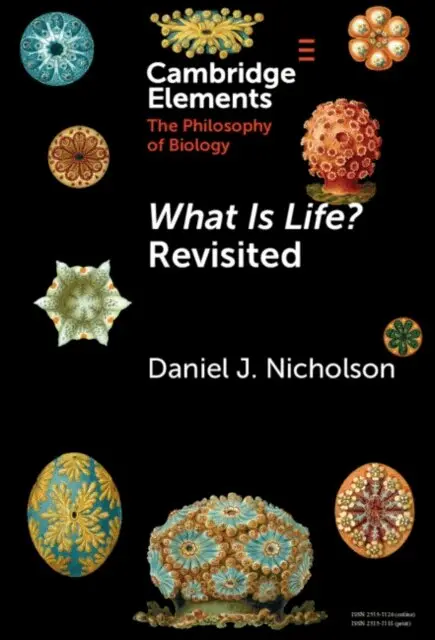
Erwin Schrödinger's What Is Life? is one of the most celebrated scientific works of the twentieth century. However, like most classics, it is far more often cited than read. Efforts to seriously engage with Schrödinger's arguments are rare. This Element explores how well his ideas have stood the test of time. It argues that Schrödinger's emphasis on the rigidity and specificity of the hereditary material (which stemmed from his attempt to explain biological order from physical principles) influenced how molecular biologists conceptualized macromolecules, resulting in a deterministic, engineering view of the cell that is still popular today-even if it is increasingly at odds with experimental findings. Drawing on archival sources, this Element also uncovers Schrödinger's motivations in writing What Is Life? and suggests that his biological proposals are best understood in the context of his longstanding dispute with other physicists regarding the interpretation and extension of quantum mechanics.
753 kr
Skickas inom 7-10 vardagar
Erwin Schrödinger's What Is Life? is one of the most celebrated scientific works of the twentieth century. However, like most classics, it is far more often cited than read. Efforts to seriously engage with Schrödinger's arguments are rare. This Element explores how well his ideas have stood the test of time. It argues that Schrödinger's emphasis on the rigidity and specificity of the hereditary material (which stemmed from his attempt to explain biological order from physical principles) influenced how molecular biologists conceptualized macromolecules, resulting in a deterministic, engineering view of the cell that is still popular today-even if it is increasingly at odds with experimental findings. Drawing on archival sources, this Element also uncovers Schrödinger's motivations in writing What Is Life? and suggests that his biological proposals are best understood in the context of his longstanding dispute with other physicists regarding the interpretation and extension of quantum mechanics.