Daniel J. Weeks - Böcker
Visar alla böcker från författaren Daniel J. Weeks. Handla med fri frakt och snabb leverans.
6 produkter
6 produkter
1 034 kr
Skickas inom 10-15 vardagar
In this new volume in Springer-Verlag's series "Recent Research in Psychology", Drs. Proctor and Weeks examine what has long been a "self-asserted superiority" of behavior analysts and Skinnerian researchers. Most behavior-analytic views derive from the philosophy of radical behaviorism, as conceived by B.F. Skinner, and prescribe a "world view" where environmental contingencies determine all aspects of behavior. This view necessarily assumes all other views to be inferior because of its world view, hence, those subscribing to behavior analysis will tolerate no other theory. The Goal of B.F. Skinner and Behavior Analysis examines closely the rationale behind the Skinnerian philosophy, challenging its validity through the author's own research.
1 280 kr
Skickas inom 7-10 vardagar
Two decades after the American Civil War, no name was more closely associated with the nation's inventive and entrepreneurial spirit than that of Thomas Edison. The restless changes of those years were reflected in the life of America's foremost inventor. Having cemented his reputation with his electric lighting system, Edison had decided to withdraw partially from that field. At the start of 1885, newly widowed at mid-life with three young children, he launched into a series of personal and professional migrations, setting in motion chains of events that would influence his work and fundamentally reshape his life. Edison's inventive activities took off in new directions, flowing between practical projects (such as wireless and high-capacity telegraph systems) and futuristic ones (exploring forms of electromagnetic energy and the convertibility of one to another). Inside of two years, he would travel widely, marry the daughter of a prominent industrialist and religious educator, leave New York City for a grand home in a sylvan suburb, and construct a winter laboratory and second home in Florida.Edison's family and interior life are remarkably visible at this moment; his papers include the only known diary in which he recorded personal thoughts and events. By 1887, the familiar rhythms of his life began to reassert themselves in his new settings; the family faded from view as he planned, built, and occupied a New Jersey laboratory complex befitting his status. The eighth volume of the series, New Beginnings includes 358 documents (chosen from among thousands) that are the most revealing and representative of Edison's work, life, and place in American culture in these years. Illustrated with hundreds of Edison's drawings, these documents are further illuminated by meticulous research on a wide range of sources, including the most recently digitized newspapers and journals of the day.
1 297 kr
Skickas inom 7-10 vardagar
This richly illustrated volume explores Edison's inventive and personal pursuits from 1888 to 1889, documenting his responses to technological, organizational, and economic challenges.Thomas A. Edison was received at the 1889 Paris Exposition Universelle—the World's Fair—as a conquering hero. Extravagantly fêted and besieged by well-wishers, he was seen, like Gustave Eiffel's iron tower, as a triumphal symbol of republicanism and material progress. The visit was a high-water mark of his international fame.Out of the limelight, Edison worked as hard as ever. On top of his work as an inventor, entrepreneur, and manufacturer, he created a new role as a director of research. At his peerless laboratory in Orange, New Jersey, he directed assistants working in parallel on multiple projects. These included the "perfected" phonograph; a major but little-recognized effort to make musical recordings for sale; the start of work on motion pictures; and improvements in the recovery of low-grade iron ore. He also pursued a public "War of the Currents" against electrical rival George Westinghouse. Keenly attuned to manufacturing as a way to support the laboratory financially and control his most iconic products, Edison created a new cluster of factories. He kept his manufacturing rights to the phonograph while selling the underlying patents to an outside investor in a deal he would regret. When market pressures led to the consolidation of Edison lighting interests, he sold his factories to the new Edison General Electric Company. These changes disrupted his longtime personal and professional relations even as he planned an iron-mining project that would take him to the New Jersey wilderness for long periods.The ninth volume of the series, Competing Interests explores Edison's inventive and personal pursuits from 1888 to 1889, documenting his responses to technological, organizational, and economic challenges. The book includes 331 documents and hundreds of Edison's drawings, which are all revealing and representative of his life and work in these years. Essays and notes based on meticulous research in a wide range of sources, many only recently available, provide a rich context for the documents.
Papers of Thomas A. Edison
From Laboratory to Marketplace, January 1890–June 1892
Inbunden, Engelska, 2025
1 397 kr
Skickas inom 7-10 vardagar
A comprehensive chronicle of Edison's industrial, technological, and electrical pursuits from 1890 to 1892.Thomas A. Edison started the 1890s as one of the most famous people in the Western world, with his name celebrated in small-town newspapers and imperial courts. However, the changing technological and corporate environments of this decade raised obstacles that Edison could only partially overcome while reorienting his career away from his signature electrical technologies.The tenth volume of the widely acclaimed series The Papers of Thomas A. Edison chronicles the end of the "Battle of the Currents," the contest over the development of US electric utility infrastructure. Edison struggled to adapt his direct-current system to overcome the advantages of the Westinghouse Electric alternating-current system and to outpace Thomson-Houston Electric's development of motors for industry and electric traction. The forced merger with Thomson-Houston that created General Electric in 1892 ended Edison's dozen years of leadership in the electrical business. Edison remained prolific in other fields documented in this volume—sound recording, motion pictures, and batteries. But all these projects were overshadowed by his efforts to revitalize uncompetitive eastern iron mines by concentrating low-grade iron ores. Edison opened a massive ore-concentrating works in Ogdensburg, New Jersey, in 1890. The operation, improvement, and expansion of that plant consumed much of his energy and wealth for the rest of the decade.
1 754 kr
Skickas inom 10-15 vardagar
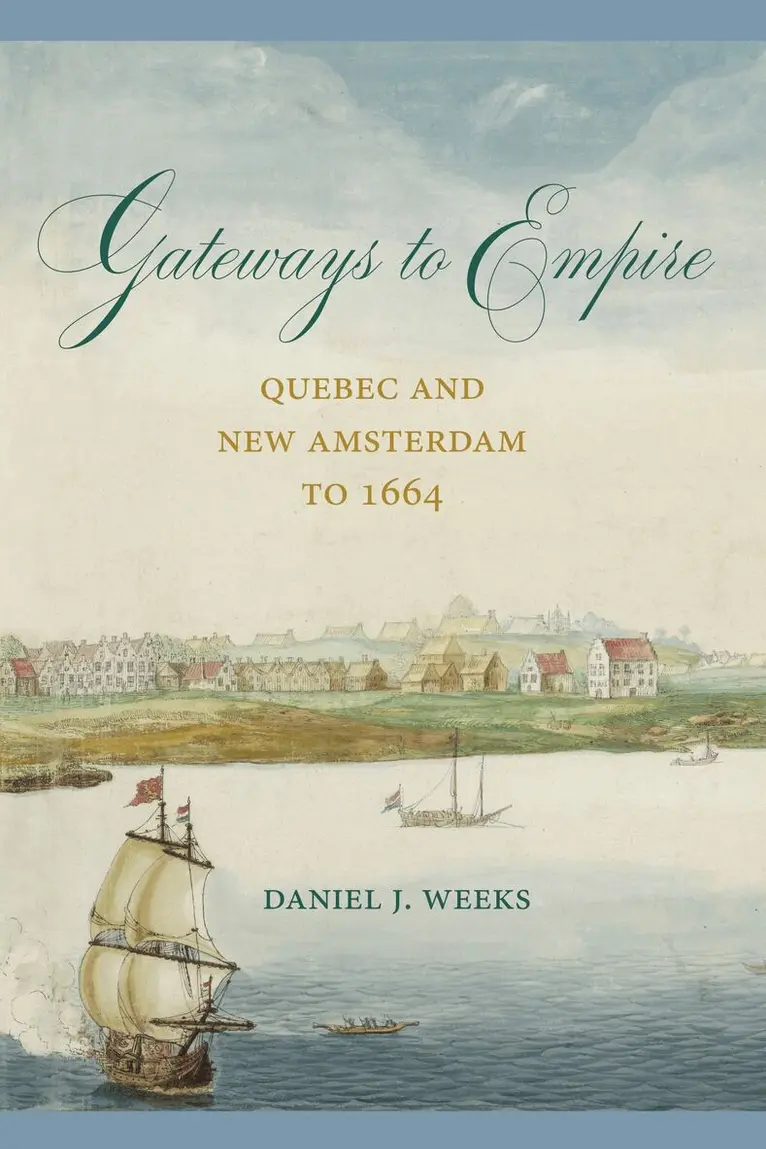
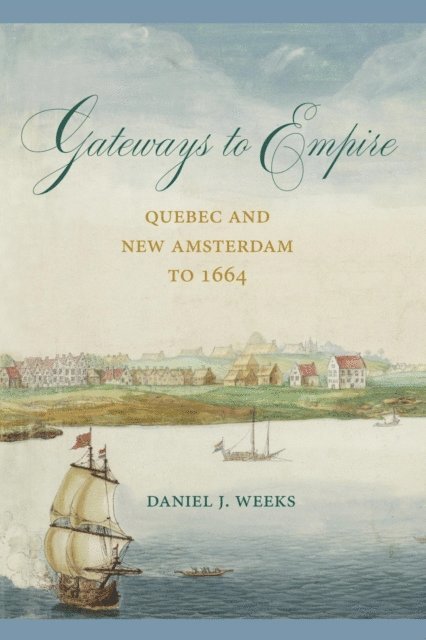
In Gateways to Empire: Quebec and New Amsterdam to 1664, historian Daniel Weeks has provided the first comprehensive comparative study of the North-American fur-trading colonies New France and New Netherland. While neither colony profited very much, if at all, from the fur trade (though many individuals fortunes were undoubtedly made), Weeks finds that New France, which far outpaced New Netherland in this trade, grew more slowly and had greater difficulty sustaining itself. As he demonstrates in Gateways to Empire, other factors, including New Netherland’s openness to religious and ethnic diversity and wider connections to the Atlantic World, allowed it to become more economically secure than its rival north of the St. Lawrence. And yet, in both cases, the principal towns of these European colonies—Quebec and New Amsterdam—moved beyond their initial purposes as hubs for trade with the indigenous peoples to become gateways to European settlement. In this, New Amsterdam, by the late 1640s, was singularly successful, so that it rapidly fostered the production of new European towns in its hinterlands, organizing the landscape for settlement and also for trade within the European-dominated Atlantic-World system.
257 kr
Skickas inom 5-8 vardagar