Daniel M. Master - Böcker
Visar alla böcker från författaren Daniel M. Master. Handla med fri frakt och snabb leverans.
5 produkter
5 produkter
552 kr
Skickas inom 7-10 vardagar
The catalogue for the exciting exhibition at New York University's Institute for the Study of the Ancient World, Masters of Fire presents a comprehensive overview of the little-known yet extraordinary Chalcolithic culture, which existed in the southern Levant from 4500-3600 bce. Masters of Fire focuses on the people of the southern Levant who harnessed the power of metallurgy during the fourth millennium bce. Artisans produced extraordinary copper objects while other craftsmen molded pottery and stone into complex anthropomorphic burial containers, statuettes, and ritual objects. Taken together, these artifacts reveal the first stratified culture known in the ancient Near East. Highlights of the exhibition include a selection of material from the Nahal Mishmar hoard, an unprecedented collection of copper prestige and ritual objects, organic materials from the Cave of the Warrior, and an exceptional group of ritual figurines. Contributors include Thomas E. Levy, Daniel M. Master, Osnat Misch-Brandl, Yorke M. Rowan, Michael Sebbane, Dina Shalem, and Orit Shamir. Cover photograph (c) Bruce M. White, 2016
Del 1 - Final Reports of The Leon Levy Expedition to Ashkelon
Ashkelon 1
Introduction and Overview (1985–2006)
Inbunden, Engelska, 2008
2 016 kr
Skickas inom 7-10 vardagar
Since 1985, the Leon Levy Expedition to Ashkelon, directed by Lawrence E. Stager of Harvard University, has been a leading American archaeological project in Israel. Now, the work of the project is being collected in ten final report volumes published by the Harvard Museum of the Ancient Near East. The first volume, Introduction and Overview (1985–2006), spans more than 700 copiously illustrated pages, many in full color, and includes subjects ranging from microscopic DNA to monumental architecture. In addition, Volume 1 includes plans and descriptions of every architectural phase excavated during the course of seventeen field seasons and reveals the archaeological sequence of the site and aspects of the city plan from the Bronze Age to Crusader times, with special emphasis on Canaanite (Bronze Age) and Philistine (Iron Age) Ashkelon. The chapters in this volume, by more than three dozen contributors, combine to describe Ashkelon’s cultural constants and contingencies over la longue durée (3000 BCE to 1500 CE). As a result, Ashkelon 1: Introduction and Overview (1985–2006) will be an indispensable resource for investigating the maritime and terrestrial history of the southeastern Mediterranean littoral.
Del 3 - Final Reports of The Leon Levy Expedition to Ashkelon
Ashkelon 3
The Seventh Century B.C.
Inbunden, Engelska, 2011
1 096 kr
Skickas inom 11-20 vardagar
The Leon Levy Expedition to Ashkelon continues its final report series with a study of the city destroyed in the campaign of the Babylonian king Nebuchadrezzar in December of 604 B.C. In this era, Ashkelon’s markets linked land routes from the southeast to a web of international Mediterranean merchants, and this volume describes the Iron Age bazaar where shopkeepers sold the goods of Egypt, Greece, Phoenicia, Cyprus, and Judah. In addition, in another part of the city, a winery produced a homegrown vintage for distribution abroad.This volume spans more than 800 full-color pages illustrating the range of imported and local artifacts recovered by more than ten years of excavation. The twenty-eight chapters, by more than two dozen contributors, combine to describe Ashkelon’s pivotal role in the economy and politics of the late seventh century B.C. As such, Ashkelon 3: The Seventh Century B.C. is a indispensable resource for those interested in the Iron Age history of the Eastern Mediterranean and the study of trade and economy in the ancient world.
Del 7 - Final Reports of The Leon Levy Expedition to Ashkelon
Ashkelon 7
The Iron Age I
Inbunden, Engelska, 2020
1 813 kr
Skickas inom 11-20 vardagar
The Leon Levy Expedition to Ashkelon continues its final report series with a study of the Iron Age I. Following the dramatic collapse of the Mediterranean world at the end of the Bronze Age, new groups emerged across the Levantine littoral. One of those groups was the Philistines, famous archenemies of the Israelites in the Hebrew Bible. This volume shows how Ashkelon became a Philistine city. The volume presents evidence for the arrival of a new group from the West that changed fundamental patterns of life. Ceramics shapes, architectural patterns, foodways, industrial technology, decorative traditions, and forms of writing are all explored in this volume, and each of these forms of evidence shows how the newly arrived Philistines first responded to the Levantine world around them. After settling in the seaport of Ashkelon, the Philistines continued to trade internationally, as was typical of earlier inhabitants of the city, and their ongoing maritime connections provide additional insight into the economy of the Mediterranean in the twelfth and eleventh centuries B.C. This volume represents the culmination of more than thirty years of archaeological research into questions of Philistine culture, bringing together research from more than thirty scholars covering all aspects of ancient life in Ashkelon during the Iron Age I.The volume spans more than 900 full-color pages with forty chapters. The architecture, stratigraphy, pottery, and other finds are presented in considerable detail, shedding new light on this important period in the history of ancient Ashkelon. It is an indispensable resource for scholars interested in the history of the eastern Mediterranean or the background of the Biblical world.
Del 10 - Final Reports of The Leon Levy Expedition to Ashkelon
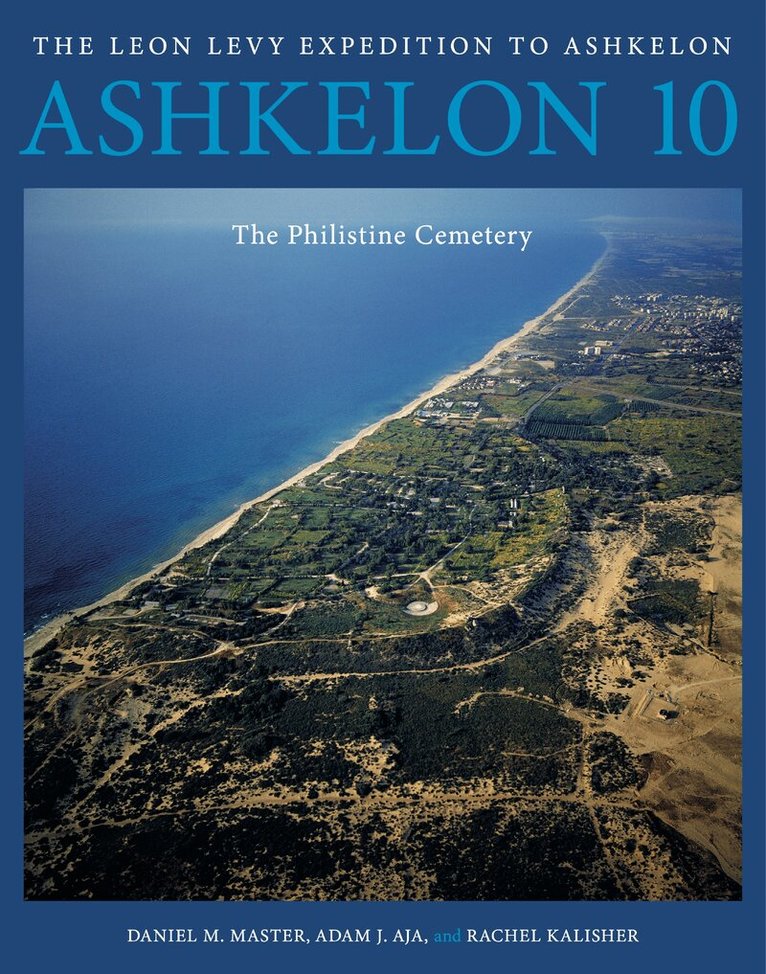
Ashkelon 10
The Philistine Cemetery
Inbunden, Engelska, 2026
1 417 kr
Skickas
From 2013 to 2016, the Leon Levy Expedition to Ashkelon excavated an Iron Age cemetery located immediately outside the rampart of the ancient city. This cemetery dates from the period when Ashkelon was a Philistine city, and it is the first one excavated at any of the core Philistines cities. The Philistines are known today mainly as they are portrayed in sources written by others, such as the Hebrew Bible, in stories told by their enemies. In Ashkelon 10, the Philistine story is retold using archaeological evidence. As such, the Philistine cemetery is not only an important reference for the history of the Philistines but a critical piece for understanding the broader puzzle of death and burial in the southern Levant in the first millennium b.c. The excavation of the Philistine cemetery produced not only human remains but a wealth of objects, including pottery, jewelry, metals, and personal seals. In this volume, the material culture is addressed by scholars who frame their work within the larger world of southern Levantine cultural patterns.In the process of excavating the area of the Philistine cemetery, an examination of the broader landscape in this part of Ashkelon led to the discovery of a Roman vineyard covering the Iron Age remains. This is one of the few vineyards excavated in the region, and the findings are also presented in this volume. This five-hundred-page volume features hundreds of full-color illustrations and includes a catalog of 141 separate burial events. It represents an important contribution to the study of the peoples of the eastern Mediterranean in the first millennium b.c.