Daniel S. Nagin - Böcker
Visar alla böcker från författaren Daniel S. Nagin. Handla med fri frakt och snabb leverans.
4 produkter
4 produkter
495 kr
Tillfälligt slut
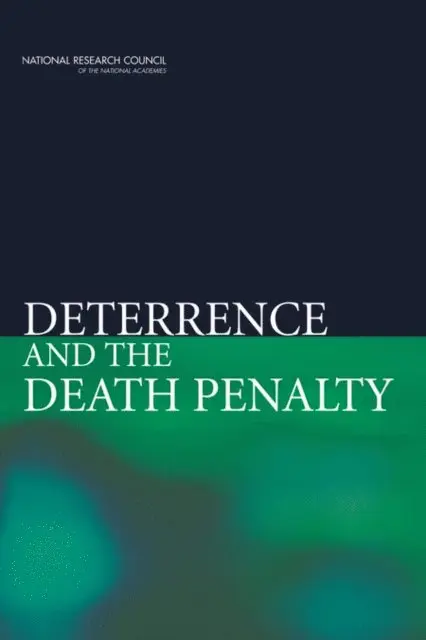
Many studies during the past few decades have sought to determine whether the death penalty has any deterrent effect on homicide rates. Researchers have reached widely varying, even contradictory, conclusions. Some studies have concluded that the threat of capital punishment deters murders, saving large numbers of lives; other studies have concluded that executions actually increase homicides; still others, that executions have no effect on murder rates. Commentary among researchers, advocates, and policymakers on the scientific validity of the findings has sometimes been acrimonious. Against this backdrop, the National Research Council report Deterrence and the Death Penalty assesses whether the available evidence provides a scientific basis for answering questions of if and how the death penalty affects homicide rates. This new report from the Committee on Law and Justice concludes that research to date on the effect of capital punishment on homicide rates is not useful in determining whether the death penalty increases, decreases, or has no effect on these rates.The key question is whether capital punishment is less or more effective as a deterrent than alternative punishments, such as a life sentence without the possibility of parole. Yet none of the research that has been done accounted for the possible effect of noncapital punishments on homicide rates. The report recommends new avenues of research that may provide broader insight into any deterrent effects from both capital and noncapital punishments.
644 kr
Skickas inom 10-15 vardagar
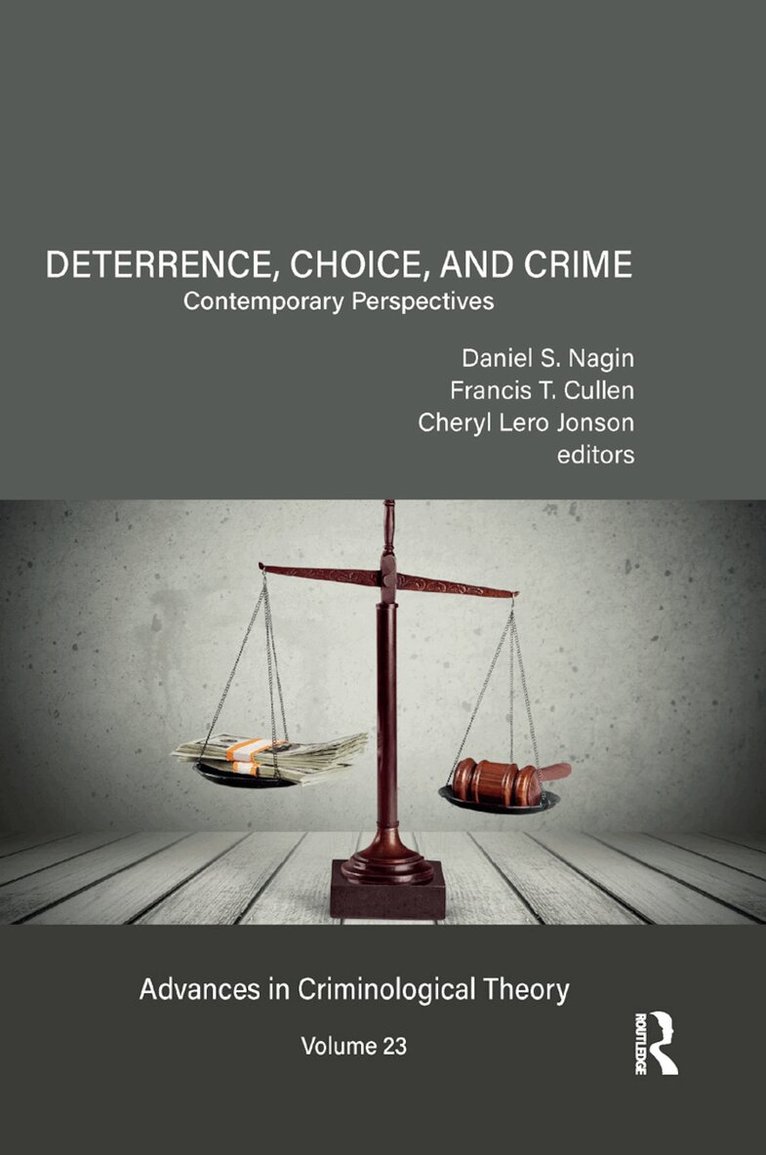
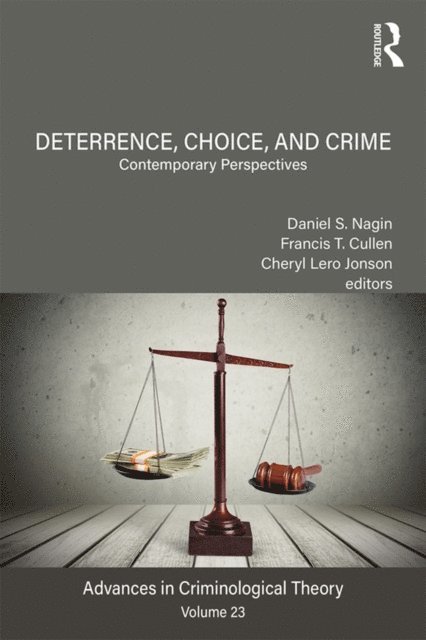
Deterrence, Choice, and Crime explores the various dimensions of modern deterrence theory, relevant research, and practical applications. Beginning with the classical roots of deterrence theory in Cesare Beccaria’s profoundly important contributions to modern criminological thought, the book draws out the many threads in contemporary criminology that are explicitly mentioned or at least hinted by Beccaria. These include sanction risk perceptions and their behavioral consequences, the deterrent efficacy of the certainty versus the severity of punishment, the role of celerity of punishment in the deterrence process, informal versus formal deterrence, and individual differences in deterrence. The richness of the volume is seen in the inclusion of chapters that focus on the theoretical development of deterrence across disciplines such as criminology and economics. In an innovative section, the role of agents of deterrence is considered. Lessons are learned from the practical applications of deterrence undertaken in the areas of policing, corrections, and the community. The closing section includes Michael Tonry’s "An Honest Politician’s Guide to Deterrence: Certainty, Severity, Celerity, and Parsimony," a reminder of Beccaria’s dictum that "it is better to prevent crimes than punish them." In the current environment, deterrence arguments are routinely used to justify policies that do just the opposite. Ray Paternoster, who contributed two chapters, passed away as this volume was being finalized. Fittingly, this book is dedicated to him and ends with Alex Piquero’s poignant remembrance of Ray, a path-breaking deterrence scholar, beloved mentor, and ardent supporter of social justice.Suitable for researchers and graduate students as well as for advanced courses in criminology, this book breaks new ground in theorizing the effects of punishment and other sanctions on crime control.
792 kr
Skickas inom 10-15 vardagar
This book provides a systematic exposition of a group-based statistical method for analyzing longitudinal data in the social and behavioral sciences and in medicine. The methods can be applied to a wide range of data, such as that describing the progression of delinquency and criminality over the life course, changes in income over time, the course of a disease or physiological condition, or the evolution of the socioeconomic status of communities. Using real-world research data from longitudinal studies, the book explains and applies this method for identifying distinctive time-based progressions called developmental trajectories. Rather than assuming the existence of developmental trajectories of a specific form before statistical data analysis begins, the method allows the trajectories to emerge from the data itself. Thus, in an analysis of data on Montreal school children, it teases apart four distinct trajectories of physical aggression over the ages 6 to 15, examines predictors of these trajectories, and identifies events that may alter the trajectories. Aimed at consumers of statistical methodology, including social scientists, criminologists, psychologists, and medical researchers, the book presents the statistical theory underlying the method with a mixture of intuition and technical development.
1 921 kr
Skickas inom 10-15 vardagar
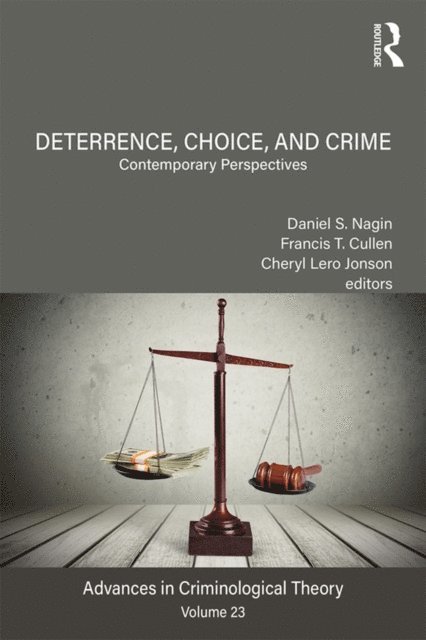
Deterrence, Choice, and Crime explores the various dimensions of modern deterrence theory, relevant research, and practical applications. Beginning with the classical roots of deterrence theory in Cesare Beccaria’s profoundly important contributions to modern criminological thought, the book draws out the many threads in contemporary criminology that are explicitly mentioned or at least hinted by Beccaria. These include sanction risk perceptions and their behavioral consequences, the deterrent efficacy of the certainty versus the severity of punishment, the role of celerity of punishment in the deterrence process, informal versus formal deterrence, and individual differences in deterrence. The richness of the volume is seen in the inclusion of chapters that focus on the theoretical development of deterrence across disciplines such as criminology and economics. In an innovative section, the role of agents of deterrence is considered. Lessons are learned from the practical applications of deterrence undertaken in the areas of policing, corrections, and the community. The closing section includes Michael Tonry’s "An Honest Politician’s Guide to Deterrence: Certainty, Severity, Celerity, and Parsimony," a reminder of Beccaria’s dictum that "it is better to prevent crimes than punish them." In the current environment, deterrence arguments are routinely used to justify policies that do just the opposite. Ray Paternoster, who contributed two chapters, passed away as this volume was being finalized. Fittingly, this book is dedicated to him and ends with Alex Piquero’s poignant remembrance of Ray, a path-breaking deterrence scholar, beloved mentor, and ardent supporter of social justice.Suitable for researchers and graduate students as well as for advanced courses in criminology, this book breaks new ground in theorizing the effects of punishment and other sanctions on crime control.