Daniel Star - Böcker
Visar alla böcker från författaren Daniel Star. Handla med fri frakt och snabb leverans.
5 produkter
5 produkter
712 kr
Skickas inom 7-10 vardagar
The Oxford Handbook of Reasons and Normativity maps a central terrain of philosophy, and provides an authoritative guide to it. Few concepts have received as much attention in recent philosophy as the concept of a reason to do or believe something. And one of the most contested ideas in philosophy is normativity, the 'ought' in claims that we ought to do or believe something. This is the first volume to provide broad coverage of the study of reasons and normativity across multiple philosophical subfields. In addition to focusing on reasons in ethics, epistemology, and the philosophy of mind, action, and language, the Handbook explores philosophical work on the nature of normativity in general.Topics covered include: the unity of normativity; the fundamentality of reasons; attempts to explain reasons in other terms; the relation of motivational reasons to normative reasons; the internalist constraint; the logic and language of reasons and 'ought'; connections between reasons, intentions, choices, and actions; connections between reasons, reasoning, and rationality; connections between reasons, knowledge, understanding and evidence; reasons encountered in perception and testimony; moral principles, prudence and reasons; agent-relative reasons; epistemic challenges to our access to reasons; normativity in relation to meaning, concepts, and intentionality; instrumental reasons; pragmatic reasons for belief; aesthetic reasons; and reasons for emotions.
1 317 kr
Skickas inom 3-6 vardagar
Knowing Better presents a novel solution to the problem of reconciling the seemingly conflicting perspectives of ordinary virtue and normative ethics. These two perspectives appear to tell us incompatible things about the practical reasons that guide our deliberation and justify our actions. Normative ethics is a sophisticated, open-ended philosophical enterprise that attempts to articulate and defend highly general ethical principles. Such principles aspire to specify our reasons, and tell us what it is right to do. However, it is not attractive to suppose that virtuous people generally follow such principles, or that the reasons that they specify are familiar to them. These principles are difficult to articulate and assess, and we do not (or should not) think that advanced philosophical expertise is a necessary requirement for virtue. At the same time, the virtuous do not only accidentally get things right; rather, they act well in a reliable fashion, and they do so by responding appropriately to genuine reasons. How is it possible for there to be genuine reasons that the virtuous are able to rely on to determine what they should do, given that they are, generally speaking, ignorant of fundamental ethical principles and the reasons that they specify?Daniel Star argues that the solution to this problem requires a new approach to understanding the relation between ethical theory and ordinary deliberation, a new way of thinking about the nature of practical authority and normative reasons, a new account of the nature of virtue, and a rethinking of how best to understand the role that knowledge plays in deliberation and action.
2 367 kr
Skickas inom 5-8 vardagar
The Oxford Handbook of Reasons and Normativity maps a central terrain of philosophy, and provides an authoritative guide to it. Few concepts have received as much attention in recent philosophy as the concept of a reason to do or believe something. And one of the most contested ideas in philosophy is normativity, the 'ought' in claims that we ought to do or believe something. This is the first volume to provide broad coverage of the study of reasons and normativity across multiple philosophical subfields. In addition to focusing on reasons in ethics, epistemology, and the philosophy of mind, action, and language, the Handbook explores philosophical work on the nature of normativity in general. Topics covered include: the unity of normativity; the fundamentality of reasons; attempts to explain reasons in other terms; the relation of motivational reasons to normative reasons; the internalist constraint; the logic and language of reasons and 'ought'; connections between reasons, intentions, choices, and actions; connections between reasons, reasoning, and rationality; connections between reasons, knowledge, understanding and evidence; reasons encountered in perception and testimony; moral principles, prudence and reasons; agent-relative reasons; epistemic challenges to our access to reasons; normativity in relation to meaning, concepts, and intentionality; instrumental reasons; pragmatic reasons for belief; aesthetic reasons; and reasons for emotions.
462 kr
Skickas inom 7-10 vardagar
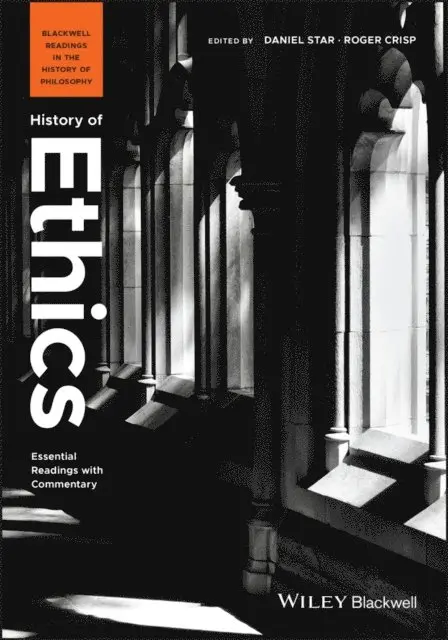
Is there an objective moral standard that applies to all our actions? To what extent should I sacrifice my own interests for the sake of others? How might philosophers of the past help us think about contemporary ethical problems?As the most recent addition to the Blackwell Readings in Philosophy series, History of Ethics: Essential Readings with Commentary brings together rich and varied excerpts of canonical work and contemporary scholarship to span the history of Western moral philosophy in one volume. Editors Star and Crisp, noted scholars in their fields, expertly introduce the readings to illuminate the main philosophical ideas and arguments in each selection, and connect them to broader themes. These detailed and incisive editorial commentaries make the primary source texts accessible to students while guiding them chronologically through the history of Western ethics.Structured around a thematic table of contents divided into three distinct sections, History of Ethics charts patterns in the development of ethical thought across time to highlight connections between intellectual movements. Selections range from the work of well-known figures such as Plato, Aristotle, Nietzsche, and Mill to the work of philosophers often overlooked by such anthologies, including Butler, Smith, Sidgwick, Anscombe, Foot, and Frankena. Star and Crisp skillfully arrange the collection to connect readings to contemporary issues and interests by featuring examples such as Aquinas on self-defense and the doctrine of double effect, Kant on virtue, and Mill’s The Subjection of Women.Written for students and scholars of ethics, History of Ethics is a comprehensive collection of readings with expert editorial commentary that curates the most important and influential work in the history of ethics in the Western world.
878 kr
Skickas inom 7-10 vardagar
Is there an objective moral standard that applies to all our actions? To what extent should I sacrifice my own interests for the sake of others? How might philosophers of the past help us think about contemporary ethical problems?As the most recent addition to the Blackwell Readings in Philosophy series, History of Ethics: Essential Readings with Commentary brings together rich and varied excerpts of canonical work and contemporary scholarship to span the history of Western moral philosophy in one volume. Editors Star and Crisp, noted scholars in their fields, expertly introduce the readings to illuminate the main philosophical ideas and arguments in each selection, and connect them to broader themes. These detailed and incisive editorial commentaries make the primary source texts accessible to students while guiding them chronologically through the history of Western ethics.Structured around a thematic table of contents divided into three distinct sections, History of Ethics charts patterns in the development of ethical thought across time to highlight connections between intellectual movements. Selections range from the work of well-known figures such as Plato, Aristotle, Nietzsche, and Mill to the work of philosophers often overlooked by such anthologies, including Butler, Smith, Sidgwick, Anscombe, Foot, and Frankena. Star and Crisp skillfully arrange the collection to connect readings to contemporary issues and interests by featuring examples such as Aquinas on self-defense and the doctrine of double effect, Kant on virtue, and Mill’s The Subjection of Women.Written for students and scholars of ethics, History of Ethics is a comprehensive collection of readings with expert editorial commentary that curates the most important and influential work in the history of ethics in the Western world.