Daniel Yankelovich - Böcker
Visar alla böcker från författaren Daniel Yankelovich. Handla med fri frakt och snabb leverans.
6 produkter
6 produkter
189 kr
Tillfälligt slut
485 kr
Skickas inom 5-8 vardagar
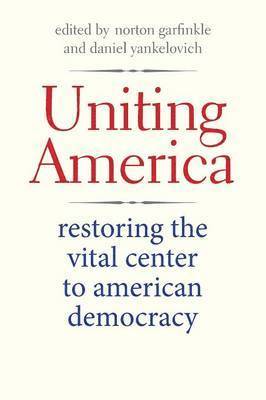
In Uniting America, some of the country’s most prominent social thinkers—among them Francis Fukuyama, Daniel Yankelovich, Amitai Etzioni, Alan Wolfe, Uwe Reinhardt, and Thomas E. Mann—reject the myth of polarization. On topics ranging from the war on terrorism, health care, economic policy, and Social Security to religion, diversity, and immigration, the authors argue that there are sensible, centrist solutions that are more in keeping with prevailing public sentiment and that would better serve the national interest. On issue after issue, the authors show how the conventional framing of the debate in Washington has misled Americans, creating a series of false dilemmas and forcing choices between two extremes—at the expense of more balanced and pragmatic policy solutions based on enduring American values.Uniting America provides a blueprint for a fresh approach to American politics, grounded in moderation, pragmatism, and the shared values that unite Americans.
667 kr
Skickas inom 10-15 vardagar
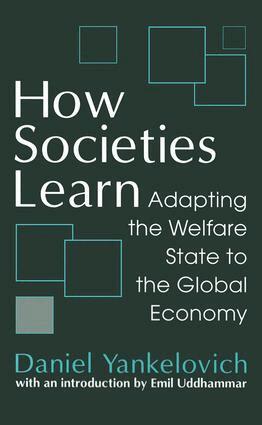
The theme of Daniel Yankelovich's Zetterberg Lecture is timely and urgent: how do societies learn? We know that individuals can learn, but can collectivities do likewise? More specifically, how can complex political systems adapt to a changing world? Yankelovich focuses specifically on the severe problems of the different attempts to treat welfare in the United States and Sweden. What kind of strategies can be attempted to accommodate these systems to the economic forces of globalization? Yankelovich answers by citing a version of trial and error in human affairs, a process of "lurch and learn." Yankelovich suggests that future changes in welfare systems will have to rely on mechanisms of reciprocity, rather than the claims of specific interest groups. Sociologist and public opinion analyst, Daniel Yankelovich is co-founder with Cyrus Vance and current president of the Public Agenda, a nonpartisan, nonprofit public opinion research and citizenship education organization based in New York City. He is a past chairman of the board of Transaction. This is the first of the Hans L. Zetterberg Lecture Series delivered at the City University of Stockholm in 1997.
1 451 kr
Skickas inom 5-8 vardagar
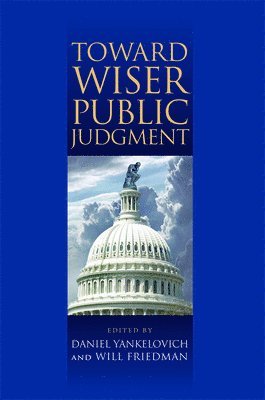
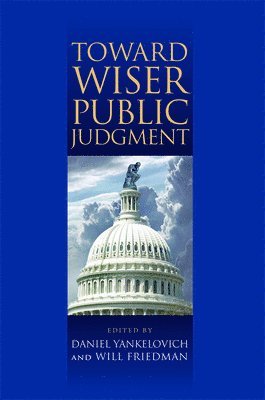
This work revisits and expands upon Yankelovich¹s seminal 1991 book, Coming to Public Judgment, which argued that people advance through several distinct stages to form politically meaningful judgments about public issues. In particular, citizens must "work through" the temptation to opt for easy answers or engage in wishful thinking, reconcile conflicting values, and come to terms with tough tradeoffs, before they can truly support a new course of action. The present work examines these themes in light of changing societal conditions, from the advent of the Internet and the weakening of traditional media to the proliferation of urgent and complex problems that cannot be put off without courting disaster.In his lead chapter, Dan Yankelovich urges us to move away from a "misleading model of public opinion" that "dominates the expert culture of our society, including journalists, scientists, business leaders, scholars, professional experts, and political leaders." He and the other contributors (Will Friedman, Keith Melville, Robert Kingston, Alison Kadlec, Steven A. Rosell, and Heidi Gantwerk) describe methods used by organizations like Public Agenda, National Issues Forums, and Viewpoint Learning, Inc., to advance the public's learning curve through various forms of civic engagement, education, dialogue and deliberation.They provide case studies of education reform in Bridgeport, Connecticut, and math and science initiatives in the Kansas City area, and examples of programs that have focused on issues ranging from energy and health care to US-Muslim relations. One chapter is a dialogue between Yankelovich and Friedman.While our political culture resonates to the public's desire for a stronger voice, it fails to ensure that this voice reflects anything more than the spin, spectacle, and excessive partisanship that dominate today's public discourse. Toward Wiser Public Judgment offers insights and strategies to counteract these troubling trends.
590 kr
Skickas inom 5-8 vardagar
This work revisits and expands upon Yankelovich¹s seminal 1991 book, Coming to Public Judgment, which argued that people advance through several distinct stages to form politically meaningful judgments about public issues. In particular, citizens must "work through" the temptation to opt for easy answers or engage in wishful thinking, reconcile conflicting values, and come to terms with tough tradeoffs, before they can truly support a new course of action. The present work examines these themes in light of changing societal conditions, from the advent of the Internet and the weakening of traditional media to the proliferation of urgent and complex problems that cannot be put off without courting disaster.In his lead chapter, Dan Yankelovich urges us to move away from a "misleading model of public opinion" that "dominates the expert culture of our society, including journalists, scientists, business leaders, scholars, professional experts, and political leaders." He and the other contributors (Will Friedman, Keith Melville, Robert Kingston, Alison Kadlec, Steven A. Rosell, and Heidi Gantwerk) describe methods used by organizations like Public Agenda, National Issues Forums, and Viewpoint Learning, Inc., to advance the public's learning curve through various forms of civic engagement, education, dialogue and deliberation.They provide case studies of education reform in Bridgeport, Connecticut, and math and science initiatives in the Kansas City area, and examples of programs that have focused on issues ranging from energy and health care to US-Muslim relations. One chapter is a dialogue between Yankelovich and Friedman.While our political culture resonates to the public's desire for a stronger voice, it fails to ensure that this voice reflects anything more than the spin, spectacle, and excessive partisanship that dominate today's public discourse. Toward Wiser Public Judgment offers insights and strategies to counteract these troubling trends.
2 104 kr
Skickas inom 10-15 vardagar
The theme of Daniel Yankelovich's Zetterberg Lecture is timely and urgent: how do societies learn? We know that individuals can learn, but can collectivities do likewise? More specifically, how can complex political systems adapt to a changing world? Yankelovich focuses specifically on the severe problems of the different attempts to treat welfare in the United States and Sweden. What kind of strategies can be attempted to accommodate these systems to the economic forces of globalization? Yankelovich answers by citing a version of trial and error in human affairs, a process of "lurch and learn." Yankelovich suggests that future changes in welfare systems will have to rely on mechanisms of reciprocity, rather than the claims of specific interest groups. Sociologist and public opinion analyst, Daniel Yankelovich is co-founder with Cyrus Vance and current president of the Public Agenda, a nonpartisan, nonprofit public opinion research and citizenship education organization based in New York City. He is a past chairman of the board of Transaction. This is the first of the Hans L. Zetterberg Lecture Series delivered at the City University of Stockholm in 1997.