Danielle Tran - Böcker
Visar alla böcker från författaren Danielle Tran. Handla med fri frakt och snabb leverans.
3 produkter
3 produkter
Decolonizing University Teaching and Learning
An Entry Model for Grappling with Complexities
Inbunden, Engelska, 2021
1 435 kr
Skickas inom 10-15 vardagar
Decolonizing University Teaching and Learning considers apprehensions around decolonizing and offers a summary of key arguments within critical discussion around its meaning and value through engagement with a growing body of literature. The contextually based and complex discussions concerning decolonization means one cannot be guided through the process in a particular way. Therefore, the text is not intended to be read as a handbook for decolonizing teaching and learning, nor is it an anthropologically oriented text. Drawing on Critical Race Theory, the book highlights the benefits of decolonizing teaching and learning for all students and staff. This book offers up the TRAAC model as an entry point for challenging conversations. By bringing together questions raised within existing scholarly discussions, the TRAAC model provides prompts to instigate deeper reflections around decolonizing by way of supporting colleagues to start a productive dialogue. Through these critically reflective and reflexive conversations, action-oriented discussions can simultaneously take place. The value of this book lies in the contributions from authors based across a number of universities and disciplines. Reflecting on personal experiences, staff and student relationships, subject specific challenges, and wider issues within HE, the contributions are grounded in the employment of the TRAAC model as a mode of entry into discussing particular issues around decolonizing teaching and learning.
Decolonizing University Teaching and Learning
An Entry Model for Grappling with Complexities
Häftad, Engelska, 2022
396 kr
Skickas inom 10-15 vardagar
Decolonizing University Teaching and Learning considers apprehensions around decolonizing and offers a summary of key arguments within critical discussion around its meaning and value through engagement with a growing body of literature. The contextually based and complex discussions concerning decolonization means one cannot be guided through the process in a particular way. Therefore, the text is not intended to be read as a handbook for decolonizing teaching and learning, nor is it an anthropologically oriented text. Drawing on Critical Race Theory, the book highlights the benefits of decolonizing teaching and learning for all students and staff. This book offers up the TRAAC model as an entry point for challenging conversations. By bringing together questions raised within existing scholarly discussions, the TRAAC model provides prompts to instigate deeper reflections around decolonizing by way of supporting colleagues to start a productive dialogue. Through these critically reflective and reflexive conversations, action-oriented discussions can simultaneously take place. The value of this book lies in the contributions from authors based across a number of universities and disciplines. Reflecting on personal experiences, staff and student relationships, subject specific challenges, and wider issues within HE, the contributions are grounded in the employment of the TRAAC model as a mode of entry into discussing particular issues around decolonizing teaching and learning.
1 446 kr
Kommande
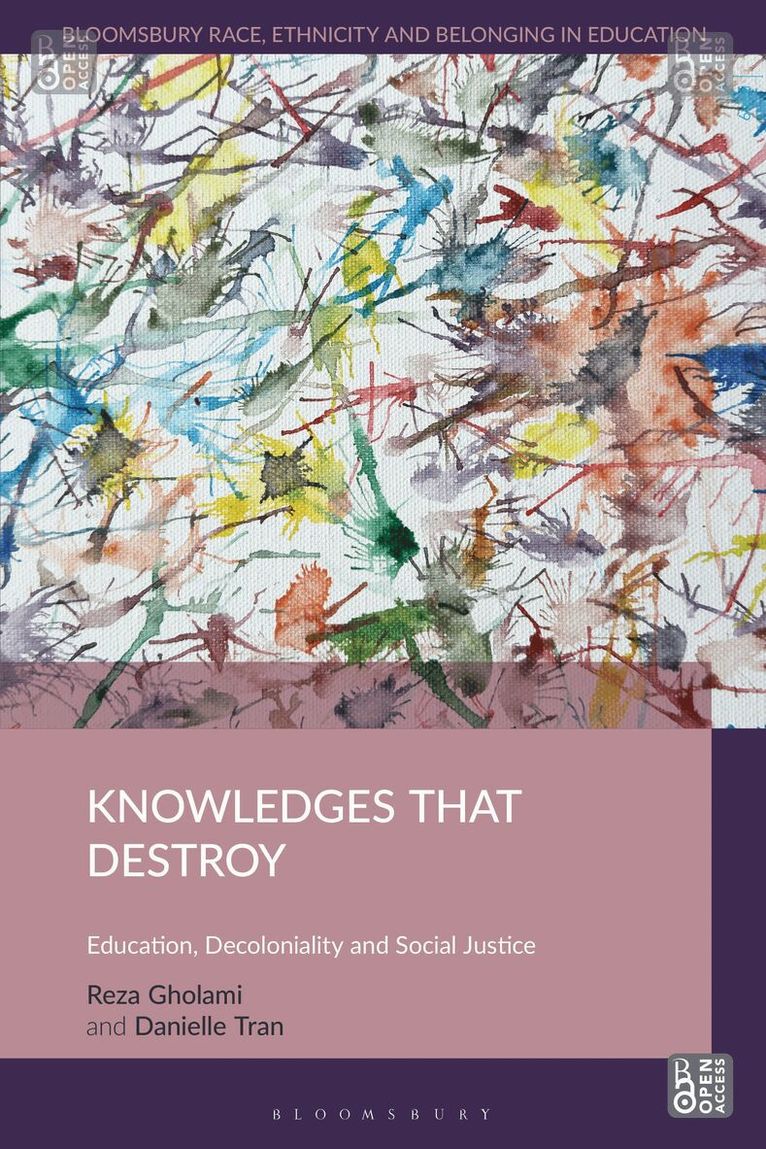
This book offers an urgently needed re-imagining of what education can and must be in an era marked by escalating division, culture wars, and global precarity. Writing against the backdrop of “Brexit”, the Covid-19 pandemic, far-right resurgence, and intensifying geopolitical crises, Gholami and Tran show how contemporary politics weaponizes concepts such as social justice, diversity, and decolonization—either to vilify them or to empty them of meaning. In response, the book reframes social justice as a “good ideology”: an educational necessity that transcends left–right political binaries and offers a foundation for democratic, pluralist educational futures.Addressing a range of issues from the politics of untruth to climate injustice, from the religious-secular nexus to higher-education free speech debates, the authors illuminate how the "thumbprint" of coloniality can be discerned across all the key issues affecting education today, threatening both democracy and the ethical purpose of education. They argue that a re-energized decoloniality must run through the practice of education at all levels. The book thus offers a practical, research-informed framework for educators to make social justice immediately “workable” in their classrooms, communities, and institutions. It maps a pathway towards “collective knowledge”—a collectivist epistemology born of and reflecting the unique ethical dynamics of diverse locales and rooted firmly in social justice. Accessible, timely, and conceptually innovative, Knowledges that Destroy is essential reading for educators, policymakers, and all those committed to renewing education as a shared, democratic, and socially just endeavour.