Dario Gentili - Böcker
Visar alla böcker från författaren Dario Gentili. Handla med fri frakt och snabb leverans.
8 produkter
8 produkter
576 kr
Skickas inom 10-15 vardagar
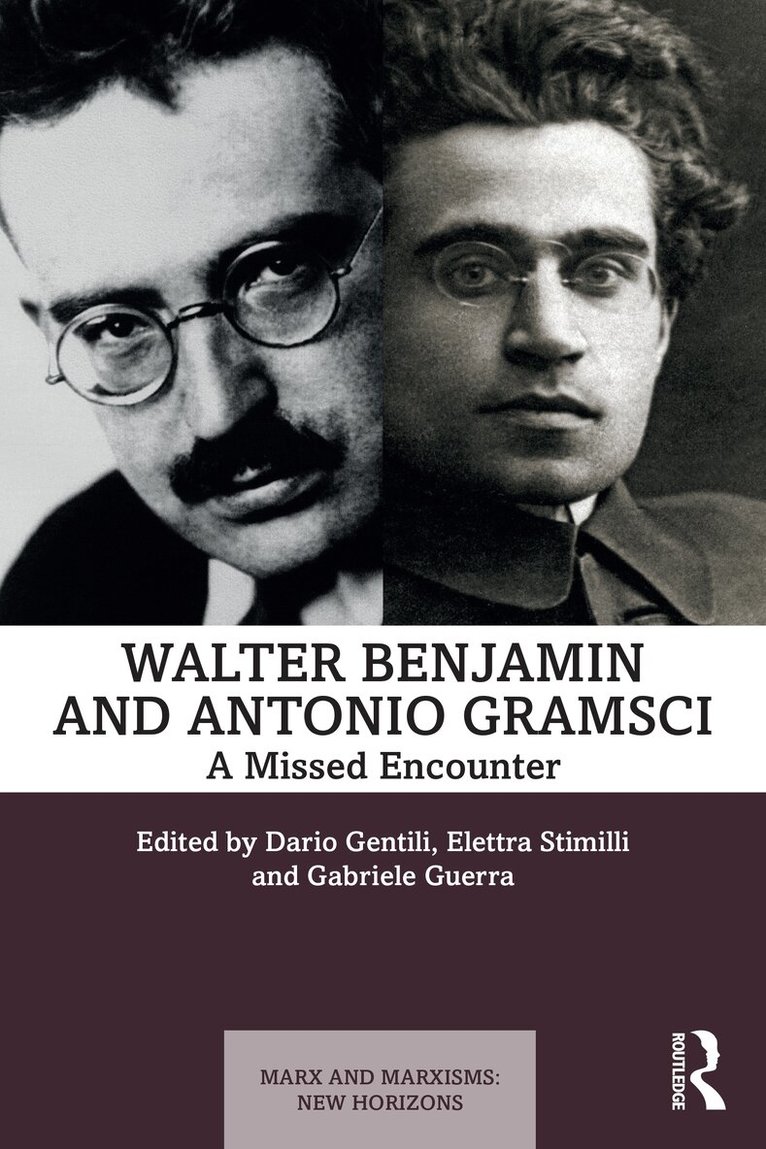
This book marks a missed encounter between two of the most influential Marxist thinkers of our age, Walter Benjamin and Antonio Gramsci, studied here for the first time side by side.Benjamin and Gramsci were contemporaries, whose births and deaths took place within a few years of each other in Western Europe in the first half of the twentieth century. Two Marxists sui generis, they radically changed Marxism’s themes and vocabulary, profoundly influencing the most significant analyses and debates. At a time in which Marxism was considered to be outdated and in crisis, both Gramsci’s and Benjamin’s thoughts provided resources for its renewal: particularly in postcolonial studies for Gramsci and in new media studies for Benjamin. Both were victims of fascism, on the threshold of the catastrophe of the Second World War. These two philosophers’ posthumous fortune depended on the transmission of their thought, which was first entrusted to friends and comrades, and then to entire generations of scholars from a wide range of disciplines.Editors, Dario Gentili, Elettra Stimilli, and Gabriele Guerra explore with leading voices on Benjamin and Gramsci the most relevant and topical issues today. The book gives an indispensable new perspective in Marxism for students and researchers alike.
2 155 kr
Skickas inom 10-15 vardagar
This book marks a missed encounter between two of the most influential Marxist thinkers of our age, Walter Benjamin and Antonio Gramsci, studied here for the first time side by side.Benjamin and Gramsci were contemporaries, whose births and deaths took place within a few years of each other in Western Europe in the first half of the twentieth century. Two Marxists sui generis, they radically changed Marxism’s themes and vocabulary, profoundly influencing the most significant analyses and debates. At a time in which Marxism was considered to be outdated and in crisis, both Gramsci’s and Benjamin’s thoughts provided resources for its renewal: particularly in postcolonial studies for Gramsci and in new media studies for Benjamin. Both were victims of fascism, on the threshold of the catastrophe of the Second World War. These two philosophers’ posthumous fortune depended on the transmission of their thought, which was first entrusted to friends and comrades, and then to entire generations of scholars from a wide range of disciplines.Editors, Dario Gentili, Elettra Stimilli, and Gabriele Guerra explore with leading voices on Benjamin and Gramsci the most relevant and topical issues today. The book gives an indispensable new perspective in Marxism for students and researchers alike.
265 kr
Kommande
Dario Gentili analyses the genesis of Italian Thought through the history of the political and theoretical conflicts in Italy from the 1960s to the present, from Gramscianism to operaismo to biopolitics.Covering well-known thinkers such as Agamben, Negri, and Esposito as well as those less familiar to English speaking audiences, including Tronti, Cacciari and Marramao, this is an essential book for anyone seeking to understand the development of critical thought in Italy.A Genealogy of Italian Thought elucidates the persistence of fundamental concerns that tie together the Italian left’s post-war break with the communist party, the analysis of post-Fordist labour in the 1970s and 1980s, the politics of sexual difference, the postmodernism of ‘weak thought’, up to the current debate on post-Covid-19 biopolitics. Following decade by decade thinkers central to Italian Thought, the book shows how the development of these theoretical strains is deeply intertwined with Italian history. Understanding conflicts, struggles, polemics, and ruptures as the leading motifs of Italian Thought, Gentili demonstrates how philosophical and political reflection born within a branch of heretical Western Marxism (operaismo) would later see its exponents take different paths: some in the recovery of political theology, others in an original approach to biopolitics.The chronological approach will help to orient readers new to recent Italian philosophy and history; at the same time, the book will appeal to advanced readers with a fresh critical perspective on the coherence of Italian Thought. An updated final chapter takes the history up to the present day, following the topics and fault-lines that have emerged since the book’s 2012 publication in Italian.
820 kr
Kommande
Dario Gentili analyses the genesis of Italian Thought through the history of the political and theoretical conflicts in Italy from the 1960s to the present, from Gramscianism to operaismo to biopolitics.Covering well-known thinkers such as Agamben, Negri, and Esposito as well as those less familiar to English speaking audiences, including Tronti, Cacciari and Marramao, this is an essential book for anyone seeking to understand the development of critical thought in Italy.A Genealogy of Italian Thought elucidates the persistence of fundamental concerns that tie together the Italian left’s post-war break with the communist party, the analysis of post-Fordist labour in the 1970s and 1980s, the politics of sexual difference, the postmodernism of ‘weak thought’, up to the current debate on post-Covid-19 biopolitics. Following decade by decade thinkers central to Italian Thought, the book shows how the development of these theoretical strains is deeply intertwined with Italian history. Understanding conflicts, struggles, polemics, and ruptures as the leading motifs of Italian Thought, Gentili demonstrates how philosophical and political reflection born within a branch of heretical Western Marxism (operaismo) would later see its exponents take different paths: some in the recovery of political theology, others in an original approach to biopolitics.The chronological approach will help to orient readers new to recent Italian philosophy and history; at the same time, the book will appeal to advanced readers with a fresh critical perspective on the coherence of Italian Thought. An updated final chapter takes the history up to the present day, following the topics and fault-lines that have emerged since the book’s 2012 publication in Italian.
1 572 kr
Skickas inom 10-15 vardagar
Italian philosophical and political thought has been receiving ever-growing attention in international debates. This has mainly been driven by the revival of the Italian neo- and post-Marxist tradition and of the Italian interpretation of French Theory, in particular of Foucault’s biopolitics. So, is it now possible to speak of an ‘Italian Theory’ or an ‘Italian difference’ in the context of philosophical and political thought? This book collects together leading names in Italian critical thought to examine the significant contributions that they are giving to contemporary political debates. The first part of the book draws a possible genealogy of the so-called ‘Italian Theory’, questioning the possibility of grouping together many authors, and political and theoretical approaches which are often reciprocally in conflict. The second part of the book presents certain categories that have become characteristic of Italian Thought for their original interpretation and use by some of the authors recognized as part of the Italian Theory tradition, from biopolitics and political theology to crisis and immanence.
541 kr
Skickas inom 10-15 vardagar
Italian philosophical and political thought has been receiving ever-growing attention in international debates. This has mainly been driven by the revival of the Italian neo- and post-Marxist tradition and of the Italian interpretation of French Theory, in particular of Foucault’s biopolitics. So, is it now possible to speak of an ‘Italian Theory’ or an ‘Italian difference’ in the context of philosophical and political thought? This book collects together leading names in Italian critical thought to examine the significant contributions that they are giving to contemporary political debates. The first part of the book draws a possible genealogy of the so-called ‘Italian Theory’, questioning the possibility of grouping together many authors, and political and theoretical approaches which are often reciprocally in conflict. The second part of the book presents certain categories that have become characteristic of Italian Thought for their original interpretation and use by some of the authors recognized as part of the Italian Theory tradition, from biopolitics and political theology to crisis and immanence.
153 kr
Skickas inom 7-10 vardagar
Crisis dominates the present historical moment. The economy is in crisis, politics in both its past and present forms is in crisis and our own individual lives are in crisis, made vulnerable by the fluctuations of the labor market and by the undoing of social and political ties we inherited from modernity. Yet, traditional views of crises as just temporary setbacks do not seem to hold any longer; this crisis seems permanent, with no way out and no alternatives on the horizon. Reconstructing a political genealogy of the term from the Greek world to today's neoliberalism, this book demonstrates that crisis, understood as a "choice" between revolution and conservation, is a peculiarity of the modern era that does not apply to the present day. However, since its origin, the trope of crisis has proven to be one of the most effective instruments of social discipline and administration. The analytical trajectory followed by this book - which spans from Plato to Hayek, from the juridical and medical science of antiquity to the current technocracy, passing through the "weapons of criticism" of Marx and Gramsci - finally identifies, following Benjamin and Foucault, precariousness as the "form of life" that characterizes crisis understood as an art of government. But we still need to answer the question: "How can we recreate the possibility of political alternatives?"
494 kr
Skickas inom 3-6 vardagar