Darren P. Croft - Böcker
Visar alla böcker från författaren Darren P. Croft. Handla med fri frakt och snabb leverans.
3 produkter
3 produkter
Evolution of Cetacean Societies
Uncovering the Social Complexity of Whales and Dolphins
Inbunden, Engelska, 2026
1 069 kr
Skickas inom 7-10 vardagar
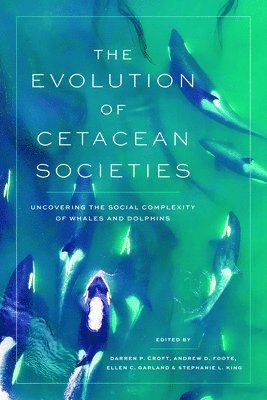
From leading cetacean biologists, an up-to-date, comprehensive collection exploring advancements in our understanding of cetacean ecology, behavior, and societies. Cetaceans—whales, dolphins, and porpoises—represent an evolutionary peak with respect to their advanced cognitive capacities; flexible communication systems; and structured, multilevel societies. Indeed, the social lives of whales and dolphins have long fascinated scientists and the public alike. The Evolution of Cetacean Societies provides a comprehensive overview of the significant advancements made in studying cetacean behavior and ecology over the last twenty-five years, focusing on our growing understanding of these animals’ complex social lives. Bringing together scientists from multiple disciplines, the volume summarizes key innovations and progress related to studying cetacean societies’ cultural and genetic basis, their complex social structures, their use of cooperation and patterns of social conflict, and their significant interactions with humans. Each chapter provides an in-depth account of the social lives of whales and dolphins, incorporating the latest cutting-edge research from genomics, communication, network analysis, and animal culture to explain how these animals form societies, maintain relationships, and share information. The final chapters focus on the existential threats facing these diverse and charismatic species, how human-cetacean interactions have shaped our perceptions, and what scientists can learn from their diverse social lives by championing researcher diversity in marine mammal science. The result is an essential and forward-looking book that both contextualizes the lessons of the past two decades and questions the challenges these enigmatic species might face in the future. Published in 2000 by Chicago, Cetacean Societies: Field Studies of Dolphins and Whales, edited by Janet Mann, Richard C. Connor, Peter Tyack, and Hal Whitehead, inspired a generation of marine biologists. In this new volume, Darren P. Croft, Andrew D. Foote, Ellen C. Garland, and Stephanie L. King—all respected cetacean researchers—offer a worthy successor.
Evolution of Cetacean Societies
Uncovering the Social Complexity of Whales and Dolphins
Häftad, Engelska, 2026
400 kr
Skickas inom 7-10 vardagar
From leading cetacean biologists, an up-to-date, comprehensive collection exploring advancements in our understanding of cetacean ecology, behavior, and societies. Cetaceans—whales, dolphins, and porpoises—represent an evolutionary peak with respect to their advanced cognitive capacities; flexible communication systems; and structured, multilevel societies. Indeed, the social lives of whales and dolphins have long fascinated scientists and the public alike. The Evolution of Cetacean Societies provides a comprehensive overview of the significant advancements made in studying cetacean behavior and ecology over the last twenty-five years, focusing on our growing understanding of these animals’ complex social lives. Bringing together scientists from multiple disciplines, the volume summarizes key innovations and progress related to studying cetacean societies’ cultural and genetic basis, their complex social structures, their use of cooperation and patterns of social conflict, and their significant interactions with humans. Each chapter provides an in-depth account of the social lives of whales and dolphins, incorporating the latest cutting-edge research from genomics, communication, network analysis, and animal culture to explain how these animals form societies, maintain relationships, and share information. The final chapters focus on the existential threats facing these diverse and charismatic species, how human-cetacean interactions have shaped our perceptions, and what scientists can learn from their diverse social lives by championing researcher diversity in marine mammal science. The result is an essential and forward-looking book that both contextualizes the lessons of the past two decades and questions the challenges these enigmatic species might face in the future. Published in 2000 by Chicago, Cetacean Societies: Field Studies of Dolphins and Whales, edited by Janet Mann, Richard C. Connor, Peter Tyack, and Hal Whitehead, inspired a generation of marine biologists. In this new volume, Darren P. Croft, Andrew D. Foote, Ellen C. Garland, and Stephanie L. King—all respected cetacean researchers—offer a worthy successor.
479 kr
Skickas inom 7-10 vardagar
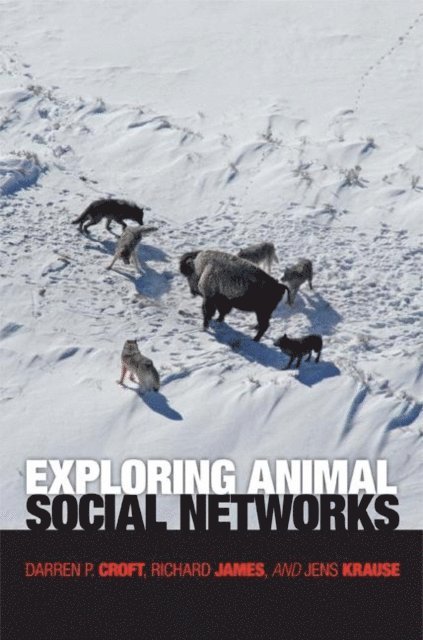
Social network analysis is used widely in the social sciences to study interactions among people, groups, and organizations, yet until now there has been no book that shows behavioral biologists how to apply it to their work on animal populations. Exploring Animal Social Networks provides a practical guide for researchers, undergraduates, and graduate students in ecology, evolutionary biology, animal behavior, and zoology. Existing methods for studying animal social structure focus either on one animal and its interactions or on the average properties of a whole population. This book enables researchers to probe animal social structure at all levels, from the individual to the population. No prior knowledge of network theory is assumed. The authors give a step-by-step introduction to the different procedures and offer ideas for designing studies, collecting data, and interpreting results. They examine some of today's most sophisticated statistical tools for social network analysis and show how they can be used to study social interactions in animals, including cetaceans, ungulates, primates, insects, and fish.Drawing from an array of techniques, the authors explore how network structures influence individual behavior and how this in turn influences, and is influenced by, behavior at the population level. Throughout, the authors use two software packages--UCINET and NETDRAW--to illustrate how these powerful analytical tools can be applied to different animal social organizations.