Dave Page - Böcker
Visar alla böcker från författaren Dave Page. Handla med fri frakt och snabb leverans.
6 produkter
6 produkter
151 kr
Skickas inom 11-20 vardagar
When F. Scott Fitzgerald was fourteen and living in the Crocus Hill neighborhood of St. Paul, he began keeping a short diary of his exploits among his friends, friendly rivals, and crushes. He gave the journal a title page-Thoughtbook of Francis Scott Key Fitzgerald of St. Paul Minn. U.S.A.-and kept it securely locked in a box under his bed. He would later use The Thoughtbook as the basis for “The Book of Scandal” in his Basil Lee Duke stories, and brief sections were copied over the years for use by scholars and even published in Life magazine. “Are you going to the Ordways’? the Herseys’? the Schultzes’?” Here, for the first time, is a complete transcription of this charming, twenty-seven-page diary highlighting Fitzgerald’s escapades among the children of some of St. Paul’s most influential families-models for the families described in The Great Gatsby. Presented in a simple format for both scholars and general readers alike, The Thoughtbook of F. Scott Fitzgerald includes a new introduction by Dave Page that covers the history and provenance of the diary, its place and meaning in Fitzgerald’s literary development, and its revelations about his life and writing process.One of the earliest known works by F. Scott Fitzgerald, The Thoughtbook provides a unique glimpse of Fitzgerald as a young boy and his social circle as they played among the grand homes of Summit Avenue, making up games, starting secret societies, competing with rivals, and (at all times) staying up-to-date on who exactly is vying for whose attention.
287 kr
Skickas inom 3-6 vardagar
186 kr
Skickas inom 5-8 vardagar
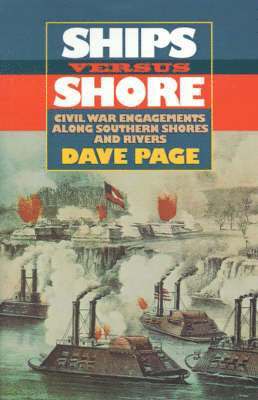
At the beginning of the Civil War, Southern militias moved swiftly to secure the military assets within their borders. In several instances, the action required no more than demanding the key to the fort from a lone ordnance sergeant. By and large these seizures were peaceful, and in one case the militia even signed a receipt. Yet what had the South achieved? Most of these forts were little more than damp dungeons sheltering time-worn cannon, some of the War of 1812 and Mexican War vintage.Forts are, by nature, defensive structures. Thus the South dug in and waited for the Northern invaders. And they came. But they came mostly by ship and, in the case of the inland waterways and rivers, by boat?gunboat. Although more Yankee sailors were lost to exploding weaponry than to Rebel fire, naval barrages were relentles, and more forts were abandoned than defended.Dave Page's Ships Versus Shore narrates ship-to-shore engagements in the eleven states of the Confederacy along their riverways as well as their coasts. A brief tour guide follows each description, noting what visitors can find today when they see the area. Page has visited each site and notes what remains of the Confederate forts and what historical places have been preserved that were part of the nearby struggle. The text is illustrated with 130 photos and engravings.

193 kr
Skickas inom 3-6 vardagar
145 kr
Skickas inom 5-8 vardagar
145 kr
Skickas inom 5-8 vardagar