David A. Ellwood - Böcker
Visar alla böcker från författaren David A. Ellwood. Handla med fri frakt och snabb leverans.
3 produkter
3 produkter
995 kr
Skickas
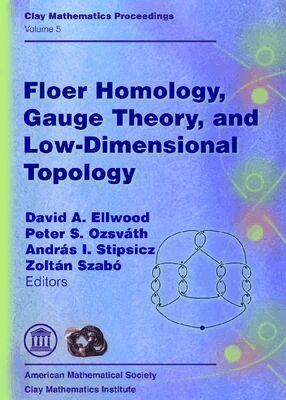
Mathematical gauge theory studies connections on principal bundles, or, more precisely, the solution spaces of certain partial differential equations for such connections. Historically, these equations have come from mathematical physics, and play an important role in the description of the electro-weak and strong nuclear forces. The use of gauge theory as a tool for studying topological properties of four-manifolds was pioneered by the fundamental work of Simon Donaldson in the early 1980s, and was revolutionized by the introduction of the Seiberg-Witten equations in the mid-1990s. Since the birth of the subject, it has retained its close connection with symplectic topology.The analogy between these two fields of study was further underscored by Andreas Floer's construction of an infinite-dimensional variant of Morse theory that applies in two a priori different contexts: either to define symplectic invariants for pairs of Lagrangian submanifolds of a symplectic manifold, or to define topological invariants for three-manifolds, which fit into a framework for calculating invariants for smooth four-manifolds. 'Heegaard Floer homology', the recently-discovered invariant for three- and four-manifolds, comes from an application of Lagrangian Floer homology to spaces associated to Heegaard diagrams. Although this theory is conjecturally isomorphic to Seiberg-Witten theory, it is more topological and combinatorial in flavor and thus easier to work with in certain contexts.The interaction between gauge theory, low-dimensional topology, and symplectic geometry has led to a number of striking new developments in these fields. The aim of this volume is to introduce graduate students and researchers in other fields to some of these exciting developments, with a special emphasis on the very fruitful interplay between disciplines. This volume is based on lecture courses and advanced seminars given at the 2004 Clay Mathematics Institute Summer School at the Alfred Renyi Institute of Mathematics in Budapest, Hungary. Several of the authors have added a considerable amount of additional material to that presented at the school, and the resulting volume provides a state-of-the-art introduction to current research, covering material from Heegaard Floer homology, contact geometry, smooth four-manifold topology, and symplectic four-manifolds.
1 750 kr
Skickas
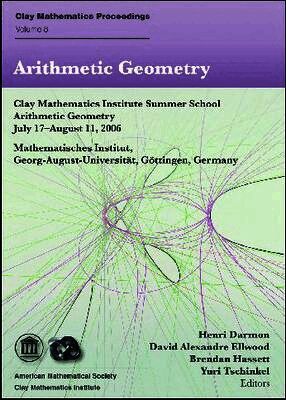
This book is based on survey lectures given at the 2006 Clay Summer School on Arithmetic Geometry at the Mathematics Institute of the University of Gottingen. Intended for graduate students and recent Ph.D.'s, this volume will introduce readers to modern techniques and outstanding conjectures at the interface of number theory and algebraic geometry. The main focus is rational points on algebraic varieties over non-algebraically closed fields. Do they exist? If not, can this be proven efficiently and algorithmically? When rational points do exist, are they finite in number and can they be found effectively? When there are infinitely many rational points, how are they distributed? For curves, a cohesive theory addressing these questions has emerged in the last few decades. Highlights include Faltings' finiteness theorem and Wiles' proof of Fermat's Last Theorem. Key techniques are drawn from the theory of elliptic curves, including modular curves and parametrizations, Heegner points, and heights. The arithmetic of higher-dimensional varieties is equally rich, offering a complex interplay of techniques including Shimura varieties, the minimal model program, moduli spaces of curves and maps, deformation theory, Galois cohomology, harmonic analysis, and automorphic functions. However, many foundational questions about the structure of rational points remain open, and research tends to focus on properties of specific classes of varieties.
835 kr
Skickas
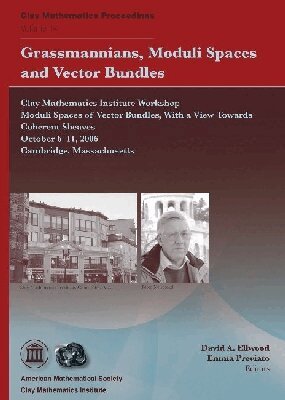
This collection of cutting-edge articles on vector bundles and related topics originated from a CMI workshop, held in October 2006, that brought together a community indebted to the pioneering work of P. E. Newstead, visiting the United States for the first time since the 1960s. Moduli spaces of vector bundles were then in their infancy, but are now, as demonstrated by this volume, a powerful tool in symplectic geometry, number theory, mathematical physics, and algebraic geometry. In fact, the impetus for this volume was to offer a sample of the vital convergence of techniques and fundamental progress, taking place in moduli spaces at the outset of the twenty-first century. This volume contains contributions by J. E. Andersen and N. L. Gammelgaard (Hitchin's projectively flat connection and Toeplitz operators), M. Aprodu and G. Farkas (moduli spaces), D. Arcara and A. Bertram (stability in higher dimension), L. Jeffrey (intersection cohomology), J. Kamnitzer (Langlands program), M. Lieblich (arithmetic aspects), P. E. Newstead (coherent systems), G. Pareschi and M. Popa (linear series on Abelian varieties), and M. Teixidor i Bigas (bundles over reducible curves). These articles do require a working knowledge of algebraic geometry, symplectic geometry and functional analysis, but should appeal to practitioners in a diversity of fields. No specialization should be necessary to appreciate the contributions, or possibly to be stimulated to work in the various directions opened by these path-blazing ideas; to mention a few, the Langlands program, stability criteria for vector bundles over surfaces and threefolds, linear series over abelian varieties and Brauer groups in relation to arithmetic properties of moduli spaces.