David A.J. Seargent - Böcker
Visar alla böcker från författaren David A.J. Seargent. Handla med fri frakt och snabb leverans.
4 produkter
4 produkter
395 kr
Skickas inom 10-15 vardagar
The Great Comets of History is unique. There are a few books on comets that make passing reference to some of the famous and spectacular objects of earlier years, and a few descriptive catalogues are available, but little detailed descriptive information is contained in either of these sources. This book fills the vacant niche that exists between general books, academic (and often cryptic) catalogues, and huge detailed catalogues such as Kronk's Cometography. The Great Comets of History is a detailed descriptive account -- in non-technical language -- of what are deemed to have been the most spectacular and notable comets ever recorded, beginning with 'Aristotle's Comet' of 372 BC and ending with McNaught's Comet of 2007. Halley's Comet is given a separate chapter and there is an introductory chapter on comets in general, explaining in lay terms what they are and correcting a few popular misconceptions. This is not only a fascinating read for astronomers at every level, but in pulling together a vast amount of information previously available only in disparate academic sources it is a major contribution to the literature.
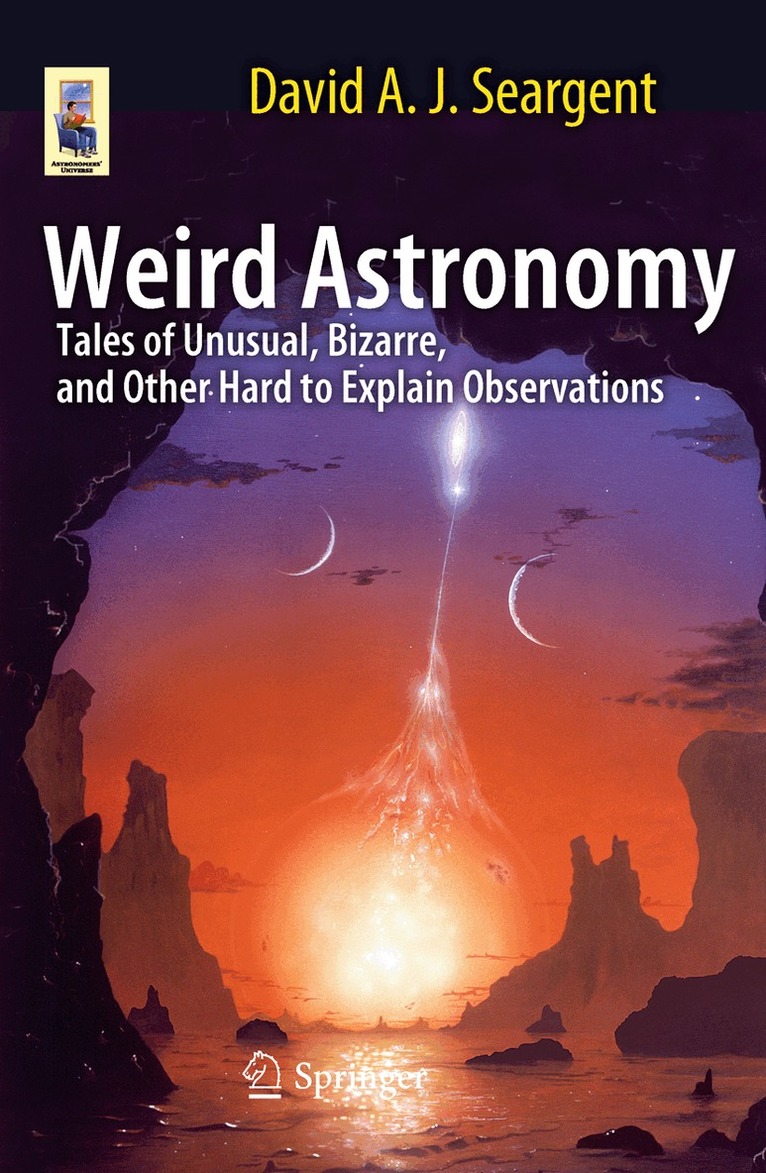
Weird Astronomy
Tales of Unusual, Bizarre, and Other Hard to Explain Observations
Häftad, Engelska, 2010
468 kr
Skickas inom 10-15 vardagar
Weird Astronomy appeals to all who are interested in unusual celestial phenomena, whether they be amateur or professional astronomers or science buffs who just enjoy reading of odd coincidences, unexplained observations, and reports from space probes that "don’t quite fit." This book relates a variety of "unusual" astronomical observations – unusual in the sense of refusing to fit easily into accepted thinking, or unusual in the observation having been made under difficult or extreme circumstances. Although some of the topics covered are instances of "bad astronomy," most are not. Some of the observations recorded here have actually turned out to be important scientific breakthroughs.Included are some amusing anecdotes (such as the incident involving "potassium flares" in ordinary stars and the story of Abba 1, the solar system’s own flare star!), but the book’s purpose is not to ridicule those who report anomalous observations, nor is it to challenge scientific orthodoxy. It is more to demonstrate how what's "weird" often turns out to be far more significant than observations of what we expect to see.
1 064 kr
Skickas inom 10-15 vardagar
by D. M. Armstrong In the history of the discussion of the problem of universals, G. F. Stout has an honoured, and special. place. For the Nominalist, meaning by that term a philosopher who holds that existence of repeatables - kinds, sorts, type- and the indubitable existence of general terms, is a problem. The Nominalist's opponent, the Realist, escapes the Nominalist's difficulty by postulating universals. He then faces difficulties of his own. Is he to place these universals in a special realm? Or is he to bring them down to earth: perhaps turning them into repeatable properties of particulars (universalia in res), and repeatable relations between universals (universalia inter res)? Whichever solution he opts for, there are well-known difficulties about how particulars stand to these universals. Under these circumstances the Nominalist may make an important con cession to the Realist, a concession which he can make without abandoning his Nominalism. He may concede that metaphysics ought to recognize that particulars have properties (qualities, perhaps) and are related by relations. But, he can maintain, these properties and relations are particulars, not universals. Nor, indeed, is such a position entirely closed to the Realist. A Realist about universals may, and some Realists do, accept particularized properties and relations in addition to universals. As Dr. Seargent shows at the beginning of his book. a doctrine of part icularized properties and relations has led at least a submerged existence from Plato onwards. The special, classical.
1 064 kr
Skickas inom 10-15 vardagar
by D. M. Armstrong In the history of the discussion of the problem of universals, G. F. Stout has an honoured, and special. place. For the Nominalist, meaning by that term a philosopher who holds that existence of repeatables - kinds, sorts, type- and the indubitable existence of general terms, is a problem. The Nominalist's opponent, the Realist, escapes the Nominalist's difficulty by postulating universals. He then faces difficulties of his own. Is he to place these universals in a special realm? Or is he to bring them down to earth: perhaps turning them into repeatable properties of particulars (universalia in res), and repeatable relations between universals (universalia inter res)? Whichever solution he opts for, there are well-known difficulties about how particulars stand to these universals. Under these circumstances the Nominalist may make an important con cession to the Realist, a concession which he can make without abandoning his Nominalism. He may concede that metaphysics ought to recognize that particulars have properties (qualities, perhaps) and are related by relations. But, he can maintain, these properties and relations are particulars, not universals. Nor, indeed, is such a position entirely closed to the Realist. A Realist about universals may, and some Realists do, accept particularized properties and relations in addition to universals. As Dr. Seargent shows at the beginning of his book. a doctrine of part icularized properties and relations has led at least a submerged existence from Plato onwards. The special, classical.