David Castriota - Böcker
Visar alla böcker från författaren David Castriota. Handla med fri frakt och snabb leverans.
4 produkter
4 produkter
282 kr
Skickas inom 10-15 vardagar
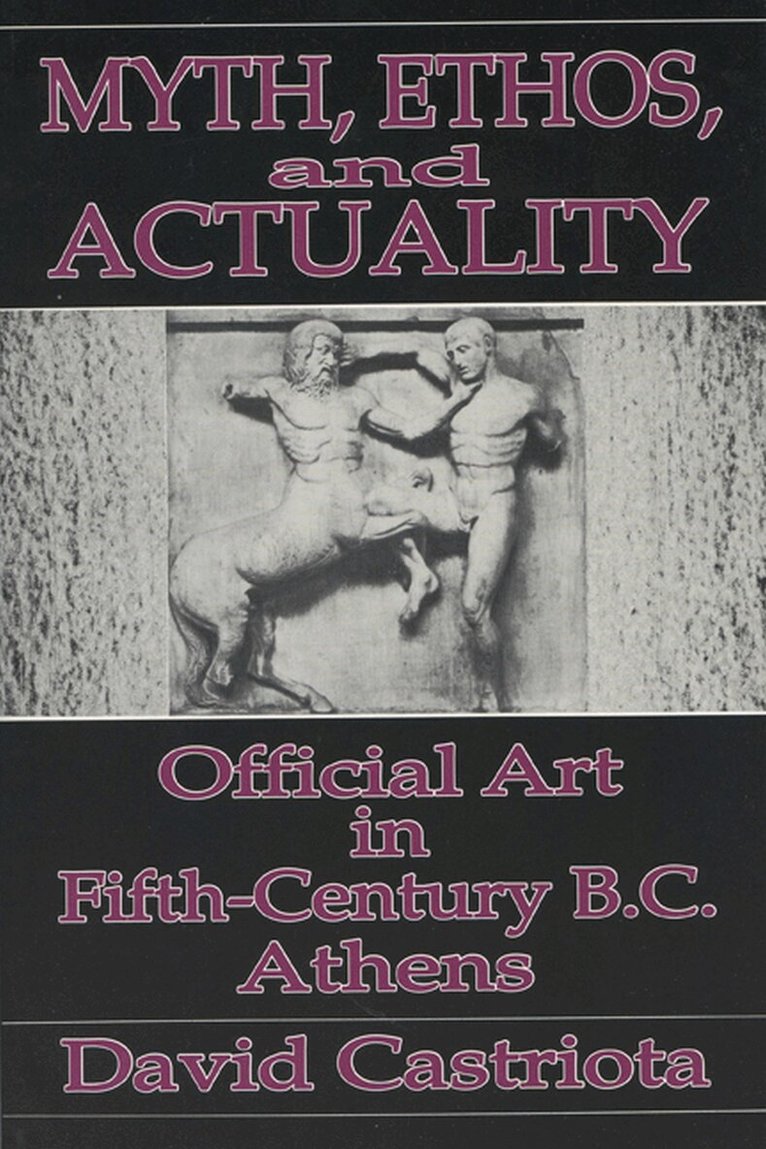
Myth, Ethos, and Actuality examines the depiction of mythic themes on Athenian public monuments in the period following the Persian Wars, during the second and third quarters of the 5th century BC. Using material remains, as well as the evidence of contemporary Greek history, rhetoric and poetry, David Castriota interprets the Athenian monuments as vehicles of an official ideology intended to celebrate and justify the present in terms of the past. Castriota focuses on the strategy of ethical antithesis asserting Greek moral superiority over the ""barbaric"" Persians, whose invasion had been repelled a generation earlier. He examines how, in major public programmes of painting and sculpture, the leading artists of the period recast the Persians in the guise of wild and impious mythic antagonists to associate them with the ethical flaws or weakness commonly ascribed to women, animals and foreigners. The Athenians in contrast, were compared to mythic protagonists representing the excellence and triumph of Hellenic culture. Castriota's study attempts to break new ground in emphasising the ethical implication of mythic precedents, which required substantial alterations to render them more effective as archetypes for the defence of Greek culture against a foreign, morally inferior enemy. The book looks at how the patrons and planners sought to manipulate viewer response through the selective presentation or repackaging of mythic traditions.
712 kr
Skickas inom 7-10 vardagar
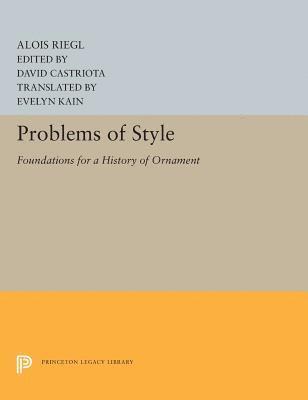
Written at the height of the arts and crafts movement in fin-de-siecle Vienna, Alois Riegl's Stilfragen represented a turning point in defining art and understanding the sources of its inspiration. Demonstrating an uninterrupted continunity in the history of ornament from the ancient Egyptian through the Islamic period, Riegl argued that the creative urge manifests itself in both "great art" and the most humble artifact, and that change is an inherent part of style. This new translation, which renders Riegl's seminal work in contemporary, readable prose, allows for a fresh reexamination of his thought in light of current revisionist debate.His discovery of infinite variation in the restatement of several decorative motifs--the palmette, rosette, tendril--led Riegl to believe that art is completely independent from exterior conditions and is beyond individual volition. This thinking laid the groundwork for his famous concept of Kunstwollen, or artistic intention."Something that the translation will, I hope, convey, is the passion invsted in Riegl's enterprise. We are made to feel that the issues he discussed mattered vitally to him; it was the very nature of art and its relation to human life that were at stake, art as an absolute necessity." --From the preface of Henri ZernerAlois Reigl (1858-1905) was Curator of Textiles at the Museum of Art and Industry in Vienna during most of his career and wrote many influential works on the history of art, including Spatromische Kunstgeschichte. Evelyn Kain is Associate Professor of Art History at Ripon College, Ripon, Wisconsin. David Castriota is Assistant Professor of Art History at Sarah Lawrence College.Originally published in 1993.The Princeton Legacy Library uses the latest print-on-demand technology to again make available previously out-of-print books from the distinguished backlist of Princeton University Press. These editions preserve the original texts of these important books while presenting them in durable paperback and hardcover editions. The goal of the Princeton Legacy Library is to vastly increase access to the rich scholarly heritage found in the thousands of books published by Princeton University Press since its founding in 1905.
3 244 kr
Skickas inom 3-6 vardagar
Written at the height of the arts and crafts movement in fin-de-siecle Vienna, Alois Riegl's Stilfragen represented a turning point in defining art and understanding the sources of its inspiration. Demonstrating an uninterrupted continunity in the history of ornament from the ancient Egyptian through the Islamic period, Riegl argued that the creative urge manifests itself in both "great art" and the most humble artifact, and that change is an inherent part of style. This new translation, which renders Riegl's seminal work in contemporary, readable prose, allows for a fresh reexamination of his thought in light of current revisionist debate.His discovery of infinite variation in the restatement of several decorative motifs--the palmette, rosette, tendril--led Riegl to believe that art is completely independent from exterior conditions and is beyond individual volition. This thinking laid the groundwork for his famous concept of Kunstwollen, or artistic intention."Something that the translation will, I hope, convey, is the passion invsted in Riegl's enterprise. We are made to feel that the issues he discussed mattered vitally to him; it was the very nature of art and its relation to human life that were at stake, art as an absolute necessity." --From the preface of Henri ZernerAlois Reigl (1858-1905) was Curator of Textiles at the Museum of Art and Industry in Vienna during most of his career and wrote many influential works on the history of art, including Spatromische Kunstgeschichte. Evelyn Kain is Associate Professor of Art History at Ripon College, Ripon, Wisconsin. David Castriota is Assistant Professor of Art History at Sarah Lawrence College.Originally published in 1993.The Princeton Legacy Library uses the latest print-on-demand technology to again make available previously out-of-print books from the distinguished backlist of Princeton University Press. These editions preserve the original texts of these important books while presenting them in durable paperback and hardcover editions. The goal of the Princeton Legacy Library is to vastly increase access to the rich scholarly heritage found in the thousands of books published by Princeton University Press since its founding in 1905.
782 kr
Kommande
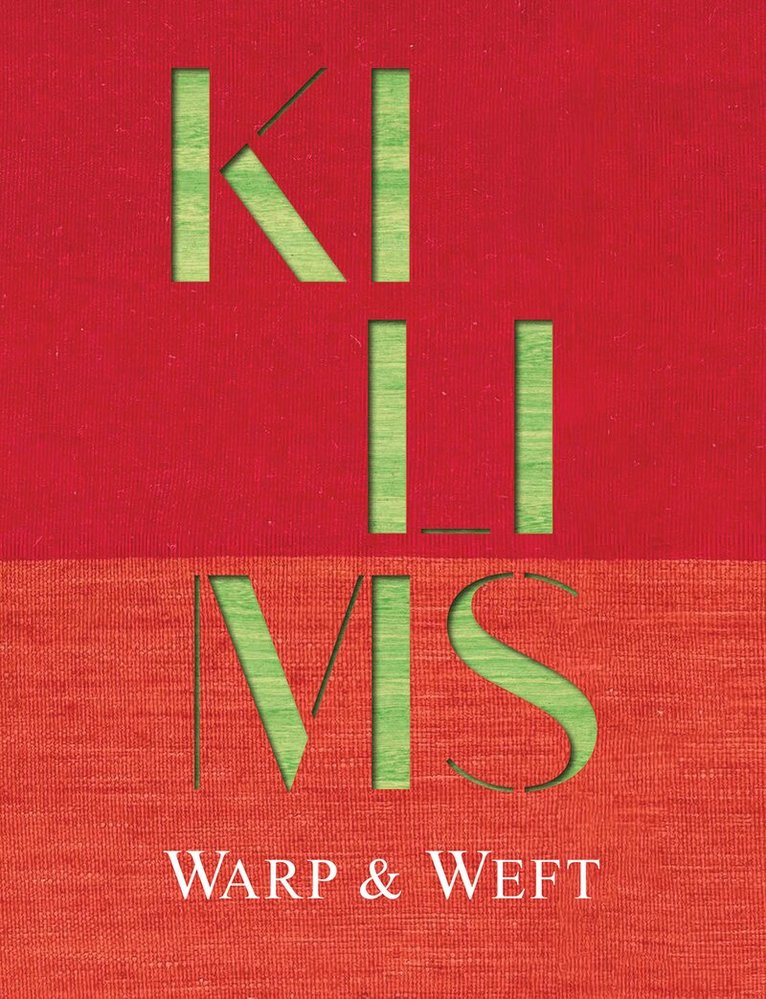
Kilims from Mazandaran are true masterpieces of woven minimalism. From stripes to fields of pure and deep colour, these textiles represent a singular kind of artistic abstraction.The women who authored these pieces made them for their own use. In wool and silk, they created works of textile art using the basic building blocks of all hand weaving: warp and weft. The grid thus created is at the same time rigid and flexible; it lends itself to geometric pattern, but also allows for feathery ikat-like effects and multidimensional colour expression.This book is a sumptuous visual celebration of a largely unknown modern art form. Expert writers add context to the pieces by contemplating subjects such as 20th-century minimalism, materiality and the nature of colour.