David Christensen - Böcker
Visar alla böcker från författaren David Christensen. Handla med fri frakt och snabb leverans.
8 produkter
8 produkter
800 kr
Kommande
When thinkers are sophisticated enough to reflect on their own thinking, epistemological questions arise about the relation between two things: (1) what the thinker is rational to believe about their own thinking; and (2) what the thinker is rational to believe about things in general. Some have argued that evidence about one's thinking (so-called "higher-order" evidence) is generally irrelevant to what one is rational to believe about matters that have nothing direct to do with one's thinking.In Judging One's Own Case, David Christensen defends and develops the opposite view: that higher-order evidence often has dramatic effects on what it's rational to believe about matters in general. This position poses a puzzle: One must judge one's own thinking from one's own perspective-a perspective that includes the thinking to be judged. So how to avoid question-beggingly positive self-assessments? Christensen answers this question by developing a structural description of how higher-order evidence and ordinary evidence interact. He also explores some surprising implications of this position, including: limiting the power of clear deductive arguments; recognizing that rational requirements can conflict; allowing cases where it's rational to have beliefs one rationally thinks irrational; acknowledging that the correct theory of rationality may not be rationally believable; and precluding philosophers from having rational confidence in the theories they develop and defend.
641 kr
Skickas
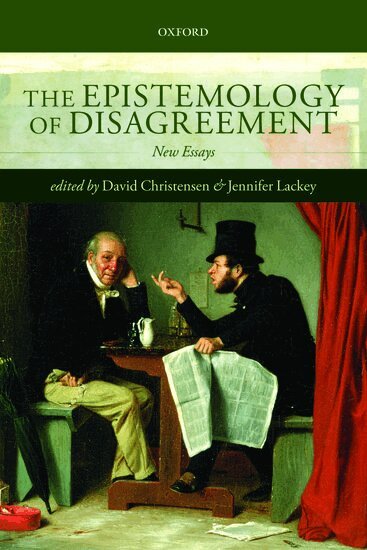
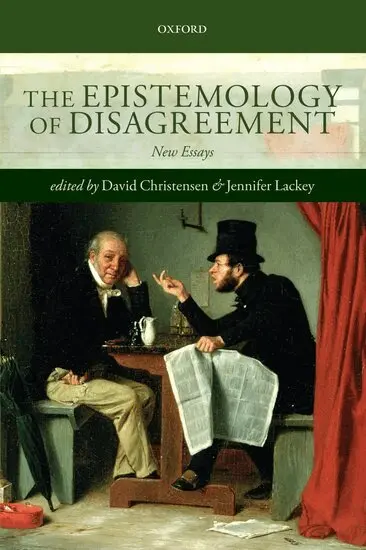
The Epistemology of Disagreement brings together essays from a dozen philosophers on the epistemic significance of disagreement; all but one of the essays are new. Questions discussed include: When (if ever) does the disagreement of others require a rational agent to revise her beliefs? Do 'conciliatory' accounts, on which agents are required to revise significantly, suffer from fatal problems of self-defeat, given the disagreement about disagreement? What is the significance of disagreement about philosophical topics in particular? How does the epistemology of disagreement relate to broader epistemic theorizing? Does the increased significance of multiple disagreeing agents depend on their being independent of one another? John Hawthorne and Amia Srinivasan, Thomas Kelly, and Brian Weatherson all weigh in with attacks on conciliatory views or defenses of non-conciliatory approaches. David Christensen and Stewart Cohen take up the opposite side of the debate. Bryan Frances, Sanford Goldberg, and Ernest Sosa discuss a kind of disagreement that will be of particular concern to most readers of this book: disagreement about philosophy. And Robert Audi, Jonathan Kvanvig, and Jennifer Lackey tackle some general theoretical issues that bear on disagreement.The philosophers represented here include some who have contributed actively to the disagreement literature already, as well as some who are exploring the issue for the first time. Their work helps to deepen and expand our understanding of some epistemic phenomena that are central to any thoughtful believer's engagement with other believers.
637 kr
Skickas inom 7-10 vardagar
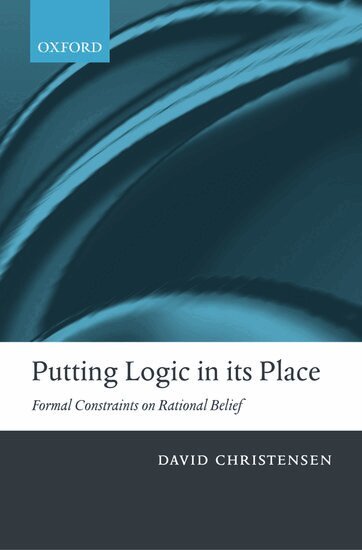
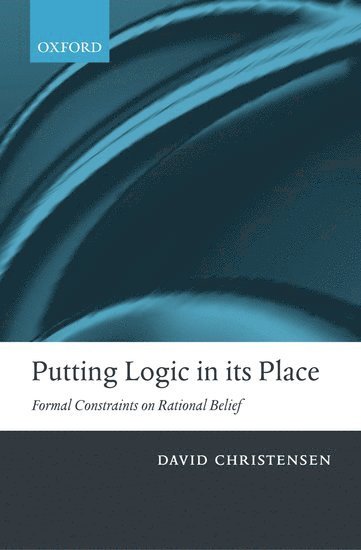
What role, if any, does formal logic play in characterizing epistemically rational belief? Traditionally, belief is seen in a binary way - either one believes a proposition, or one doesn't. Given this picture, it is attractive to impose certain deductive constraints on rational belief: that one's beliefs be logically consistent, and that one believe the logical consequences of one's beliefs. A less popular picture sees belief as a graded phenomenon. This picture (explored more by decision-theorists and philosophers of science thatn by mainstream epistemologists) invites the use of probabilistic coherence to constrain rational belief. But this latter project has often involved defining graded beliefs in terms of preferences, which may seem to change the subject away from epistemic rationality. Putting Logic in its Place explores the relations between these two ways of seeing beliefs. It argues that the binary conception, although it fits nicely with much of our commonsense thought and talk about belief, cannot in the end support the traditional deductive constraints on rational belief. Binary beliefs that obeyed these constraints could not answer to anything like our intuitive notion of epistemic rationality, and would end up having to be divorced from central aspects of our cognitive, practical, and emotional lives. But this does not mean that logic plays no role in rationality. Probabilistic coherence should be viewed as using standard logic to constrain rational graded belief. This probabilistic constraint helps explain the appeal of the traditional deductive constraints, and even underlies the force of rationally persuasive deductive arguments. Graded belief cannot be defined in terms of preferences. But probabilistic coherence may be defended without positing definitional connections between beliefs and preferences. Like the traditional deductive constraints, coherence is a logical ideal that humans cannot fully attain. Nevertheless, it furnishes a compelling way of understanding a key dimension of epistemic rationality.
1 633 kr
Skickas inom 7-10 vardagar
What role, if any, does formal logic play in characterizing epistemically rational belief? Traditionally, belief is seen in a binary way - either one believes a proposition, or one doesn't. Given this picture, it is attractive to impose certain deductive constraints on rational belief: that one's beliefs be logically consistent, and that one believe the logical consequences of one's beliefs. A less popular picture sees belief as a graded phenomenon. This picture (explored more by decision-theorists and philosophers of science thatn by mainstream epistemologists) invites the use of probabilistic coherence to constrain rational belief. But this latter project has often involved defining graded beliefs in terms of preferences, which may seem to change the subject away from epistemic rationality.Putting Logic in its Place explores the relations between these two ways of seeing beliefs. It argues that the binary conception, although it fits nicely with much of our commonsense thought and talk about belief, cannot in the end support the traditional deductive constraints on rational belief. Binary beliefs that obeyed these constraints could not answer to anything like our intuitive notion of epistemic rationality, and would end up having to be divorced from central aspects of our cognitive, practical, and emotional lives.But this does not mean that logic plays no role in rationality. Probabilistic coherence should be viewed as using standard logic to constrain rational graded belief. This probabilistic constraint helps explain the appeal of the traditional deductive constraints, and even underlies the force of rationally persuasive deductive arguments. Graded belief cannot be defined in terms of preferences. But probabilistic coherence may be defended without positing definitional connections between beliefs and preferences. Like the traditional deductive constraints, coherence is a logical ideal that humans cannot fully attain. Nevertheless, it furnishes a compelling way of understanding a key dimension of epistemic rationality.
1 281 kr
Skickas inom 7-10 vardagar
The Epistemology of Disagreement brings together essays from a dozen philosophers on the epistemic significance of disagreement; all but one of the essays are new. Questions discussed include: When (if ever) does the disagreement of others require a rational agent to revise her beliefs? Do 'conciliatory' accounts, on which agents are required to revise significantly, suffer from fatal problems of self-defeat, given the disagreement about disagreement? What is the significance of disagreement about philosophical topics in particular? How does the epistemology of disagreement relate to broader epistemic theorizing? Does the increased significance of multiple disagreeing agents depend on their being independent of one another? John Hawthorne and Amia Srinivasan, Thomas Kelly, and Brian Weatherson all weigh in with attacks on conciliatory views or defenses of non-conciliatory approaches. David Christensen and Stewart Cohen take up the opposite side of the debate. Bryan Frances, Sanford Goldberg, and Ernest Sosa discuss a kind of disagreement that will be of particular concern to most readers of this book: disagreement about philosophy. And Robert Audi, Jonathan Kvanvig, and Jennifer Lackey tackle some general theoretical issues that bear on disagreement.The philosophers represented here include some who have contributed actively to the disagreement literature already, as well as some who are exploring the issue for the first time. Their work helps to deepen and expand our understanding of some epistemic phenomena that are central to any thoughtful believer's engagement with other believers.
134 kr
Skickas inom 5-8 vardagar
165 kr
Skickas inom 5-8 vardagar
171 kr
Skickas inom 5-8 vardagar