David Cowling - Böcker
Visar alla böcker från författaren David Cowling. Handla med fri frakt och snabb leverans.
2 produkter
2 produkter
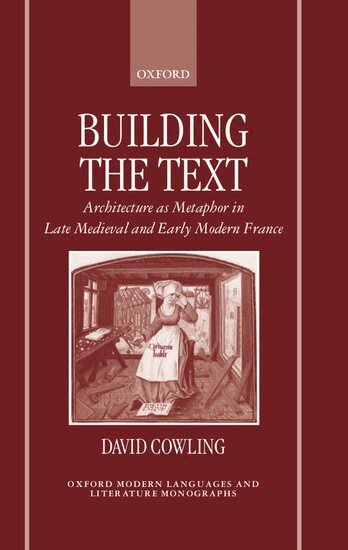
Building the Text
Architecture as Metaphor in Late Medieval and Early Modern France
Inbunden, Engelska, 1998
3 323 kr
Skickas inom 5-8 vardagar
Descriptions of imaginary buildings abound in late medieval and early modern texts in France as in other European countries. The vogue for allegorical buildings was, however, more than a literary fashion: by deploying familiar metaphors of the building in new contexts, writers gained a powerful tool of persuasion. This book explores the complex relationship between metaphor and allegory in the largely neglected but extremely rich corpus of writing that spans the late fifteenth and early sixteenth century in France, and concentrates on the output of Jean Lemaire (c.1473-after 1515), whose fascination with architecture played a crucial role in defining his self-image as a writer. By exploiting the semantic richness of the image of the temple, Lemaire was able to combine panegyric of his patrons with advertisement of his own talents and to promote an ideology of the self-conscious and self-confident writer that was to characterize the stance of Ronsard and the Pléiade in the poet-architect debate of the later sixteenth century.
Del 281 - Faux Titre
Conceptions of Europe in Renaissance France
Essays in Honour of Keith Cameron
Häftad, Engelska, 2006
966 kr
Skickas inom 5-8 vardagar
This collection of essays by ten leading British and French Renaissance specialists explores, for the first time, differing conceptions of Europe in Renaissance France. Four essays concentrate on problems of definition in ideological, chronological, geographical and linguistic terms, concentrating on the relationship between Christendom and Europe, Antiquity and its Renaissance heirs, and Latin and the vernacular languages of south-western France. A further three essays address cultural exchange and political collaboration (and, inevitably, conflict) between France and England at the time of the Wars of Religion,exploring Catholic and Protestant reactions to the battle of Lepanto, Anglo-French Protestant espionage and pragmatic conceptions of the state based on geography rather than religion. The final three contributions focus on the construction of a European identity in the early modern period that defines itself in contrast to a significant other, be it Islamic or ‘Atlantic’, with particular reference to the presentation of Turkish characters in the work of Christian writers, exotic travel in the work of François Rabelais and the genre of the Livre des contrariétés. This volume will be of interest to scholars and students of French Renaissance literature and to those interested in the prehistory of our contemporary conception of Europe.