David G. Winter - Böcker
Visar alla böcker från författaren David G. Winter. Handla med fri frakt och snabb leverans.
4 produkter
4 produkter
778 kr
Kommande
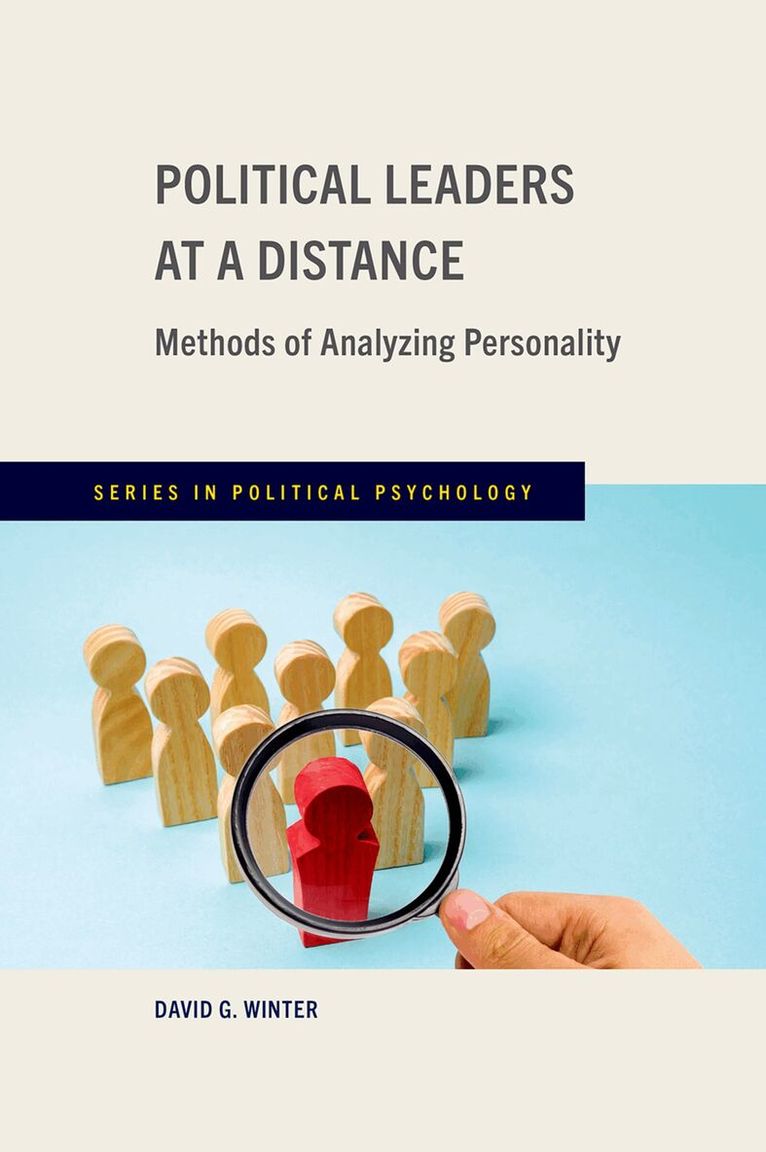
The personalities of political leaders often play an important role in domestic and international outcomes. However, leaders cannot be studied directly by the usual means of interviews or psychological tests. In consequence, psychologists have developed a variety of indirect methods to assess and measure personality "at a distance." Many of these at-a-distance measures are based on content analysis of what leaders say or write.Political Leaders at a Distance begins by describing several cases when leaders' personality played critical roles in important political outcomes, such as the outbreak of war in 1914. The book then reviews the history of at-a-distance studies and offers a conceptual framework for personality, consisting of four different elements: social contexts, traits, cognitions, and motives.Subsequent chapters focus on the personality variables of each element: their theoretical bases, the validity credentials of existing at-a-distance measures, and additional measurement techniques that might be developed in the future. Each variable is discussed with case examples of particular leaders and historical figures, research results from previous at-a-distance studies of leaders, and links to instructions, procedures, and scoring systems for measuring that variable. The final chapter brings together theory and at-a-distance research from the four separate elements of personality, revisiting examples throughout the book to offer a complete assessment. The book concludes with a discussion of future directions for at-a-distance personality measurement and research such as exploring the personality characteristics of literary figures, and the work of artists and architects.
707 kr
Skickas inom 5-8 vardagar
Ever since Thucydides pondered reasons for the outbreak of the Peloponnesian War, writers, philosophers, and social scientists have all tried to identify and catalog factors that promote conflict escalation. Historians emphasize path-dependencies: the future grows out of the past, hence tomorrow's wars are rooted in yesterday's conflicts. Political scientists attend to changes in power balance or domestic political forces. All of these causes, however, are constructed by human beings and involve the memories, emotions, and motives of both the leaders and the led.In July 1914, the long peace of the great European powers was shattered when the Sarajevo assassinations quickly escalated to a world war that few ever anticipated. In contrast, at the height of the Cold War, the Cuban Missile Crisis could have easily plunged us into a thermonuclear world war, but was ultimately peacefully resolved. Why?In Roots of War: Wanting Power, Seeing Threat, Justifying Force, author David G. Winter identifies the three psychological factors that contributed to the differences in these historical outcomes: the desire for power (power motivation), exaggerated perception of the opponent's threat, and justification for using military power and force. As Winter illustrates, several different lines of research establish how these three factors lead to escalation and war: the role of power motivation is demonstrated by comparative content analysis of documents (i.e. diplomatic communications, leaders' speeches, and media coverage) from crises that escalated to war versus similar events that did not; case studies of several American and British wars; and analysis of "new wars" (i.e. civil unrest, state-sponsored violence, and terrorism).Drawing on this research, Roots of War is a powerful testament to the roles of power and the preservation of peace, and demonstrates their enormous influence in diplomatic interventions in the past and present-day.
605 kr
Skickas inom 3-6 vardagar
Originally published in 1924, this study of the Don Juan legend is a powerful interpretation of one of the most popular themes in Western culture. Also valuable for the insights it offers into Rank's thought immediately before his break with Freud, the book has not been available in English until now. Rank's study draws on psychoanalysis, literature, history, and anthropology to suggest some psychological mechanisms that operate both within the principal characters of the legend and within the audience or reader. Originally published in 1975. The Princeton Legacy Library uses the latest print-on-demand technology to again make available previously out-of-print books from the distinguished backlist of Princeton University Press. These editions preserve the original texts of these important books while presenting them in durable paperback and hardcover editions. The goal of the Princeton Legacy Library is to vastly increase access to the rich scholarly heritage found in the thousands of books published by Princeton University Press since its founding in 1905.
1 374 kr
Skickas inom 3-6 vardagar
Originally published in 1924, this study of the Don Juan legend is a powerful interpretation of one of the most popular themes in Western culture. Also valuable for the insights it offers into Rank's thought immediately before his break with Freud, the book has not been available in English until now. Rank's study draws on psychoanalysis, literature, history, and anthropology to suggest some psychological mechanisms that operate both within the principal characters of the legend and within the audience or reader. Originally published in 1975. The Princeton Legacy Library uses the latest print-on-demand technology to again make available previously out-of-print books from the distinguished backlist of Princeton University Press. These editions preserve the original texts of these important books while presenting them in durable paperback and hardcover editions. The goal of the Princeton Legacy Library is to vastly increase access to the rich scholarly heritage found in the thousands of books published by Princeton University Press since its founding in 1905.