David Hackett Fischer - Böcker
Visar alla böcker från författaren David Hackett Fischer. Handla med fri frakt och snabb leverans.
15 produkter
15 produkter
445 kr
Skickas inom 3-6 vardagar
206 kr
Skickas inom 5-8 vardagar
A history of aging in America surveys and compares actualities and attitudes in the eighteenth, nineteenth, and twentieth centuries and suggests practical improvements on the current inadequate system of pensions, social security, medicare, and other programs.
649 kr
Skickas inom 7-10 vardagar
The initial volume of what will become a multi-volume social history of the United States, this book treats the transmission of English culture to America. Fischer argues that during the period 1629 to 1775 the United States was settled by four large waves of English-speaking immigrants from different parts of Britain. These groups had many qualities in common; but what Fischer is more concerned with is how they differed from each other in `their unique folkways' and how these folkways were transferred to America and became the basis for regional differences that have persisted to some degree down to the present. Among these were: different dialects of English; different ways of building houses, naming children, and doing much of the ordinary business of life; different customs of courtship and marriage, ways of rearing children, and customs of inheritance; different forms of music and religion; different styles of food, dress, sports, work, and wealth; and four distinct and even contradictory conceptions of liberty.
553 kr
Skickas inom 5-8 vardagar
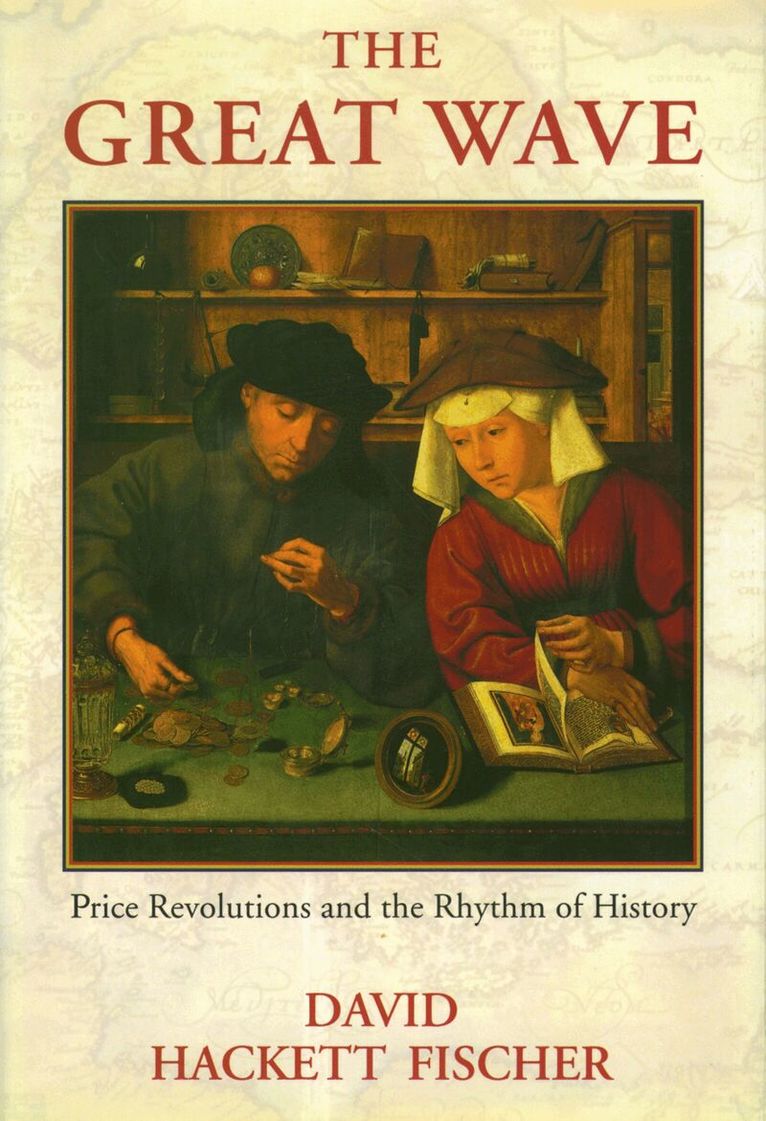
David Hackett Fischer, one of our most prominent historians, has garnered a reputation for making history come alive - even stories as familiar as Paul Revere's ride, or as complicated as the assimilation of British culture in North America. Now, in The Great Wave, Fischer has done it again, marshalling an astonishing array of historical facts in lucid and compelling prose to outline a history of prices - `the history of change', as Fischer puts it - covering the dazzling sweep of Western history from the medieval glory of Chartres to the modern day. Going far beyond the economic data, Fischer writes a powerful history of the people of the Western world: the economic patterns they lived in, and the politics, culture, and society that they created as a result. As he did in Albion's Seed and Paul Revere's Ride, two of the most talked-about history books in recent years, Fischer combines extensive research and meticulous scholarship with wonderfully evocative writing to create a book for scholars and general readers alike.Records of prices are more abundant than any other quantifiable data, and span the entire range of history, from tables of medieval grain prices to the overabundance of modern statistics. Fischer studies this wealth of data, creating a narrative that encompasses all of Western culture. He describes four waves of price revolutions, each beginning in a period of equilibrium: the High Middle Ages, the Renaissance, the Enlightenment, and finally the Victorian Age. Each revolution is marked by continuing inflation, a widening gap between rich and poor, increasing instability, and finally a crisis at the crest of the wave that is characterized by demographic contraction, social and political upheaval, and economic collapse. The most violent of these climaxes was the catastrophic fourteenth century, in which war, famine, and the Black Death devastated the continent - the only time in Europe's history that the population actually declined.Fischer also brilliantly illuminates how these long economic waves are closely intertwined with social and political events, affecting the very mindset of the people caught in them. The long periods of equilibrium are marked by cultural and intellectual movements - such as the Renaissance, the Enlightenment, and the Victorian Age - based on a belief in order and harmony and in the triumph of progress and reason. By contrast, the years of price revolution created a melancholy culture of despair.Fischer suggests that we are living now in the last stages of a price revolution that has been building since the turn of the century. The destabilizing price surges and declines and the diminished expectations the United States has suffered in recent years - and the famines and wars of other areas of the globe - are typical of the crest of a price revolution. He does not attempt to predict what will happen, noting that `uncertainty about the future is an inexorable fact of our condition'. Rather, he ends with a brilliant analysis of where we might go from here and what our choices are now. This book is essential reading for anyone concerned about the state of the world today.
399 kr
Skickas inom 3-6 vardagar
Eighty percent of Americans have no British ancestors. According to David Hackett Fischer, however, their day-to-day lives are profoundly influenced by folkways transplanted from Britain to the New World with the first settlers. Residual, yet persistent, aspects of these 17th Century folkways are indentifiable, Fischer argues, in areas as divers as politics, education, and attitudes towards gender, sexuality, age, and child-raising. Making use of both traditional and revisionist scholarship, this ground-breaking work documents how each successive wave of early emigration--Puritans to the North-East; Royalist aristocrats to the South; the Friends to the Delaware Valley; Irish and North Britons to the American backcountry--contributed to, and continue to affect, ingrained cultural differences between various regions in the United States.
302 kr
Skickas inom 5-8 vardagar
Paul Revere's midnight ride looms as an almost mythical event in American history--yet it has been largely ignored by scholars and left to patriotic writers and debunkers. Now one of the foremost American historians offers the first serious look at the events of the night of April 18, 1775--what led up to it, what really happened, and what followed--uncovering a truth far more remarkable than the myths of tradition.In Paul Revere's Ride, David Hackett Fischer fashions an exciting narrative that offers deep insight into the outbreak of revolution and the emergence of the American republic. Beginning in the years before the eruption of war, Fischer illuminates the figure of Paul Revere, a man far more complex than the simple artisan and messenger of tradition. Revere ranged widely through the complex world of Boston's revolutionary movement--from organizing local mechanics to mingling with the likes of John Hancock and Samuel Adams. When the fateful night arrived, more than sixty men and women joined him on his task of alarm--an operation Revere himself helped to organize and set in motion. Fischer recreates Revere's capture that night, showing how it had an important impact on the events that followed. He had an uncanny gift for being at the centre of events, and the author follows him to Lexington Green--setting the stage for a fresh interpretation of the battle that began the war. Drawing on intensive new research, Fischer reveals a clash very different from both patriotic and iconoclastic myths. The local militia were elaborately organized and intelligently led, in a manner that had deep roots in New England. On the morning of April 19, they fought in fixed positions and close formation, twice breaking the British regulars. In the afternoon, the American officers switched tactics, forging a ring of fire around the retreating enemy which they maintained for several hours--an extraordinary feat of combat leadership. In the days that followed, Paul Revere led a new battle-- for public opinion--which proved even more decisive than the fighting itself.When the alarm-riders of April 18 took to the streets, they did not cry, "the British are coming," for most of them still believed they were British. Within a day, many began to think differently. For George Washington, Thomas Jefferson, John Adams, and Thomas Paine, the news of Lexington was their revolutionary Rubicon. Paul Revere's Ride returns Paul Revere to centre stage in these critical events, capturing both the drama and the underlying developments in a triumphant return to narrative history at its finest.
288 kr
Skickas inom 5-8 vardagar
This widely acclaimed and meticulously researched book is the first serious study of Paul Revere's famous ride. Fischer's exciting narrative offers new insight into the coming of the American Revolution.
307 kr
Skickas
A unique view of historical change, based on the rise and fall of prices.
894 kr
Skickas inom 5-8 vardagar
Liberty and freedom: Americans agree that these values are fundamental to our nation, but what do they mean? How have their meanings changed through time? In this new volume of cultural history, David Hackett Fischer shows how these varying ideas form an intertwined strand that runs through the core of American life. Fischer examines liberty and freedom not as philosophical or political abstractions, but as folkways and popular beliefs deeply embedded in American culture. Tocqueville called them "habits of the heart." From the earliest colonies, Americans have shared ideals of liberty and freedom, but with very different meanings. Like DNA these ideas have transformed and recombined in each generation. The book arose from Fischer's discovery that the words themselves had differing origins: the Latinate "liberty" implied separation and independence. The root meaning of "freedom" (akin to "friend") connoted attachment: the rights of belonging in a community of freepeople. The tension between the two senses has been a source of conflict and creativity throughout American history. Liberty & Freedom studies the folk history of those ideas through more than 400 visions, images, and symbols. It begins with the American Revolution, and explores the meaning of New England's Liberty Tree, Pennsylvania's Liberty Bells, Carolina's Liberty Crescent, and "Don't Tread on Me" rattlesnakes. In the new republic, the search for a common American symbol gave new meaning to Yankee Doodle, Uncle Sam, Miss Liberty, and many other icons. In the Civil War, Americans divided over liberty and freedom. Afterward, new universal visions were invented by people who had formerly been excluded from a free society--African Americans, American Indians, and immigrants. The twentieth century saw liberty and freedom tested by enemies and contested at home, yet it brought the greatest outpouring of new visions, from Franklin Roosevelt's Four Freedoms to Martin Luther King's "dream" to Janis Joplin's "nothin' left to lose."Illustrated in full color with a rich variety of images, Liberty and Freedom is, literally, an eye-opening work of history--stimulating, large-spirited, and ultimately, inspiring.
428 kr
Skickas inom 5-8 vardagar
Six months after Independence, the American Revolution was all but lost. A powerful British force had routed the Americans at New York, occupied three colonies, and advanced within sight of Philadelphia. George Washington lost 90 percent of his army, and was driven across the Delaware River. Panic and despair spread through the states. As the author recounts in this riveting history, many Americans refused to let the Revolution die. In mid-December, the people of occupied New Jersey began to rise against British and German troops. They created an opportunity for George Washington. On Christmas night, as a howling nor'easter struck the Delaware Valley, Washington led his men across the river and attacked the exhausted Hessian garrison at Trenton, killing or capturing nearly a thousand men. A second battle of Trenton followed a week later. The Americans repelled an attack by Lord Cornwallis, but were nearly trapped. They escaped in the night, marched behind the enemy, and defeated a British brigade at Princeton. Badly shaken, the British retreated to an enclave near the coast. For twelve weeks the Americans kept the initiative in small attacks that took a large toll of Howe's army, and wrecked his strategy. American spirits soared. A new three-year army was recruited, a continental executive was organized, and the states created permanent republican governments. European leaders were quick to take notice. Fischer's richly textured narrative reveals the role of contingency in these events. We see how the campaign developed in a web of hard choices by many actors on both sides. While British and German forces remained rigid and hierarchical, Americans invented an open and flexible system that was fundamental to their success. At the same time, Washington and his army developed an American way of war, and also a war-ethic that John Adams called "the policy of humanity." Their conduct of the War for Independence gave new meaning to the Revolution, in a pivotal moment for American history.
292 kr
Skickas inom 3-6 vardagar
Six months after the Declaration of Independence, the American Revolution was all but lost. A powerful British force had routed the Americans at New York, occupied three colonies, and advanced within sight of Philadelphia.Yet, as David Hackett Fischer recounts in this riveting history, George Washington--and many other Americans--refused to let the Revolution die. On Christmas night, as a howling nor'easter struck the Delaware Valley, he led his men across the river and attacked the exhausted Hessian garrison at Trenton, killing or capturing nearly a thousand men. A second battle of Trenton followed within days. The Americans held off a counterattack by Lord Cornwallis's best troops, then were almost trapped by the British force. Under cover of night, Washington's men stole behind the enemy and struck them again, defeating a brigade at Princeton. The British were badly shaken. In twelve weeks of winter fighting, their army suffered severe damage, their hold on New Jersey was broken, and their strategy was ruined.Fischer's richly textured narrative reveals the crucial role of contingency in these events. We see how the campaign unfolded in a sequence of difficult choices by many actors, from generals to civilians, on both sides. While British and German forces remained rigid and hierarchical, Americans evolved an open and flexible system that was fundamental to their success. The startling success of Washington and his compatriots not only saved the faltering American Revolution, but helped to give it new meaning.
301 kr
Kommande
Fairness and Freedom
A History of Two Open Societies: New Zealand and the United States
Inbunden, Engelska, 2012
441 kr
Skickas inom 3-6 vardagar
Fairness and Freedom compares the history of two open societies - New Zealand and the United States - with much in common. Both have democratic polities, mixed-enterprise economies, individuated societies, pluralist cultures, and a deep concern for human rights and the rule of law. But all of these elements take different forms, because constellations of value are far apart. The dream of living free is America's Polaris; fairness and natural justice are New Zealand's Southern Cross. Fischer asks why these similar countries went different ways. Both were founded by English-speaking colonists, but at different times and with disparate purposes. They lived in the first and second British Empires, which operated in very different ways. Indians and Maori were important agents of change, but to different ends. On the American frontier and in New Zealand's Bush, material possibilities and moral choices were not the same. Fischer takes the same comparative approach to parallel processes of nation-building and immigration, women's rights and racial wrongs, reform causes and conservative responses, war-fighting and peace-making, and global engagement in our own time--with similar results. On another level, this book expands Fischer's past work on liberty and freedom. It is the first book to be published on the history of fairness. And it also poses new questions in the old tradition of history and moral philosophy. Is it possible to be both fair and free? In a vast array of evidence, Fischer finds that the strengths of these great values are needed to correct their weaknesses. As many societies seek to become more open - never twice in the same way, an understanding of our differences is the only path to peace.
552 kr
Skickas inom 3-6 vardagar
432 kr
Skickas inom 3-6 vardagar