David Himmelgreen - Böcker
Visar alla böcker från författaren David Himmelgreen. Handla med fri frakt och snabb leverans.
10 produkter
10 produkter
345 kr
Skickas inom 11-20 vardagar
The team coalition has become an increasingly common part of the practicing anthropologist’s lexicon. Today, anthropologists frequently utilize coalition formation as a tool for achieving positive, sustainable community change and conducting commonly-based research. In this issue of Annals of Anthropological Practice, authors critically examine factors influencing coalition participation, dispelling the notion that the coalition process itself ensures diversity, while offering concrete examples of how participatory diversity might be achieved. Anthropologists examine the complex intersection of roles they and others find themselves assuming as academic researchers, educators, concerned community members, advocates for marginalized populations, and representatives of the scientific community in community-based coalition practice. Also woven into this volume is a clear depiction of contemporary methods and theories in anthropological community coalition and partnership research. Throughout the volume contains examples of coalition program and strategies that will be of use to coalition practitioners across locations and disciplines.
342 kr
Skickas inom 11-20 vardagar
This collection includes research on engineering robots for emotional interaction, the vulnerability of soldiers to post-traumatic stress disorder, cognitive dimensions of political and science communication, sports coaching across cultures, intergenerational health problems in Aboriginal populations, the political economy of addiction treatment, the impact of poverty on the developing brain, psychiatric care for Nepali Bhutanese refugees, and how culture and institutions affect psychosis. These cases show how a holistic approach to neural development and structure in social contexts provides a powerful new way to apply anthropology.
Anthropology and the Engaged University
New Vision for the Discipline within Higher Education
Häftad, Engelska, 2014
305 kr
Skickas inom 11-20 vardagar
The case studies in this volume demonstrate how community engagement and public scholarship are applied as vibrant and inventive responses to the need for increased relevance in higher education. The chapters reflect the myriad of ways in which anthropologists conceptualize and “do” community engagement in nine large public universities as they connect anthropology to the needs and priorities of off campus constituencies. Each chapter embodies the Carnegie definition of community engagement. “The purpose of community engagement is the partnership of college and university knowledge an resources with those of the public and private sectors to enrich scholarship, research, and creative activity; enhance curriculum, teaching and learning; prepare educated, engaged citizens; strengthen democratic values and civic responsibility; address critical societal issues; and contribute to the public good.” (Carnegie Classifications website 2013). In addition, the volume includes “Lessons Learned” from the experiences of the nine universities to help those faculty, students, and administrators who wish to imbue increased meaning and excitement in their teaching and research.
305 kr
Skickas inom 11-20 vardagar
Almost a decade ago, in 2004, noted anthropologist Louise Lamphere observed a "sea change" in anthropology, with the interests of applied, practicing, and public interest anthropologists converging around the themes of increased collaborations and partnerships, outreach to the public, and efforts to influence policy. The sea change was concretized in anthropology's flagship journal, American Anthropologist, with the 2010 inauguration of the "Public Anthropology Reviews" section. Public anthropology, arguably the convergence that Lamphere foretold, represents an expansion of the value and relevance of anthropology, as well as a shift in the production and dissemination of knowledge. Furthermore, as Nancy Scheper-Hughes articulated in 2009, public anthropology involves not only responding to public issues but making public issues. Anthropologists working in the federal sector, such as the Veterans Administration (VA), realize the challenges and rewards of practicing public anthropology on a daily basis. The movement of anthropologists into the largest integrated health care system in the U.S. exemplifies the sea change toward public anthropology, particularly with regard to the contributions our discipline can make to improving health care. This volume addresses three key aspects of the contributors' voices within a growing anthropology in/of/for the VA. First, we describe pathways and approaches to practicing anthropology in the VA. Second, we characterize anthropological contributions to Veteran empowerment efforts. Finally, we illustrate how anthropology informs current dialogues and policies related to Veterans at the margins of health and social services. Within and across these themes, issues of praxis, ethics, action, and service are highlighted. Collectively the contributors resonate with—and exemplify—Scheper-Hughes's contention that public anthropology is a "precious right and a privilege."
Practicing Forensic Anthropology
A Human Rights Approach to the Global Problem of Missing and Unidentified Persons
Häftad, Engelska, 2014
305 kr
Skickas inom 11-20 vardagar
The problem of missing, endangered, and unidentified persons is increasingly approached through a human rights model with successful outcomes. Contexts vary from international investigations into war crimes, genocide, and extrajudicial killings to American “cold cases.” In all these examples, anthropologists play critical roles such as searching for clandestine graves, crime scene recovery, human identification, interviewing witnesses, repatriation, public education, and testifying in court. To successfully identify unknown persons, key questions about human variation and biology are essential. For example, can ancestry be reliably estimated? What are the ramifications of estimating the biological profile of an unknown person without appropriate references samples? Does the variation occur because of inherent genetic variation or environmental conditions? Given the potential variation that exists, what are the implications of using standard calibrations across populations in criminal trials? Moreover, forensic anthropologists today work in diverse cultural and legal environments. How do the roles of forensic anthropologists differ in diverse legal settings? The current practice of forensic anthropology ranges from field to lab to courtroom and has evolved as a discipline from what it was almost a century ago. The purpose of this volume is to explore the ways in which forensic anthropology intersects with current human right and humanitarian justice initiatives. The 11 papers in this series include a range of emerging new tools and approaches to human identification and the investigation of long-term missing and unidentified persons.
294 kr
Skickas inom 11-20 vardagar
The study of health disparities has emerged as an important theme in public health and the social sciences, and efforts to eliminate health disparities are a major thrust of governments and nongovernmental organizations in the US and abroad. Initially, much work focused on identifying disparities with less emphasis on the contexts that create these disparities. An important shift over the past two decades has been the recognition that health disparities have their roots in social and economic inequalities. Biocultural anthropologists have been addressing issues of health inequities for decades in multiple environments and ethnographic contexts and have increasingly expanded their approaches to more directly focus on the important relationships between inequalities and health in global contexts. These more critical biocultural approaches to health have much to offer studies of health disparities by exploring the contexts of inequality and the embodied processes linking inequalities to biology and health in global-local contexts, demonstrating how large-scale forces and local-level lived realities 'get under the skin.' The papers collected here make theoretical, methodological and applied contributions, employing biocultural approaches to address inequalities and health disparities in a range of cultural contexts and, by exploring multiple dimensions of poverty and inequality, of food insecurity, health transitions, and the growing problems of global obesity and diabetes.
Del 31 - NAPA Bulletin
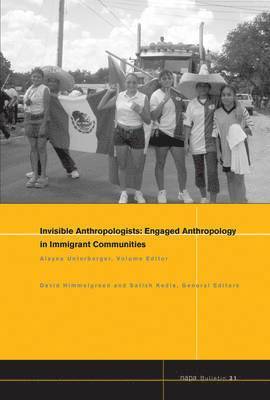
Invisible Anthropologists
Engaged Anthropology in Immigrant Communities
Häftad, Engelska, 2009
241 kr
Tillfälligt slut
Anthropology is generally thought of as the study of exotic peoples in far-away lands. However, anthropologists have a long history of less exotic, applied “get-your-hands-dirty work.” As a nation of immigrants, the United States has enjoyed a reputation as a model for democracy and a place where newcomers’ dreams can come true. As such, this Bulletin could only have been written in the United States, home to so many immigrants from so many lands, who adapt in different and unique ways to form what we consider the nation. Comparatively little has been written about anthropologists engaged with immigrant communities. In fact, it is somewhat shocking that anthropologists—and historians—seem to have forgotten to document this important contribution to the extent that we have documented our far-away travels and studies. This Bulletin is one such attempt. In it, we present a variety of perspectives, viewpoints, insights, and experiences of anthropologists who are actively engaged with immigrant communities across the United States, offering case studies from Florida, California, North Carolina, Texas, and Pennsylvania. Representing both university-based and NGO-based applied anthropologists, the authors discuss how deep, long-term engagement with immigrants has impacted our anthropological practice and how it in turn has shaped both theory and praxis. We share the personal and the professional, our challenges and our successes. The authors explore the nuances of our simultaneous, multiple roles vis-à-vis the immigrants themselves, the consequences of generational changes within our immigrant populations and how state policies, migration shifts and post-9/11 group responses have affected both our work and our multiple roles with communities. We present recommendations, lessons learned and future opportunities for U.S.-based anthropologists working with our unique brand of “exotic”—mainly Mexican and Latin American immigrants in 21st-century United States.
Del 33 - NAPA Bulletin
Intersections of Faith and Development in Local and Global Contexts
Häftad, Engelska, 2010
259 kr
Tillfälligt slut
Focuses on anthropological analyses of and engagements with Christian faith-based organizations (FBOs).Examines the varied and shifting meanings of religiosity, volunteerism, "doing good," development, charity, and justiceCalls for a greater understanding of the macro-level promises and pitfalls of increasing reliance on FBOs to design and deliver social services and developmentRedresses the imbalance of anthropological studies that have focused on the role of secular NGOs
300 kr
Skickas inom 11-20 vardagar
In this volume of the NAPA Bulletin, practicing and applied anthropologists along with colleagues in public health examine the interactions of health and migrations in diverse settings around the world. Contributors draw on diverse theoretical and methodological perspectives to examine the various ways in which migration impacts on the health and well-being of migrants.
229 kr
Tillfälligt slut
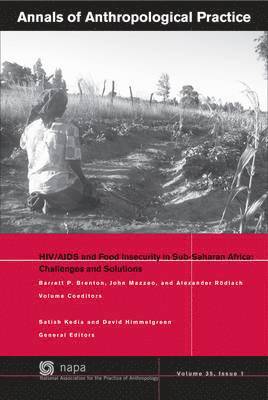
This collection of 14 chapters brings together a wide array of applied anthropologists, other social scientists, and practitioners to detail the ways in which public health measures can be effectively integrated with HIV/AIDS prevention, anti-retroviral treatment, and food security efforts in sub-Saharan Africa.