David Hochfelder - Böcker
Visar alla böcker från författaren . Handla med fri frakt och snabb leverans.
5 produkter
5 produkter
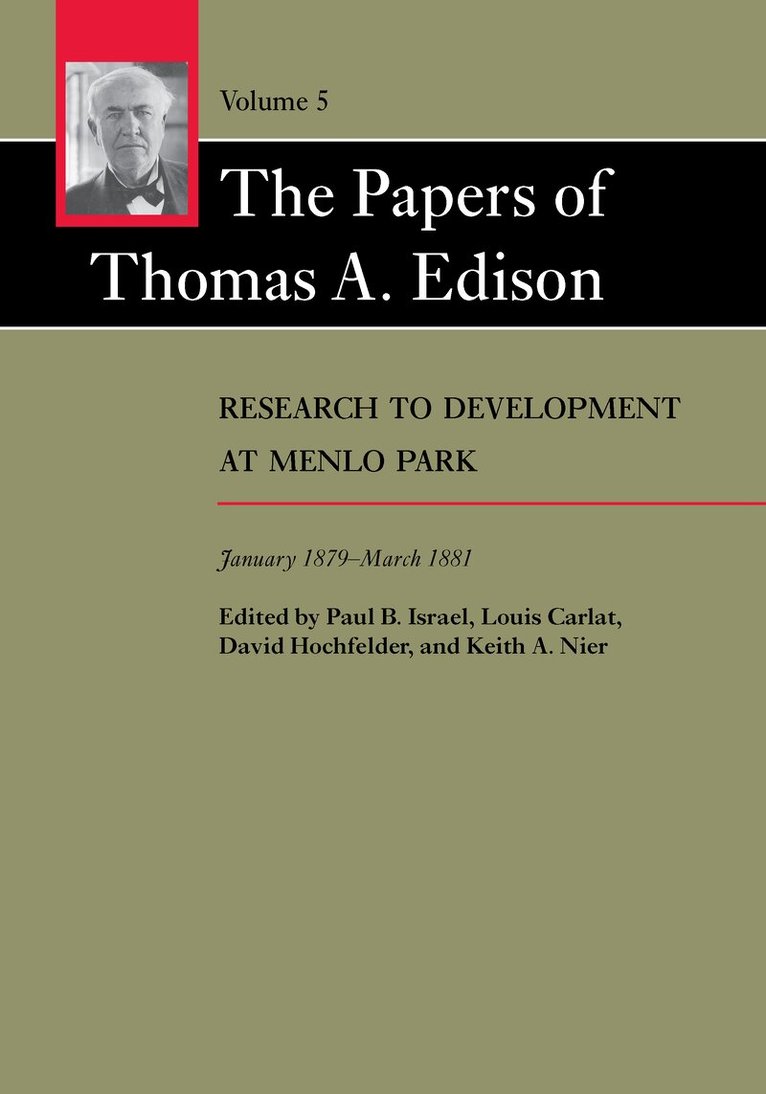
Papers of Thomas A. Edison
Research to Development at Menlo Park, January 1879-March 1881
Inbunden, Engelska, 2005
1 172 kr
Skickas inom 7-10 vardagar
The fifth volume of The Papers of Thomas A. Edison covers Edison's invention and development of the first commercial incandescent electric light and power system. In the process he turned his famed Menlo Park laboratory into the first true research and development facility. This also enabled him to develop a new telephone for the British market in the midst of his herculean efforts on electric lighting. In the face of daunting technical challenges and skepticism from leading scientists and engineers, Edison and his team of experimenters and machinists found the solution to the decades-old problem of creating a practical incandescent lamp. By focusing on the characteristics of the entire system Edison reconceptualized the requirements of a successful lamp design. While rivals worked primarily on lamps, Edison developed other parts of a complete system as well. This approach was most notable in his revolutionary work on generator technology, one of the highlights of this volume. Successful exhibitions of the system in December 1879 drew crowds to Menlo Park to witness the softly glowing lamps.These spectacles gratified his financial backers but Edison realized the importance of following experimental demonstrations with the hard work of commercial development. He needed to make each component work effectively in daily use and to improve the designs so that they were easy to use and inexpensive to manufacture. To create a daytime market for electricity he also developed electric motors for a variety of uses, including electric railways, for which he built a small demonstration line at Menlo Park. To accomplish all this Edison greatly enlarged his staff to as many as sixty experimenters, machinists, carpenters, and office workers. He began manufacturing lamps at a factory in Menlo Park. At the end of 1880, Edison was ready to move his system into commercial production and made plans to produce other components in New York. He also invited New York officials to a demonstration in order to win their approval for running underground lines in lower Manhattan where he planned to put his first commercial central station.In March 1881, he moved to the Edison Electric Light Company's headquarters on Fifth Avenue and began the hard work of introducing the new electric light and power technology.
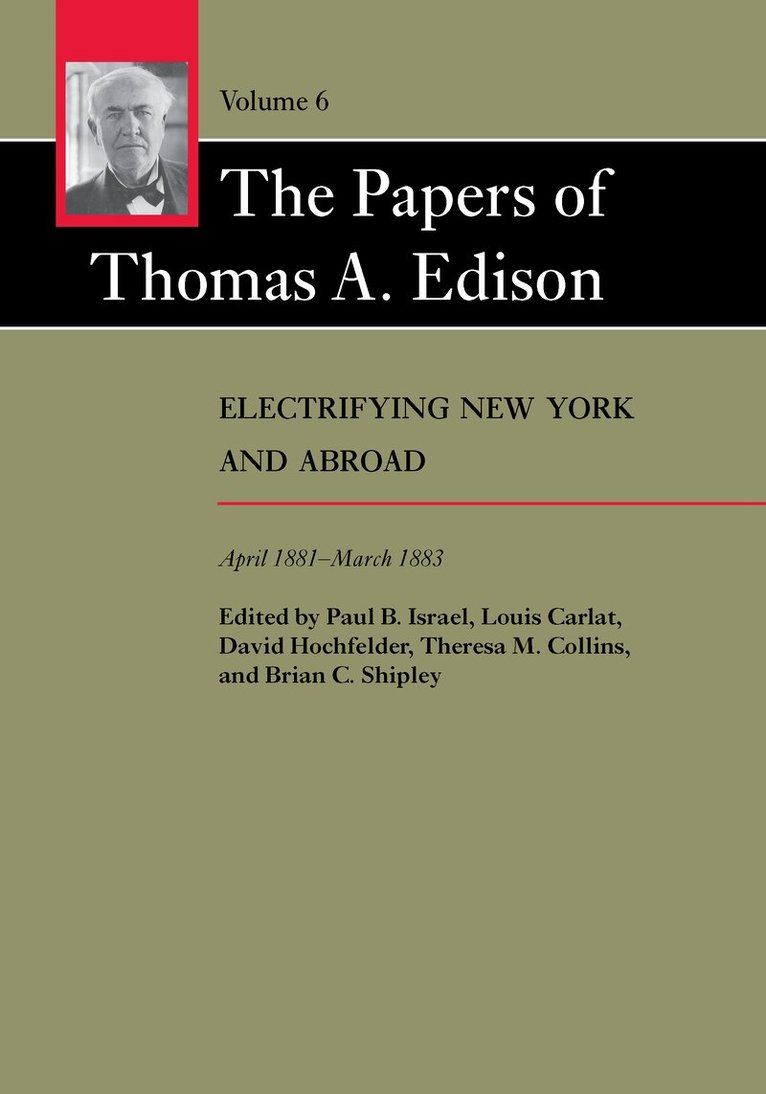
Papers of Thomas A. Edison
Electrifying New York and Abroad, April 1881–March 1883
Inbunden, Engelska, 2007
1 158 kr
Tillfälligt slut
With his move from Menlo Park, New Jersey, to New York City at the end of March 1881, Edison shifted his focus from research and development to the commercialization of his electric lighting system. This volume of The Papers of Thomas A. Edison chronicles Edison's central role in the enormous effort to manufacture, market, and install electric lighting systems in the United States and abroad. Standard studies of this period emphasize the inauguration of the commercial electric utility industry at the Pearl Street central station. Edison and his associates, however, audaciously operated on a global scale, not just focusing on the major cities of North America and Europe but reaching simultaneously from Appleton, Wisconsin, to Australia, through the Indian subcontinent and East Asia, to Central and South America. Praise for The Papers of Thomas A. Edison: "A mine of material...Scrupulously edited...No one could ask for more...A choplicking feast for future Edison biographers-well into the next century, and perhaps beyond."- Washington Post "What is most extraordinary about the collection isn't necessarily what it reveals about Edison's inventions...It's the insight into the process."- Associated Press "Those interested in America's technological culture can eagerly look forward to the appearance of each volume of the Edison Papers."- Technology and Culture "His lucidity comes through everywhere...His writing and drawing come together as a single, vigorous thought process."- New York Times "A triumph of the bookmaker's art, with splendidly arranged illustrations, essential background information, and cautionary reminders of the common sources on which Edison's imagination drew."- New York Review of Books "In the pages of this volume Edison the man, his work, and his times come alive...A delight to browse through or to read carefully."- Science "Beyond its status as the resource for Edison studies, providing a near inexhaustible supply of scholarly fodder, this series...will surely become a model for such projects in the future...The sheer diversity of material offered here refreshingly transcends any exclusive restriction to Edisonia."- British Journal for the History of Science
981 kr
Tillfälligt slut
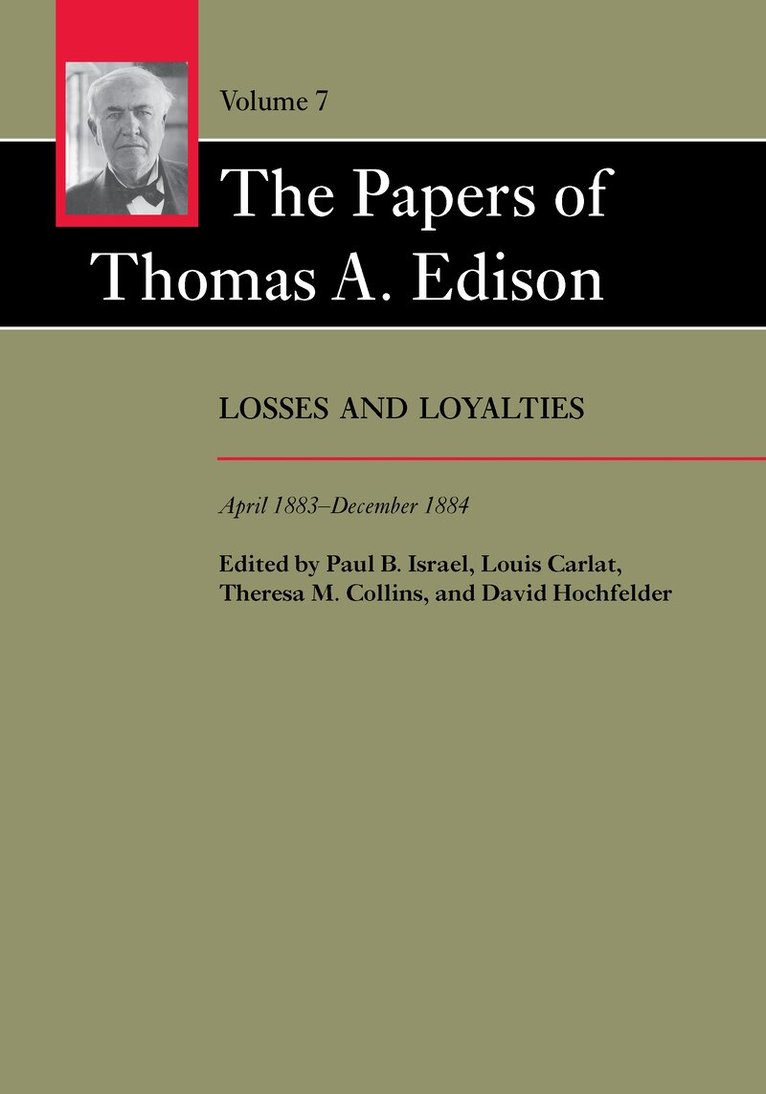
Seeking to replicate the success of his New York electric central station throughout the United States and in Europe and Latin America, Thomas A. Edison vowed to become a "business man for a year." This bold decision began a remarkable transition period for America's greatest inventive thinker. The seventh volume of Edison's papers chronicles the profound changes in his professional and personal life, including the unexpected death of his wife. It concludes with Edison returning to the laboratory to develop new communications technology.
765 kr
Skickas inom 5-8 vardagar
Telegraphy in the nineteenth century approximated the internet in our own day. Historian and electrical engineer David Hochfelder offers readers a comprehensive history of this groundbreaking technology, which employs breaks in an electrical current to send code along miles of wire. The Telegraph in America, 1832-1920 examines the correlation between technological innovation and social change and shows how this transformative relationship helps us to understand and perhaps define modernity. The telegraph revolutionized the spread of information-speeding personal messages, news of public events, and details of stock fluctuations. During the Civil War, telegraphed intelligence and high-level directives gave the Union war effort a critical advantage. Afterward, the telegraph helped build and break fortunes and, along with the railroad, altered the way Americans thought about time and space. With this book, Hochfelder supplies us with an introduction to the early stirrings of the information age.
422 kr
Skickas inom 5-8 vardagar
Telegraphy in the nineteenth century approximated the internet in our own day. Historian and electrical engineer David Hochfelder offers readers a comprehensive history of this groundbreaking technology, which employs breaks in an electrical current to send code along miles of wire. The Telegraph in America, 1832-1920 examines the correlation between technological innovation and social change and shows how this transformative relationship helps us to understand and perhaps define modernity. The telegraph revolutionized the spread of information-speeding personal messages, news of public events, and details of stock fluctuations. During the Civil War, telegraphed intelligence and high-level directives gave the Union war effort a critical advantage. Afterward, the telegraph helped build and break fortunes and, along with the railroad, altered the way Americans thought about time and space. With this book, Hochfelder supplies us with an introduction to the early stirrings of the information age.