David Leiser - Böcker
Visar alla böcker från författaren . Handla med fri frakt och snabb leverans.
3 produkter
3 produkter
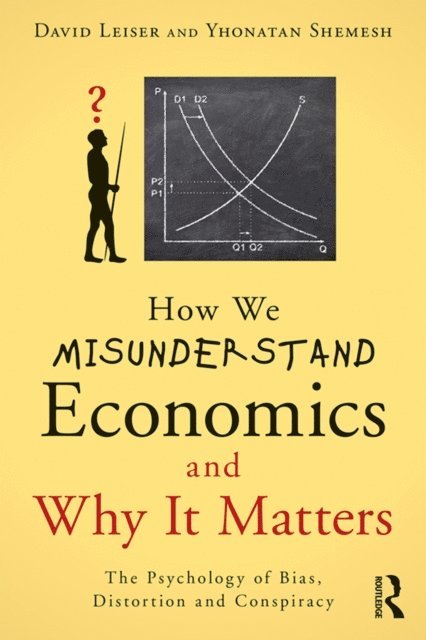
How We Misunderstand Economics and Why it Matters
The Psychology of Bias, Distortion and Conspiracy
Inbunden, Engelska, 2018
2 053 kr
Skickas inom 10-15 vardagar
This is the first book to explain why people misunderstand economics. From the cognitive shortcuts we use to make sense of complex information, to the metaphors we rely on and their effect on our thinking, this important book lays bare not only the psychological traits that distort our ability to understand such a vital topic, but also what this means for policy makers and civil society more widely.Accessibly written, the book explores the mismatch between the complexities of economics and the constraints of human cognition that lie at the root of our misconceptions. The authors document and explain the gamut of cognitive strategies laypeople employ as they grapple with such complex topics as inflation, unemployment, economic crises, finance, and money in the modern economy. The book examines sources of misconceptions ranging from the intentionality fallacy, whereby economic phenomena are assumed to have been caused deliberately rather than to have come about by an interplay of many agents and causal factors, to the role of ideology in framing economic thinking.Exposing the underlying biases and assumptions that undermine financial and economic literacy, and concluding with recommendations for how policies and ideas should be framed to enable a clearer understanding, this will be essential reading not only for students and researchers across psychology and economics, but also anyone interested in progressive public policy.Visit the associated website for the book here: http://www.misunderstandeconomics.com/
How We Misunderstand Economics and Why it Matters
The Psychology of Bias, Distortion and Conspiracy
Häftad, Engelska, 2018
561 kr
Skickas inom 10-15 vardagar
This is the first book to explain why people misunderstand economics. From the cognitive shortcuts we use to make sense of complex information, to the metaphors we rely on and their effect on our thinking, this important book lays bare not only the psychological traits that distort our ability to understand such a vital topic, but also what this means for policy makers and civil society more widely.Accessibly written, the book explores the mismatch between the complexities of economics and the constraints of human cognition that lie at the root of our misconceptions. The authors document and explain the gamut of cognitive strategies laypeople employ as they grapple with such complex topics as inflation, unemployment, economic crises, finance, and money in the modern economy. The book examines sources of misconceptions ranging from the intentionality fallacy, whereby economic phenomena are assumed to have been caused deliberately rather than to have come about by an interplay of many agents and causal factors, to the role of ideology in framing economic thinking.Exposing the underlying biases and assumptions that undermine financial and economic literacy, and concluding with recommendations for how policies and ideas should be framed to enable a clearer understanding, this will be essential reading not only for students and researchers across psychology and economics, but also anyone interested in progressive public policy.Visit the associated website for the book here: http://www.misunderstandeconomics.com/
519 kr
Skickas inom 10-15 vardagar
Some 10 years ago, Leo Apostel presented an analysis of developments taking place in genetic epistemology and artificial intelligence, and re- marked that the two disciplines appeared to be converging, without one dominating or assimilating the other. In his view, significant formal and experimental progress would be required in the post-Piagetian era: ge- netic epistemology would need to take into account developments in artificial intelligence, while remaining an independent discipline at the frontiers of biology, logic, and psychology. The work of David Leiser and Christiane Gillieron, both psychol- ogists with a Genevan training who are concerned by the procedural aspects of intelligence, is an important contribution. Their studies, which open up new theoretical perspectives, are carried out with metic- ulous attention to research methodology. Going beyond merely ad- dressing criticisms about the status of Piagetian operational structures, their work will help fill the gap between genetic epistemology and cog- nitive science.