David M. Carballo - Böcker
Visar alla böcker från författaren David M. Carballo. Handla med fri frakt och snabb leverans.
9 produkter
9 produkter
1 056 kr
Skickas inom 5-8 vardagar
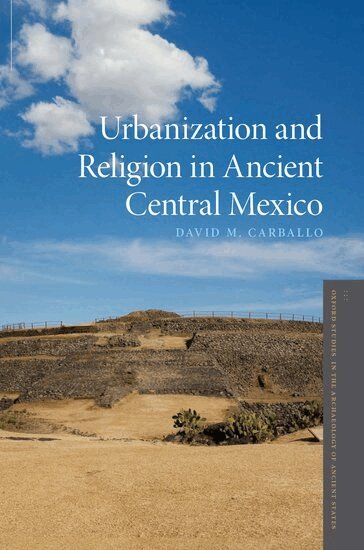
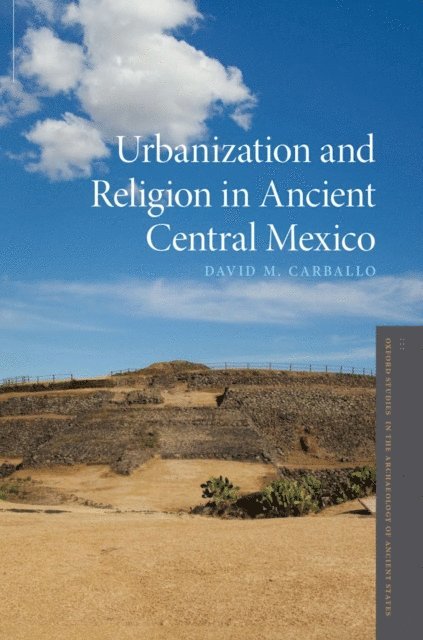
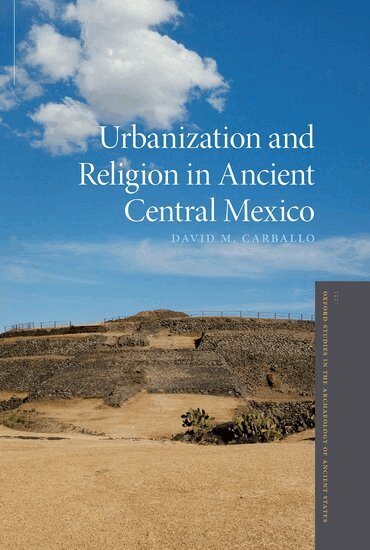
Urbanization and Religion in Ancient Central Mexico examines the ways in which urbanization and religion intersected in pre-Columbian central Mexico, with a primary focus on the later Formative period and the transition to the Classic period. The major societal transformations of this interval occurred approximately two-thousand years ago and over a millennium before Mexico's best known early civilization, the Aztecs. David M. Carballo presents a synthesis of data from regional archaeological projects and key sites such as Teotihuacan and Cuicuilco, while relying on the author's own excavations at the site of La Laguna as the central case study. A principal argument is that cities and states developed hand in hand with elements of a religious tradition of remarkable endurance and that these processes were fundamentally entangled. Prevalent religious beliefs and ritual practices created a cultural logic for urbanism, and as populations urbanized they became socially integrated and differentiated following this logic. Nevertheless, religion was used differently over time and by groups and individuals across the spectra of urbanity and social status. This book calls for a materially informed history of religion, with the temporal depth that archaeology can provide, and an archaeology of cities that considers religion seriously as a generative force in societal change.
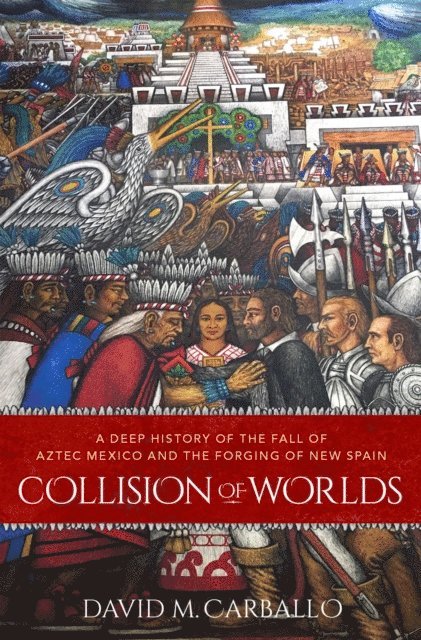
Collision of Worlds
A Deep History of the Fall of Aztec Mexico and the Forging of New Spain
Inbunden, Engelska, 2020
446 kr
Skickas inom 5-8 vardagar
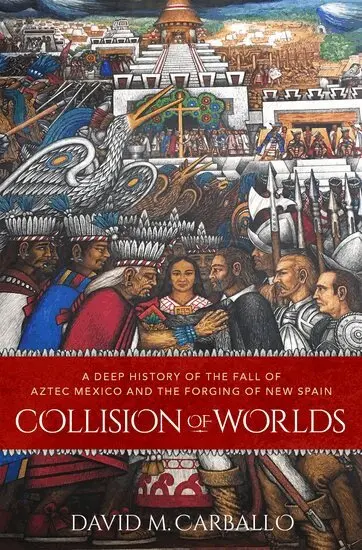
Mexico of five centuries ago was witness to one of the most momentous encounters between human societies, when a group of Spaniards led by Hernando Cortés joined forces with tens of thousands of Mesoamerican allies to topple the mighty Aztec Empire. It served as a template for the forging of much of Latin America and initiated the globalized world we inhabit today. The violent clash that culminated in the Aztec-Spanish war of 1519-21 and the new colonial order it created were millennia in the making, entwining the previously independent cultural developments of both sides of the Atlantic.Collision of Worlds provides a deep history of this encounter, one that considers temporal depth in the richly layered cultures of Mexico and Spain, from their prehistories to the urban and imperial societies they built in the fourteenth and fifteenth centuries. Leading Mesoamerican archaeologist David Carballo offers a unique perspective on these fabled events with a focus on the physical world of places and things, their similarities and differences in trans-Atlantic perspective, and their interweaving in an encounter characterized by conquest and colonialism, but also resilience on the part of Native peoples. An engrossing and sweeping account, Collision of Worlds debunks long-held myths and contextualizes the deep roots and enduring consequences of the Aztec-Spanish conflict as never before.
503 kr
Skickas inom 5-8 vardagar
Urbanization and Religion in Ancient Central Mexico examines the ways in which urbanization and religion intersected in pre-Columbian central Mexico, with a primary focus on the later Formative period and the transition to the Classic period. The major societal transformations of this interval occurred approximately two-thousand years ago and over a millennium before Mexico's best known early civilization, the Aztecs. David M. Carballo presents a synthesis of data from regional archaeological projects and key sites such as Teotihuacan and Cuicuilco, while relying on his own excavations at the site of La Laguna as the central case study. A principal argument is that cities and states developed hand in hand with elements of a religious tradition of remarkable endurance and that these processes were fundamentally entangled. Prevalent religious beliefs and ritual practices created a cultural logic for urbanism, and as populations urbanized they became socially integrated and differentiated following this logic. Nevertheless, religion was used differently over time and by groups and individuals across the spectra of urbanity and social status. The book provides a materially informed history of religion, with the temporal depth that archaeology can provide, and an archaeology of cities that considers religion seriously as a generative force in societal change.
Collision of Worlds
A Deep History of the Fall of Aztec Mexico and the Forging of New Spain
Häftad, Engelska, 2022
270 kr
Skickas inom 7-10 vardagar
Mexico of five centuries ago was witness to one of the most momentous encounters between human societies, when a group of Spaniards led by Hernando Cortés joined forces with tens of thousands of Mesoamerican allies to topple the mighty Aztec Empire. It served as a template for the forging of much of Latin America and initiated the globalized world we inhabit today. The violent clash that culminated in the Aztec-Spanish war of 1519-21 and the new colonial order it created were millennia in the making, entwining the previously independent cultural developments of both sides of the Atlantic.Collision of Worlds provides a deep history of this encounter, one that considers temporal depth in the richly layered cultures of Mexico and Spain, from their prehistories to the urban and imperial societies they built in the fourteenth and fifteenth centuries. Leading Mesoamerican archaeologist David Carballo offers a unique perspective on these fabled events with a focus on the physical world of places and things, their similarities and differences in trans-Atlantic perspective, and their interweaving in an encounter characterized by conquest and colonialism, but also resilience on the part of Native peoples. An engrossing and sweeping account, Collision of Worlds debunks long-held myths and contextualizes the deep roots and enduring consequences of the Aztec-Spanish conflict as never before.
Del 37 - Dumbarton Oaks Pre-Columbian Symposia and Colloquia
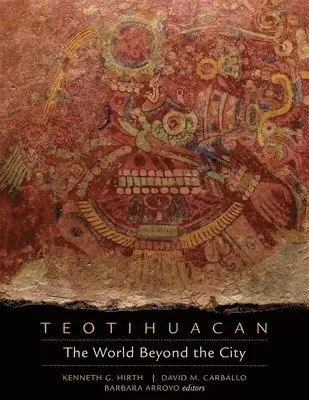
Teotihuacan
The World Beyond the City
Inbunden, Engelska, 2020
625 kr
Skickas inom 7-10 vardagar
241 kr
Skickas inom 7-10 vardagar
In considering the long trajectory of human societies, researchers have too often favored models of despotic control by the few or structural models that fail to grant agency to those with less power in shaping history. Recent scholarship demonstrates such models to be not only limiting but also empirically inaccurate. This Element reviews archaeological approaches to collective action drawing on theoretical perspectives from across the globe and case studies from prehispanic Mesoamerica. It highlights how institutions and systems of governance matter, vary over space and time, and can oscillate between more pluralistic and more autocratic forms within the same society, culture, or polity. The historical coverage examines resource dilemmas and ways of mediating them, how ritual and religion can foster both social solidarity and hierarchy, the political financing of institutions and variability in forms of governance, and lessons drawn to inform the building of more resilient communities in the present.
775 kr
Skickas inom 7-10 vardagar
In considering the long trajectory of human societies, researchers have too often favored models of despotic control by the few or structural models that fail to grant agency to those with less power in shaping history. Recent scholarship demonstrates such models to be not only limiting but also empirically inaccurate. This Element reviews archaeological approaches to collective action drawing on theoretical perspectives from across the globe and case studies from prehispanic Mesoamerica. It highlights how institutions and systems of governance matter, vary over space and time, and can oscillate between more pluralistic and more autocratic forms within the same society, culture, or polity. The historical coverage examines resource dilemmas and ways of mediating them, how ritual and religion can foster both social solidarity and hierarchy, the political financing of institutions and variability in forms of governance, and lessons drawn to inform the building of more resilient communities in the present.
965 kr
Tillfälligt slut
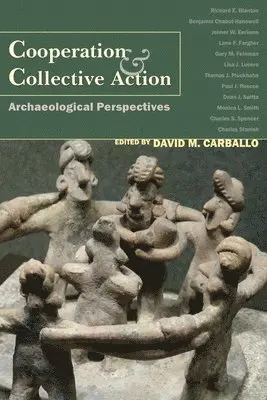
Past archaeological literature on cooperation theory has emphasized competition's role in cultural evolution. As a result, bottom-up possibilities for group cooperation have been under theorized in favor of models stressing top-down leadership, while evidence from a range of disciplines has demonstrated humans to effectively sustain cooperative undertakings through a number of social norms and institutions. Cooperation and Collective Action is the first volume to focus on the use of archaeological evidence to understand cooperation and collective action.Disentangling the motivations and institutions that foster group cooperation among competitive individuals remains one of the few great conundrums within evolutionary theory. The breadth and material focus of archaeology provide a much needed complement to existing research on cooperation and collective action, which thus far has relied largely on game-theoretic modeling, surveys of college students from affluent countries, brief ethnographic experiments, and limited historic cases. In Cooperation and Collective Action, diverse case studies address the evolution of the emergence of norms, institutions, and symbols of complex societies through the last 10,000 years. This book is an important contribution to the literature on cooperation in human societies that will appeal to archaeologists and other scholars interested in cooperation research.
827 kr
Tillfälligt slut
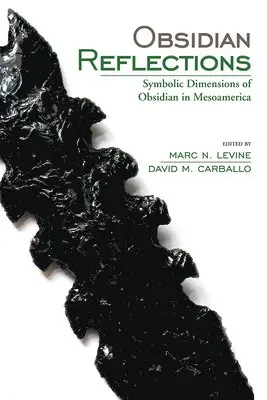
Departing from the political economy perspective taken by the vast majority of volumes devoted to Mesoamerican obsidian, Obsidian Reflections is an examination of obsidian's sociocultural dimensions—particularly in regard to Mesoamerican world view, religion, and belief systems. Exploring the materiality of this volcanic glass rather than only its functionality, this book considers the interplay among people, obsidian, and meaning and how these relationships shaped patterns of procurement, exchange, and use. An international group of scholars hailing from Belize, France, Japan, Mexico, and the United States provides a variety of case studies from Mexico, Guatemala, Belize, and Honduras. The authors draw on archaeological, iconographic, ethnographic, and ethnohistoric data to examine obsidian as a touchstone for cultural meaning, including references to sacrificial precepts, powerful deities, landscape, warfare, social relations, and fertility.Obsidian Reflections underscores the necessity of understanding obsidian from within its cultural context—the perspective of the indigenous people of Mesoamerica. It will be of great interest to Mesoamericanists as well as students and scholars of lithic studies and material culture.