David Makinson – författare
Visar alla böcker från författaren David Makinson. Handla med fri frakt och snabb leverans.
8 produkter
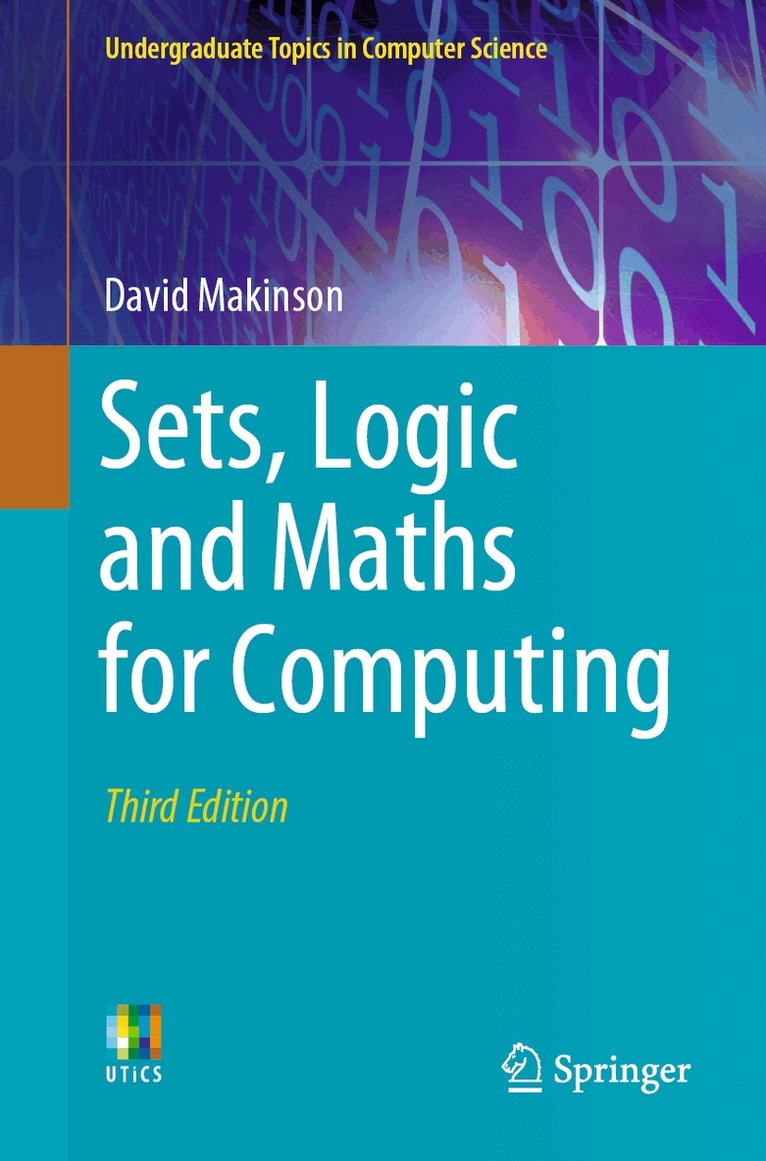
Sets, Logic and Maths for Computing
Häftad, 2020
390 kr
Lägg i varukorg
This easy-to-understand textbook introduces the mathematical language and problem-solving tools essential to anyone wishing to enter the world of computer and information sciences. Specifically designed for the student who is intimidated by mathematics, the book offers a concise treatment in an …
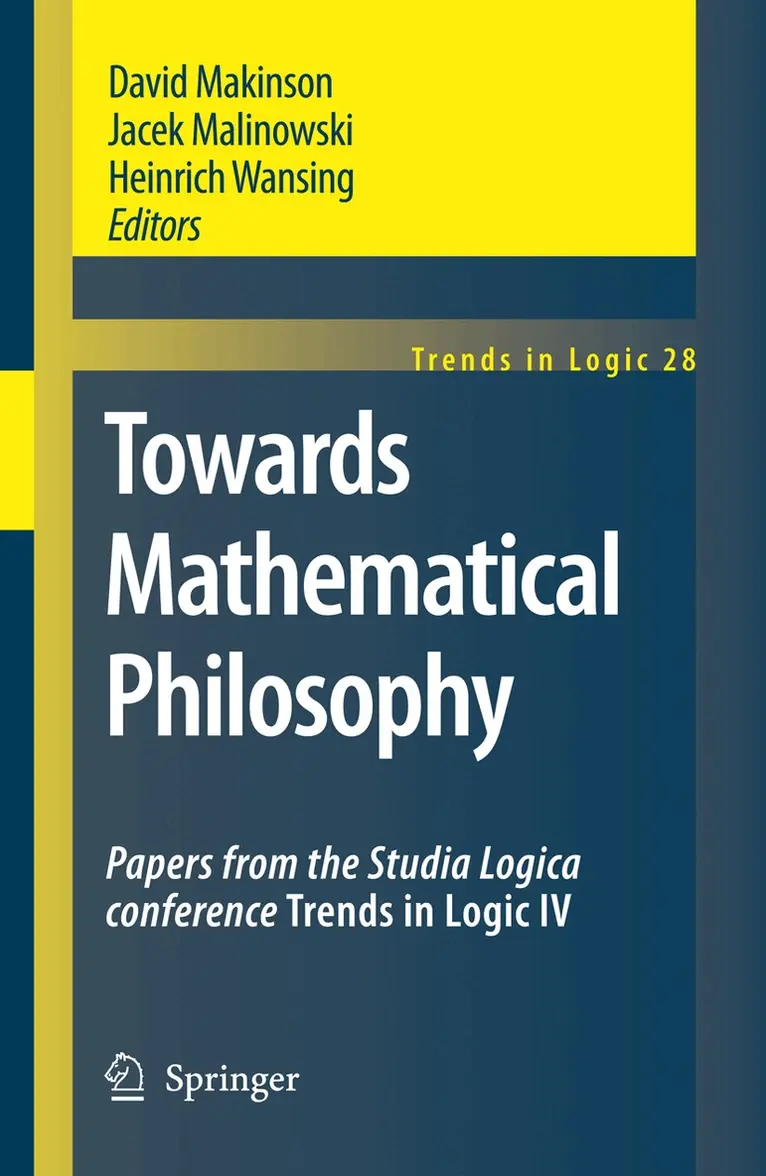
Towards Mathematical Philosophy
Papers from the Studia Logica conference Trends in Logic IV
Av David Makinson, Jacek Malinowski m. fl.
Inbunden, 2008
1641 kr
Lägg i varukorg
area and in applications to linguistics, formal epistemology, and the study of norms. The second contains papers on non-classical and many-valued logics, with an eye on applications in computer science and through it to engineering. The third concerns the logic of belief management,whichis likewise …
Towards Mathematical Philosophy
Papers from the Studia Logica conference Trends in Logic IV
Av Heinrich Wansing, Jacek Malinowski m. fl.
E-bok, 2008
2111 kr
Lägg i varukorg
area and in applications to linguistics, formal epistemology, and the study of norms. The second contains papers on non-classical and many-valued logics, with an eye on applications in computer science and through it to engineering. The third concerns the logic of belief management,whichis likewise …
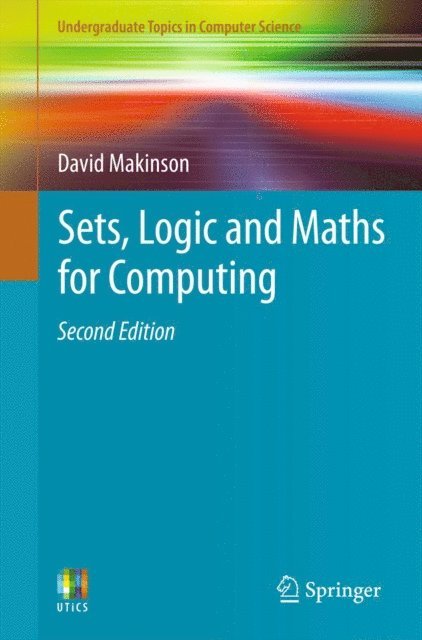
Sets, Logic and Maths for Computing
E-bok, 2012
440 kr
Lägg i varukorg
This easy-to-follow textbook introduces the mathematical language, knowledge and problem-solving skills that undergraduates need to study computing. The language is in part qualitative, with concepts such as set, relation, function and recursion/induction; but it is also partly quantitative, with …
Sets, Logic and Maths for Computing
E-bok, 2009
431 kr
Lägg i varukorg
The first part of this preface is for the student; the second for the instructor. But whoever you are, welcome to both parts. For the Student You have finished secondary school, and are about to begin at a university or technical college. You want to study computing. The course includes some …
Sets, Logic and Maths for Computing
E-bok, 2020
710 kr
Lägg i varukorg
This easy-to-understand textbook introduces the mathematical language and problem-solving tools essential to anyone wishing to enter the world of computer and information sciences. Specifically designed for the student who is intimidated by mathematics, the book offers a concise treatment in an …
Towards Mathematical Philosophy
Papers from the Studia Logica conference Trends in Logic IV
Av David Makinson, Jacek Malinowski m. fl.
Häftad, 2010
1641 kr
Lägg i varukorg
area and in applications to linguistics, formal epistemology, and the study of norms. The second contains papers on non-classical and many-valued logics, with an eye on applications in computer science and through it to engineering. The third concerns the logic of belief management,whichis likewise …