David N. Lorenzen - Böcker
Visar alla böcker från författaren David N. Lorenzen. Handla med fri frakt och snabb leverans.
6 produkter
6 produkter
382 kr
Tillfälligt slut
This book represents the first systematic collection and analysis of the principal legends about Kabir Das, a fifteenth-century poet-saint. It focuses on the ways in which the legends embody and reflect the often changing social and religious needs of those who created and listened to them. Particular attention is paid to the earliest known collection of legends, Ananta-das's Kabir Parachai. This book makes available for the first time an English translation of this text, with detailed notes on its variant readings, as well as a corrected Hindi edition based on a comparison of over a dozen manuscripts. The various historical synchronisms between Kabir and his leading contemporaries, including Ramananda and King Virasimhadev Baghel, are reevaluated, and a solution is proposed to the longstanding debate about Kabir's dates.
402 kr
Tillfälligt slut
In India, religion continues to be an absolutely vital source for social as well as personal identity. All manner of groups—political, occupational, and social—remain grounded in specific religious communities. This book analyzes the development of the modern Hindu and Sikh communities in North India starting from about the fifteenth century, when the dominant bhakti tradition of Hinduism became divided into two currents: the sagun and the nirgun.The sagun current, led mostly by Brahmins, has remained dominant in most of North India and has served as the ideological base of the development of modern Hindu nationalism. Several chapters explore the rise of this religious and political movement, paying particular attention to the role played by devotion to Ram. Alternative trends do exist in sagun tradition, however, and are represented here by chapters on the low-caste saint Chokhamel and the tantric sect founded by Kina Ram.The nirgun current, led mostly by persons of Ksand artisan castes, formed the base of both the Sikh community, founded by Guru Nanak, and of various non-Brahmin sectarian movements derived from such saints as Kabir, Raidas, Dadu, and Shiv Dayal Singh. Two chapters discuss the formation of a distinctive Sikh theology and a Sikh community identity separate from that of the Hindus. Other chapters discuss the validity of the sagun-nirgun distinction within Hindu tradition and the interplay of social and religious ideas in nirgun hagiographic texts and in sectarian movements such as the Adi Dharma Mission and the Radhasoami Satsang.
463 kr
Tillfälligt slut
Discusses and translates important compositions by famous Nirguni poets—poets dedicated to the worship of a formless God.Nirguṇ bhakti—devotion to a formless God—has been called a logical absurdity, yet the songs, verses, and narratives of the nirgun poets of North India have played a vital role in both Hinduism and Sikhism since the late fifteenth century. The compositions of famous nirguṇī poets such as Kabīr, Raidās, Guru Nānak, and Dādu Dayal also form an essential part of the vernacular literatures of North India.Other nirguṇī poets have made major religious and literary contributions to Indian culture but have been little studied by modern scholars. This book discusses, translates, and edits various important compositions by these poets. The texts include songs and narratives about the pious demon Prahlād, hagiographic songs about historical saints, the popular bhajans attributed to Kabīr, and the songs sung during the rites of the Kabir Panth. Two longer texts presented here are Jan Gopāl's narrative poem, the Prahilād charitra, and Sain's religious debate, the Kabīr-Raidās kā samvād.
353 kr
Skickas inom 11-20 vardagar
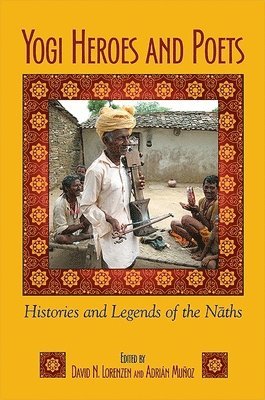
An exploration of the history, religion, and folklore of the Nāths, a Hindu lineage known for Hatha yoga practice.This book provides a remarkable range of information on the history, religion, and folklore of the Nāth Yogis. A Hindu lineage prominent in North India since the eleventh century, Nāths are well-known as adepts of Hatha yoga and alchemical practices said to increase longevity. Long a heterogeneous group, some Nāths are ascetics and some are householders; some are dedicated to personified forms of Shiva, others to a formless god, still others to Vishnu.The essays in the first part of the book deal with the history and historiography of the Nāths, their literature, and their relationships with other religious movements in India. Essays in the second part discuss the legends and folklore of the Nāths and provide an exploration of their religious ideas. Contributors to the volume depict a variety of local areas where this lineage is prominent and highlight how the Nāths have been a link between religious, metaphysical, and even medical traditions in India.
989 kr
Skickas inom 7-10 vardagar
An exploration of the history, religion, and folklore of the Nāths, a Hindu lineage known for Hatha yoga practice.This book provides a remarkable range of information on the history, religion, and folklore of the Nāth Yogis. A Hindu lineage prominent in North India since the eleventh century, Nāths are well-known as adepts of Hatha yoga and alchemical practices said to increase longevity. Long a heterogeneous group, some Nāths are ascetics and some are householders; some are dedicated to personified forms of Shiva, others to a formless god, still others to Vishnu.The essays in the first part of the book deal with the history and historiography of the Nāths, their literature, and their relationships with other religious movements in India. Essays in the second part discuss the legends and folklore of the Nāths and provide an exploration of their religious ideas. Contributors to the volume depict a variety of local areas where this lineage is prominent and highlight how the Nāths have been a link between religious, metaphysical, and even medical traditions in India.
898 kr
Skickas inom 7-10 vardagar
In India, religion continues to be an absolutely vital source for social as well as personal identity. All manner of groups – political, occupational, and social – remain grounded in specific religious communities. This book analyses the development of the modern Hindu and Sikh communities in north India starting from about the fifteenth century, when the dominant bhakti tradition of Hinduism became divided into two currents: the saguni and the nirguni. The sagu]ni current, led mostly by Brahmins, has remained dominant in most of north India and has served as the ideological base of the development of modern Hindu nationalism. Several chapters explore the rise of this religious and political movement paying particular attention to the role played by devotion to Ram.