David Ost - Böcker
Visar alla böcker från författaren David Ost. Handla med fri frakt och snabb leverans.
5 produkter
5 produkter
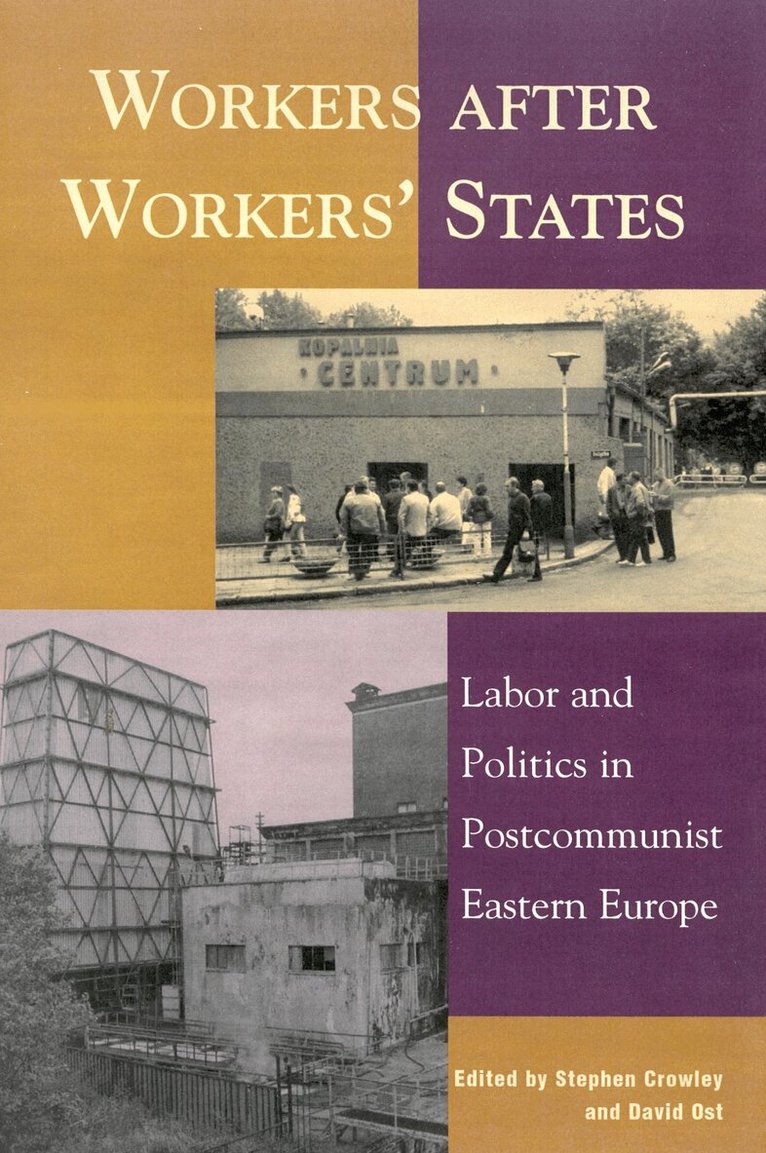
Workers after Workers' States
Labor and Politics in Postcommunist Eastern Europe
Häftad, Engelska, 2001
675 kr
Skickas inom 10-15 vardagar
After decades as the official "ruling class" of ostensible "workers' states," labor in Eastern Europe has fallen dramatically. Although the painful consequences of market transformation have hit workers hardest of all, protests have been surprisingly few and ineffective. More than ten years after the start of the transition, trade unions are among the weakest institutions of postcommunist society, unable to influence policymaking or secure material rewards for workers. Why, given unprecedented political freedoms coupled with such adverse economic change, has labor been so quiescent since the fall of communism in Eastern Europe? And what are the political consequences of that weakness for societies trying to build lasting democracies?This book, through the use of comparative case studies, explores the causes, extent, significance, and implications of this weakness. The ten cases-Bulgaria, Croatia, the Czech Republic, Hungary, Poland, Romania, Russia, Serbia, Slovakia, and Ukraine-focus on the status of trade unions and the relationship between labor and politics in each country. Comprising a full array of postcommunist societies, these countries represent a wide variation in labor institutions, political experiences, and economic outcomes. In their introduction and conclusion the editors consider structural, sociological, and ideational explanations for labor decline in the postcommunist era and assess the impact of that weakness on the consolidation of democracy in the region.
672 kr
Skickas inom 10-15 vardagar
How did the fall of communism and the subsequent transition to capitalism in Eastern Europe affect the people who experienced it? And how did their anger affect the quality of the democratic systems that have emerged? Poland offers a particularly provocative case, for it was here where workers most famously seemed to have won, thanks to the role of the Solidarity trade union. And yet, within a few short years, they had clearly lost. An oppressive communist regime gave way to a capitalist society that embraced economic and political inequality, leaving many workers frustrated and angry. Their leaders first ignored them, then began to fear them, and finally tried to marginalize them. In turn, workers rejected their liberal leaders, opening the way for right-wing nationalists to take control of Solidarity.Ost tells a fascinating story about the evolution of postcommunist society in Eastern Europe. Informed by years of fieldwork in Polish factory towns, scores of interviews with workers, labor activists, and politicians, and an exhaustive reading of primary sources, his new book gives voice to those who have not been heard. But even more, Ost proposes a novel theory about the role of anger in politics to show why such voices matter, and how they profoundly affect political outcomes. Drawing on Poland's experiences, Ost describes lessons relevant to democratization throughout Eastern Europe and to democratic theory in general.
281 kr
Skickas inom 10-15 vardagar
How did the fall of communism and the subsequent transition to capitalism in Eastern Europe affect the people who experienced it? And how did their anger affect the quality of the democratic systems that have emerged? Poland offers a particularly provocative case, for it was here where workers most famously seemed to have won, thanks to the role of the Solidarity trade union. And yet, within a few short years, they had clearly lost. An oppressive communist regime gave way to a capitalist society that embraced economic and political inequality, leaving many workers frustrated and angry. Their leaders first ignored them, then began to fear them, and finally tried to marginalize them. In turn, workers rejected their liberal leaders, opening the way for right-wing nationalists to take control of Solidarity.Ost tells a fascinating story about the evolution of postcommunist society in Eastern Europe. Informed by years of fieldwork in Polish factory towns, scores of interviews with workers, labor activists, and politicians, and an exhaustive reading of primary sources, his new book gives voice to those who have not been heard. But even more, Ost proposes a novel theory about the role of anger in politics to show why such voices matter, and how they profoundly affect political outcomes. Drawing on Poland's experiences, Ost describes lessons relevant to democratization throughout Eastern Europe and to democratic theory in general.
Solidarity and the Politics of Anti-Politics
Opposition and Reform in Poland Since 1968
Häftad, Engelska, 1991
361 kr
Skickas inom 7-10 vardagar
An analysis of Solidarity from it origins in the Polish "new left" to the union's resurgence in 1988-89
263 kr
Kommande
A smart and accessible dissection of twenty-first-century fascist politics, providing general readers with the tools to understand, and defeat, today’s resurgent far right “Fascism is the term that is everywhere and nowhere in contemporary political discussions.” —David OstAround the globe, far-right political parties and movements are on the march, stoking fears of the revival of fascism. What to make of this dangerous drift?In this masterly examination of far-right politics past and present, political scientist David Ost argues that in order to resist its revival, we must understand its often broad appeal, particularly to non-elites who have traditionally aligned with the Left. Ost shows that equating fascism only with violence and mass repression misses its distinctive populist elements, and thus keeps us from recognizing the dangers of a contemporary Right that, for now, downplays its repressive dimensions.Drawing on a wide range of contemporary and historical examples, Ost argues that both classic fascism and today’s right-wing populism should be seen as different versions of what he calls Red Pill Politics. Both promote authoritarian politics, intolerance, xenophobic outrage, and rigid gender roles. Yet they win support by speaking for the dissatisfied with anti-elitist rhetoric, while underemphasizing their repressive policies. They have their best chance of winning when the Left is failing.Red Pill Politics draws on meticulous historical research and deep familiarity with current global developments to present a startlingly original analysis that helps us understand and challenge today’s most pressing political threat.