David Pengelley - Böcker
Visar alla böcker från författaren David Pengelley. Handla med fri frakt och snabb leverans.
7 produkter
7 produkter
536 kr
Skickas inom 10-15 vardagar
Although teaching and learning with primary historical sources require a commitment of study, the investment yields the rewards of a deeper understanding of the subject, an appreciation of its details, and a glimpse into the direction research has taken.
536 kr
Skickas inom 10-15 vardagar
In introducing his essays on the study and understanding of nature and e- lution, biologist Stephen J. Gould writes: [W]e acquire a surprising source of rich and apparently limitless novelty from the primary documents of great thinkers throughout our history. But why should any nuggets, or even ?akes, be left for int- lectual miners in such terrain? Hasn’t the Origin of Species been read untold millions of times? Hasn’t every paragraph been subjected to overt scholarly scrutiny and exegesis? Letmeshareasecretrootedingeneralhumanfoibles. . . . Veryfew people, including authors willing to commit to paper, ever really read primary sources—certainly not in necessary depth and completion, and often not at all. . . . I can attest that all major documents of science remain cho- full of distinctive and illuminating novelty, if only people will study them—in full and in the original editions. Why would anyone not yearn to read these works; not hunger for the opportunity? [99, p. 6f] It is in the spirit of Gould’s insights on an approach to science based on p- mary texts that we o?er the present book of annotated mathematical sources, from which our undergraduate students have been learning for more than a decade. Although teaching and learning with primary historical sources require a commitment of study, the investment yields the rewards of a deeper understanding of the subject, an appreciation of its details, and a glimpse into the direction research has taken. Our students read sequences of primary sources.
536 kr
Skickas inom 10-15 vardagar
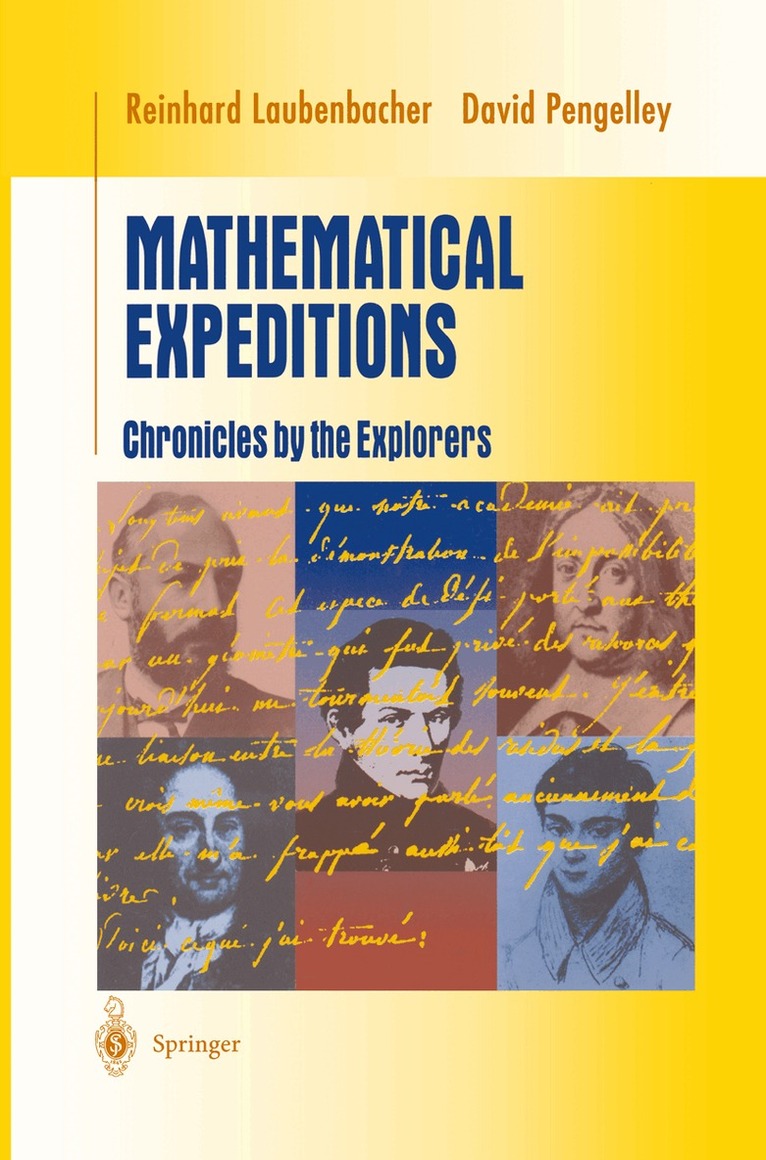
This book contains the stories of five mathematical journeys into new realms, told through the writings of the explorers themselves. Some were guided by mere curiosity and the thrill of adventure, while others had more practical motives. In each case the outcome was a vast expansion of the known mathematical world and the realization that still greater vistas remained to be explored. The authors tell these stories by guiding the reader through the very words of the mathematicians at the heart of these events, and thereby provide insight into the art of approaching mathematical problems. The book can be used in a variety of ways. The five chapters are completely independent, each with varying levels of mathematical sophistication. The book will be enticing to students, to instructors, and to the intellectually curious reader. By working through some of the original sources and supplemental exercises, which discuss and solve - or attempt to solve - a great problem, this book helps the reader discover the roots of modern problems, ideas, and concepts, even whole subjects. Students will also see the obstacles that earlier thinkers had to clear in order to make their respective contributions to five central themes in the evolution of mathematics.
536 kr
Skickas inom 10-15 vardagar
This book contains the stories of five mathematical journeys into new realms, told through the writings of the explorers themselves. Some were guided by mere curiosity and the thrill of adventure, while others had more practical motives. In each case the outcome was a vast expansion of the known mathematical world and the realization that still greater vistas remained to be explored. The authors tell these stories by guiding the reader through the very words of the mathematicians at the heart of these events, and thereby provide insight into the art of approaching mathematical problems. The book can be used in a variety of ways. The five chapters are completely independent, each with varying levels of mathematical sophistication. The book will be enticing to students, to instructors, and to the intellectually curious reader. By working through some of the original sources and supplemental exercises, which discuss and solve - or attempt to solve - a great problem, this book helps the reader discover the roots of modern problems, ideas, and concepts, even whole subjects. Students will also see the obstacles that earlier thinkers had to clear in order to make their respective contributions to five central themes in the evolution of mathematics.
Del 1 - Haiku
hAIku - AI Wisdom through Haiku
Volume 1 - Personal Responsibility from A to Z
Häftad, Engelska, 2023
218 kr
Skickas inom 5-8 vardagar
401 kr
Skickas inom 7-10 vardagar
Changing the way students learn calculus at New Mexico State University. In the Spring of 1988, Marcus Cohen, Edward D. Gaughan, Arthur Knoebel, Douglas S. Kurtz, and David Penegelley began work on a student project approach to calculus. For the next two years, most of their waking hours (and some of their dreams) would be devoted to writing projects for their students and discovering how to make the use of projects in calculus classes not only successful, but practical as well. A grant from the National Science Foundation made it possible for this experiment to go forward on a large scale. The enthusiasm of the original group of five faculty was contagious, and soon other members of the department were also writing and using projects in their calculus classes. At the present time, about 80% of the calculus students at New Mexico State University are doing projects in their Calculus courses. Teachers can use their methods in teaching their own calculus courses.Student Research Projects in Calculus provides teachers with over 100 projects ready to assign to students in single and multivariable calculus. The authors have designed these projects with one goal in mind: to get students to think for themselves. Each project is a multistep, take-home problem, allowing students to work both individually and in groups. The projects resemble mini-research problems. Most of them require creative thought, and all of them engage the student's analytic and intuitive faculties. the projects often build from a specific example to the general case, and weave together ideas from many parts of the calculus. Project statements are clearly stated and contain a minimum of mathematical symbols. Students must draw their own diagrams, decide for themselves what the problem is about, and what toolsfrom the calculus they will use to solve it. This approach elicits from students an amazing level of sincere questioning, energetic research, dogged persistence, and conscientious communication. Each project has accompanying notes to the instructor, reporting students' experiences. The notes contain helpful information on prerequisites, list the main topics the project explores, and suggests helpful hints. The authors have also provided several introductory chapters to help instructors use projects successfully in their classes and begin to create their own.
901 kr
Skickas inom 7-10 vardagar
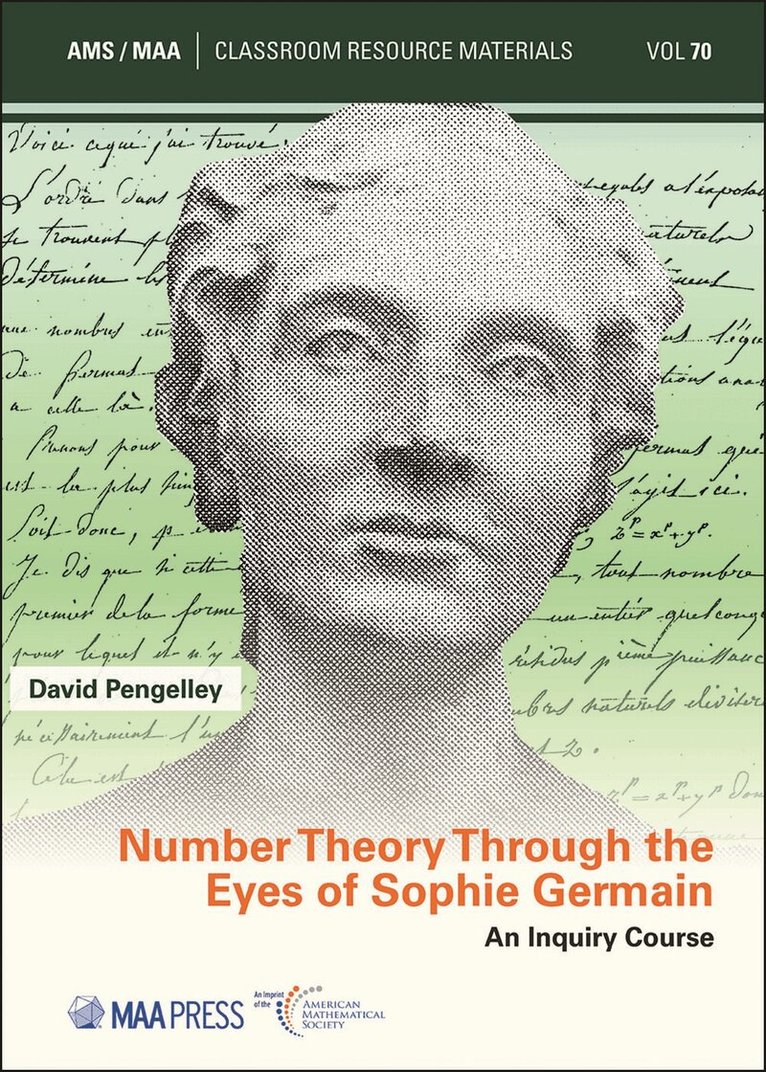
Number Theory Through the Eyes of Sophie Germain: An Inquiry Course is an innovative textbook for an introductory number theory course.Sophie Germain (1776-1831) was largely self-taught in mathematics and, two centuries ago, in solitude, devised and implemented a plan to prove Fermat's Last Theorem. We have only recently completely understood this work from her unpublished letters and manuscripts. David Pengelley has been a driving force in unraveling this mystery and here he masterfully guides his readers along a path of discovery. Germain, because of her circumstances as the first woman to do important original mathematical research, was forced to learn most of what we now include in an undergraduate number theory course for herself. Pengelley has taken excerpts of her writings (and those of others) and, by asking his readers to decipher them, skillfully leads us through an inquiry-based course in elementary number theory. It is a detective story on multiple levels. What is Sophie Germain thinking? What do her mathematical writings mean? How do we understand what she knew and what she was trying to do, where she succeeded and where she didn't?