David Post - Böcker
Visar alla böcker från författaren David Post. Handla med fri frakt och snabb leverans.
3 produkter
3 produkter
334 kr
Skickas inom 5-8 vardagar
In 1787, Thomas Jefferson, then the American Minister to France, had the "complete skeleton, skin & horns" of an American moose shipped to him in Paris and mounted in the lobby of his residence as a symbol of the vast possibilities contained in the strange and largely unexplored New World. Taking a cue from Jefferson's efforts, David Post, one of the nation's leading Internet scholars, here presents a pithy, colorful exploration of the still mostly undiscovered territory of cyberspace--what it is, how it works, and how it should be governed. What law should the Internet have, and who should make it? What are we to do, and how are we to think, about online filesharing and copyright law, about Internet pornography and free speech, about controlling spam, and online gambling, and cyberterrorism, and the use of anonymous remailers, or the practice of telemedicine, or the online collection and dissemination of personal information? How can they be controlled? Should they be controlled? And by whom? Post presents the Jeffersonian ideal--small self-governing units, loosely linked together as peers in groups of larger and larger size--as a model for the Internet and for cyberspace community self-governance. Deftly drawing on Jefferson's writings on the New World in Notes on the State of Virginia, Post draws out the many similarities (and differences) between the two terrains, vividly describing how the Internet actually functions from a technological, legal, and social perspective as he uniquely applies Jefferson's views on natural history, law, and governance in the New World to illuminate the complexities of cyberspace. In Search of Jefferson's Moose is a lively, accessible, and remarkably original overview of the Internet and what it holds for the future.
2 100 kr
Skickas inom 10-15 vardagar
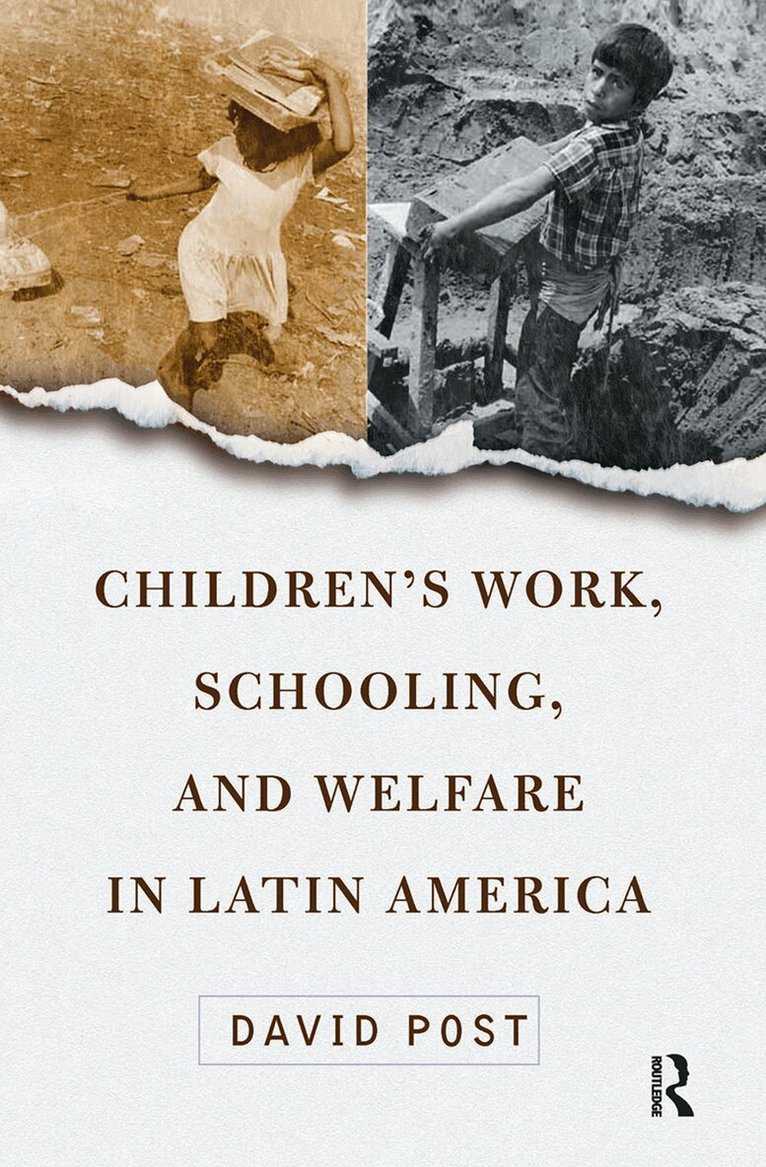
From the 1980s through the 1990s, children in many areas of the world benefited from new opportunities to attend school, but they also faced new demands to support their families because of continuing and, for many, worsening poverty. Children's Work, Schooling, And Welfare In Latin America is a comparative study of children, ages 12-17, in three different Latin American societies. Using nationally-representative household surveys from Chile, Peru, and Mexico, and repeatedly over different survey years, David Post documents tendencies for children to become economically active, to remain in school, or to do both. The survey data analyzed illustrates the roles of family and regional poverty, and parental resources, in determining what children did with their time in each country. However, rather than to treat children's activities merely as demographic phenomena, or in isolation of the policy environment, Post also scrutinizes the international differences in education policies, labor law, welfare spending, and mobilization for children's rights. Children's Work shows that child labor will not vanish of its own accord, nor follow a uniform path even within a common geographic region. Accordingly, there is a role for welfare policy and for popular mobilization. Post indicates that, even when children attend school, as in Peru or Mexico, many students will continue to work to support the family. If the consequence of their work is to impede their educational success, then schools will need to attend to a new dimension of inequality: that between part-time and full-time students.
728 kr
Skickas inom 10-15 vardagar
From the 1980s through the 1990s, children in many areas of the world benefited from new opportunities to attend school, but they also faced new demands to support their families because of continuing and, for many, worsening poverty. Children's Work, Schooling, And Welfare In Latin America is a comparative study of children, ages 12-17, in three different Latin American societies. Using nationally-representative household surveys from Chile, Peru, and Mexico, and repeatedly over different survey years, David Post documents tendencies for children to become economically active, to remain in school, or to do both. The survey data analyzed illustrates the roles of family and regional poverty, and parental resources, in determining what children did with their time in each country. However, rather than to treat children's activities merely as demographic phenomena, or in isolation of the policy environment, Post also scrutinizes the international differences in education policies, labour law, welfare spending, and mobilization for children's rights. Children's Work shows that child labour will not vanish of its own accord, nor follow a uniform path even within a common geographic region. Accordingly, there is a role for welfare policy and for popular mobilization. Post indicates that, even when children attend school, as in Peru or Mexico, many students will continue to work to support the family. If the consequence of their work is to impede their educational success, then schools will need to attend to a new dimension of inequality: that between part-time and full-time students.