David Rusk - Böcker
Visar alla böcker från författaren David Rusk. Handla med fri frakt och snabb leverans.
4 produkter
4 produkter
182 kr
Tillfälligt slut
In his highly acclaimed book, Cities without Suburbs, former Albuquerque mayor David Rusk explained why regions with wealthy suburbs surrounding a poor central city face continuing economic hardship. Now, in Baltimore Unbound, he applies his ideas in an illuminating study of Baltimore's continuing economic stagnation, offering a frank assessment of its causes and possible solutions. Placing the study in the context of national urban issues, Rusk reviews similar problems and remedial efforts in other cities. Published by the Abell Foundation.
301 kr
Skickas inom 10-15 vardagar
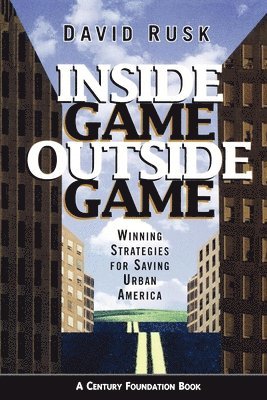
For the past three decades, the federal government has targeted the poorest areas of American cities with a succession of antipoverty initiatives, yet these urban neighborhoods continue to decline. According to David Rusk, focusing on programs aimed at improving inner-city neighborhoods--playing the ""inside game""--is a losing strategy. Achieving real improvement requires matching the ""inside game"" with a strong ""outside game"" of regional strategies to overcome growing fiscal disparities, concentrated poverty, and urban sprawl. In this persuasive book filled with personal observations as well as his trademark mastery of census statistics, Rusk argues that state legislatures must set new ""rules of the game."" He believes those rules require regional revenue or tax base sharing to reduce fiscal disparity, regional housing policies to ensure that all new developments have their fair share of low- and moderate-income housing to dissolve concentrations of poverty, and regional land-use planning and growth management to control urban sprawl. State government action, Rusk argues, is particularly crucial where regions are highly fragmented by many competing city, village, and township governments. He provides vivid success stories that demonstrate best practices for these regional strategies along with recommendations for building effective regional coalitions. A Century Foundation Book
391 kr
Tillfälligt slut
"Cities without Suburbs", first published in 1993, has influenced analysis of America's cities by city planners, scholars, and citizens alike. David Rusk, the former mayor of Albuquerque, argues that America must end the isolation of the central city from the suburbs if it is to solve its urban problems. Rusk's analysis, extending back to 1950, covers all metropolitan areas in the United States but focuses on the 137 largest metro areas and their principal central cities. He finds that cities that were trapped within old boundaries during the age of sprawl have suffered severe racial segregation and the emergence of an urban underclass; but cities with annexation powers - termed "elastic" by Rusk - have shared in area-wide development. The fourth edition updates Rusk's argument using the 2010 Census and the American Community Survey. It provides new material on the difference between population trends and household trends, the impact of Hispanic immigration, and the potential for city-county consolidation.The fourth edition also brings added emphasis to "elasticity mimics" - a variety of intergovernmental policies that can provide some of the benefits of regional consolidation efforts in situations where annexation and consolidation are impossible.
202 kr
Tillfälligt slut
"Cities without Suburbs", first published in 1993, has influenced analysis of America's cities by city planners, scholars, and citizens alike. David Rusk, the former mayor of Albuquerque, argues that America must end the isolation of the central city from the suburbs if it is to solve its urban problems. Rusk's analysis, extending back to 1950, covers all metropolitan areas in the United States but focuses on the 137 largest metro areas and their principal central cities. He finds that cities that were trapped within old boundaries during the age of sprawl have suffered severe racial segregation and the emergence of an urban underclass; but cities with annexation powers - termed "elastic" by Rusk - have shared in area-wide development. The fourth edition updates Rusk's argument using the 2010 Census and the American Community Survey. It provides new material on the difference between population trends and household trends, the impact of Hispanic immigration, and the potential for city-county consolidation.The fourth edition also brings added emphasis to "elasticity mimics" - a variety of intergovernmental policies that can provide some of the benefits of regional consolidation efforts in situations where annexation and consolidation are impossible.