David Stoffer - Böcker
Visar alla böcker från författaren David Stoffer. Handla med fri frakt och snabb leverans.
3 produkter
3 produkter
1 125 kr
Skickas
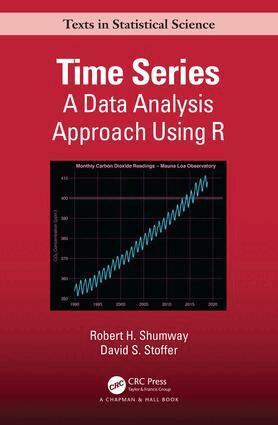
The goals of this text are to develop the skills and an appreciation for the richness and versatility of modern time series analysis as a tool for analyzing dependent data. A useful feature of the presentation is the inclusion of nontrivial data sets illustrating the richness of potential applications to problems in the biological, physical, and social sciences as well as medicine. The text presents a balanced and comprehensive treatment of both time and frequency domain methods with an emphasis on data analysis.Numerous examples using data illustrate solutions to problems such as discovering natural and anthropogenic climate change, evaluating pain perception experiments using functional magnetic resonance imaging, and the analysis of economic and financial problems. The text can be used for a one semester/quarter introductory time series course where the prerequisites are an understanding of linear regression, basic calculus-based probability skills, and math skills at the high school level. All of the numerical examples use the R statistical package without assuming that the reader has previously used the software.
197 kr
Skickas inom 3-6 vardagar
1 688 kr
Skickas inom 10-15 vardagar
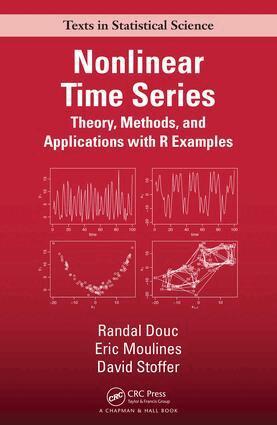
Designed for researchers and students, Nonlinear Times Series: Theory, Methods and Applications with R Examples familiarizes readers with the principles behind nonlinear time series models—without overwhelming them with difficult mathematical developments. By focusing on basic principles and theory, the authors give readers the background required to craft their own stochastic models, numerical methods, and software. They will also be able to assess the advantages and disadvantages of different approaches, and thus be able to choose the right methods for their purposes.The first part can be seen as a crash course on "classical" time series, with a special emphasis on linear state space models and detailed coverage of random coefficient autoregressions, both ARCH and GARCH models. The second part introduces Markov chains, discussing stability, the existence of a stationary distribution, ergodicity, limit theorems, and statistical inference. The book concludes with a self-contained account on nonlinear state space and sequential Monte Carlo methods. An elementary introduction to nonlinear state space modeling and sequential Monte Carlo, this section touches on current topics, from the theory of statistical inference to advanced computational methods. The book can be used as a support to an advanced course on these methods, or an introduction to this field before studying more specialized texts. Several chapters highlight recent developments such as explicit rate of convergence of Markov chains and sequential Monte Carlo techniques. And while the chapters are organized in a logical progression, the three parts can be studied independently. Statistics is not a spectator sport, so the book contains more than 200 exercises to challenge readers. These problems strengthen intellectual muscles strained by the introduction of new theory and go on to extend the theory in significant ways. The book helps readers hone their skills in nonlinear time series analysis and their applications.