Randal Douc – författare
Visar alla böcker från författaren Randal Douc. Handla med fri frakt och snabb leverans.
4 produkter
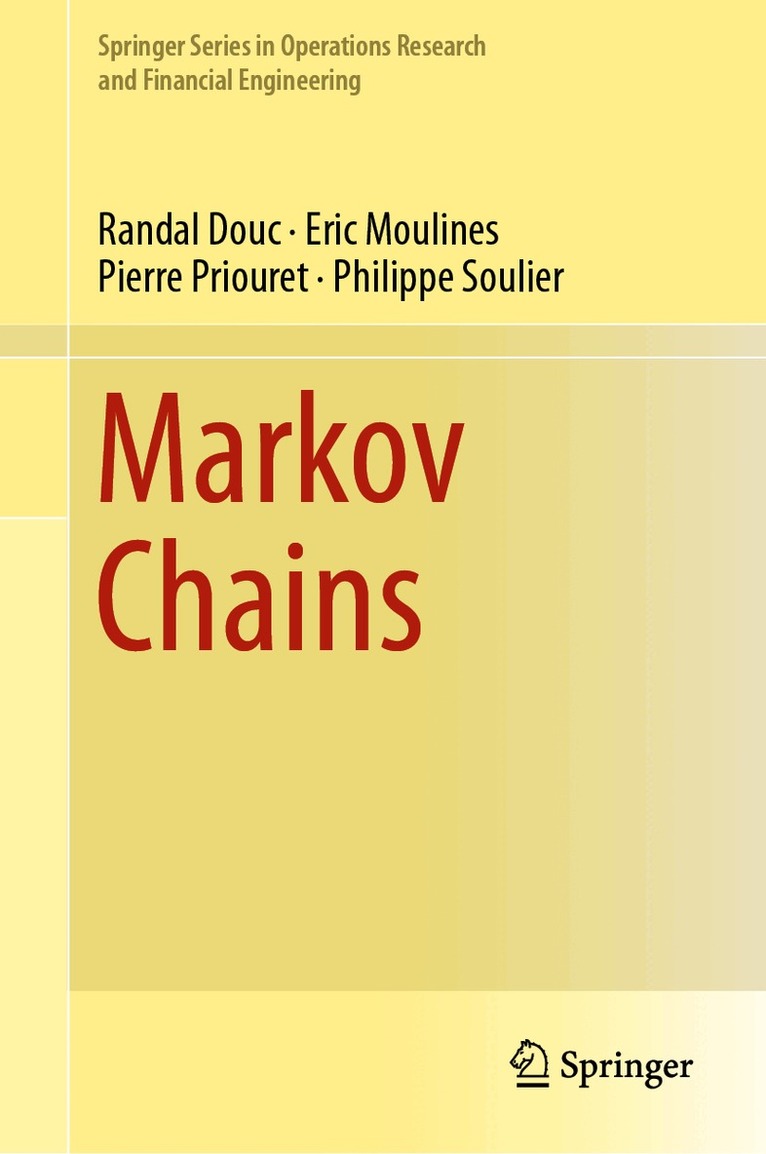
Markov Chains
Av Randal Douc, Eric Moulines m. fl.
Inbunden, 2019
987 kr
Lägg i varukorg
This book covers the classical theory of Markov chains on general state-spaces as well as many recent developments. The theoretical results are illustrated by simple examples, many of which are taken from Markov Chain Monte Carlo methods. The book is self-contained, while all the results are …
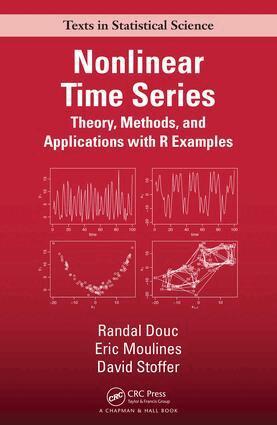
Nonlinear Time Series
Theory, Methods and Applications with R Examples
Av Randal Douc, Eric Moulines m. fl.
E-bok, 2014
2251 kr
Lägg i varukorg
This text emphasizes nonlinear models for a course in time series analysis. After introducing stochastic processes, Markov chains, Poisson processes, and ARMA models, the authors cover functional autoregressive, ARCH, threshold AR, and discrete time series models as well as several complementary …
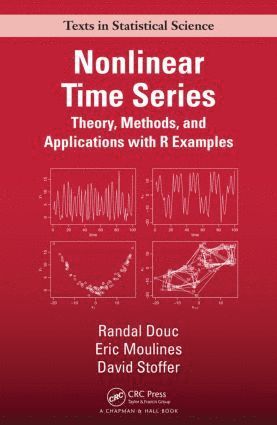
Nonlinear Time Series
Theory, Methods and Applications with R Examples
Av Randal Douc, Eric Moulines m. fl.
Inbunden, 2014
2132 kr
Lägg i varukorg
Designed for researchers and students, Nonlinear Times Series: Theory, Methods and Applications with R Examples familiarizes readers with the principles behind nonlinear time series models—without overwhelming them with difficult mathematical developments. By focusing on basic principles and …
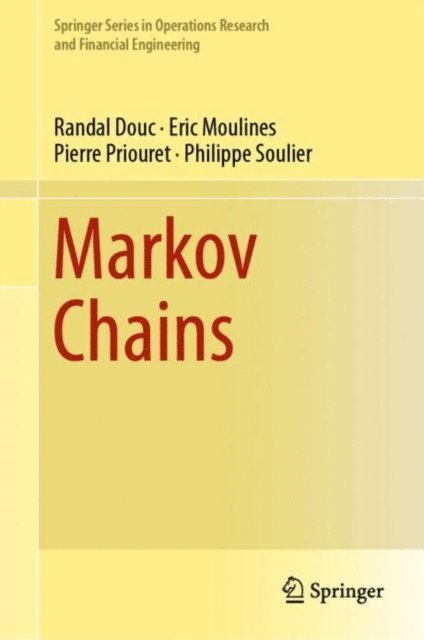
Markov Chains
Av Philippe Soulier, Pierre Priouret m. fl.
E-bok, 2018
1296 kr
Lägg i varukorg
This book covers the classical theory of Markov chains on general state-spaces as well as many recent developments. The theoretical results are illustrated by simple examples, many of which are taken from Markov Chain Monte Carlo methods. The book is self-contained, while all the results are …