David Stove - Böcker
Visar alla böcker från författaren David Stove. Handla med fri frakt och snabb leverans.
13 produkter
13 produkter
484 kr
Skickas inom 7-10 vardagar
This is a book of philosophy, written by a philosopher and intended for anyone who knows enough philosophy to have been seriously injured, antagonised, mystified or intoxicated by it. Stove is passionately polemical, a philosophical counterpart to Tom Wolfe. Setting out to deflate a few philosophical reputations, he lambastes both the dead (Plato, Hegel, Kant, Foucault) and the living (Popper, Nozick, Feyerabend, Goodman). Yet he says things that need to be said, and that others often lack the courage to say.
2 088 kr
Skickas inom 10-15 vardagar
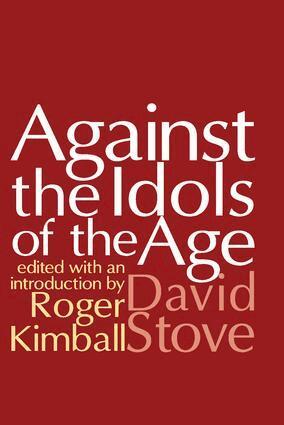
Little known outside his native Australia, David Stove was one of the most illuminating and brilliant philo-sophical essayists of the postwar era. A fearless at-tacker of intellectual and cultural orthodoxies, Stove left powerful critiques of scientific irrationalism, Dar-winian theories of human behavior, and philosophi-cal idealism. He was also an occasional essayist of considerable charm and polemical snap. Stove's writ-ing is both rigorous and immensely readable. It is, in the words of Roger Kimball, "an invigorating blend of analytic lucidity, mordant humor, and an amount of common sense too great to be called 'common.'" Against the Idols of the Age brings together a repre-sentative selection of Stove's writing and is an ideal introduction to his work.The book opens with some of Stove's most impor-tant attacks on irrationalism in the philosophy of sci-ence. He exposes the roots of this fashionable attitude, tracing it through writers like Paul Feyerabend andThomas Kuhn to Karl Popper. Stove was a born controversialist, so it is not surpris-ing that when he turned his attention to contemporary affairs he said things that are politically incorrect. The topical essays that make up the second part of the book show Stove at his most withering and combative. Whether the subject is race, femi-nism, the Enlightenment, or the demand for "non-coercive philosophy," Stove is on the mark with a battery of impressive arguments expressed in sharp, uncompromis-ing prose. Against the Idols of the Age concludes with a generous sampling of his blistering attacks on Darwinism.David Stove's writings are an undiscovered treasure. Although readers may dis-agree with some of his opinions, they will find it difficult to dismiss his razor-sharp arguments. Against the Idols of the Age is the first book to make the full range of this important thinker available to the general reader.
2 088 kr
Skickas inom 10-15 vardagar
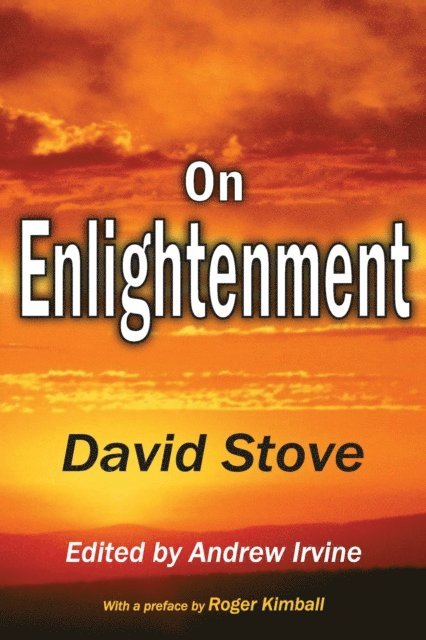
The idea of enlightenment entails liberty, equality, rationalism, secularism, and the connection between knowledge and well being. In spite of the setbacks of revolutionary violence, mass murder, and two world wars, the spread of enlightenment values is still the yardstick by which moral, political, and scientific advances are measured. In On Enlightenment, David Stove attacks the roots of enlightenment thought to define its successes, limitations, and areas of likely failures.Stove champions the use of reason and recognizes the falsity of religious claims as well as the importance of individual liberty. He rejects the enlightenment's uncritical optimism regarding social progress and its willingness to embrace revolutionary change. What evidence is there that the elimination of superstition will lead to happiness? Or that it is possible to accept Darwinism without Social Darwinism? Or that the enlightenment's liberal, rationalistic outlook will lead to the social progress envisioned by its advocates?Despite best intentions, says Stove, social reformers who attempt to improve the world inevitably make things worse. He advocates a conservative approach to change, pointing out that social structures are so large and complex that any widespread social reform will have innumerable unforeseen consequences. Writing in the tradition of Edmund Burke with the same passion for clarity and intellectual honesty as George Orwell, David Stove was one of the most articulate and insightful philosophers of his day.
712 kr
Skickas inom 10-15 vardagar
Little known outside his native Australia, David Stove was one of the most illuminating and brilliant philo-sophical essayists of the postwar era. A fearless at-tacker of intellectual and cultural orthodoxies, Stove left powerful critiques of scientific irrationalism, Dar-winian theories of human behavior, and philosophi-cal idealism. He was also an occasional essayist of considerable charm and polemical snap. Stove's writ-ing is both rigorous and immensely readable. It is, in the words of Roger Kimball, "an invigorating blend of analytic lucidity, mordant humor, and an amount of common sense too great to be called 'common.'" Against the Idols of the Age brings together a repre-sentative selection of Stove's writing and is an ideal introduction to his work.The book opens with some of Stove's most impor-tant attacks on irrationalism in the philosophy of sci-ence. He exposes the roots of this fashionable attitude, tracing it through writers like Paul Feyerabend andThomas Kuhn to Karl Popper. Stove was a born controversialist, so it is not surpris-ing that when he turned his attention to contemporary affairs he said things that are politically incorrect. The topical essays that make up the second part of the book show Stove at his most withering and combative. Whether the subject is race, feminism, the Enlightenment, or the demand for "non-coercive philosophy," Stove is on the mark with a battery of impressive arguments expressed in sharp, uncompromis-ing prose. Against the Idols of the Age concludes with a generous sampling of his blistering attacks on Darwinism.David Stove's writings are an undiscovered treasure. Although readers may dis-agree with some of his opinions, they will find it difficult to dismiss his razor-sharp arguments. Against the Idols of the Age is the first book to make the full range of this important thinker available to the general reader.
698 kr
Skickas inom 10-15 vardagar
The political impulse to secede - to attempt to separate from central government control - is a conspicuous feature of the post-cold war world. It is alive and growing in Canada, Russia, China, Italy, Belgium, Britain, and even the United States Yet secession remains one of the least studied and least understood of all historical and political phenomena. The contributors to this volume have filled this gap with wide-ranging investigations - rooted in history, political philosophy, ethics, and economic theory - of secessionist movements in the United States, Canada, and Europe.
2 088 kr
Skickas inom 10-15 vardagar
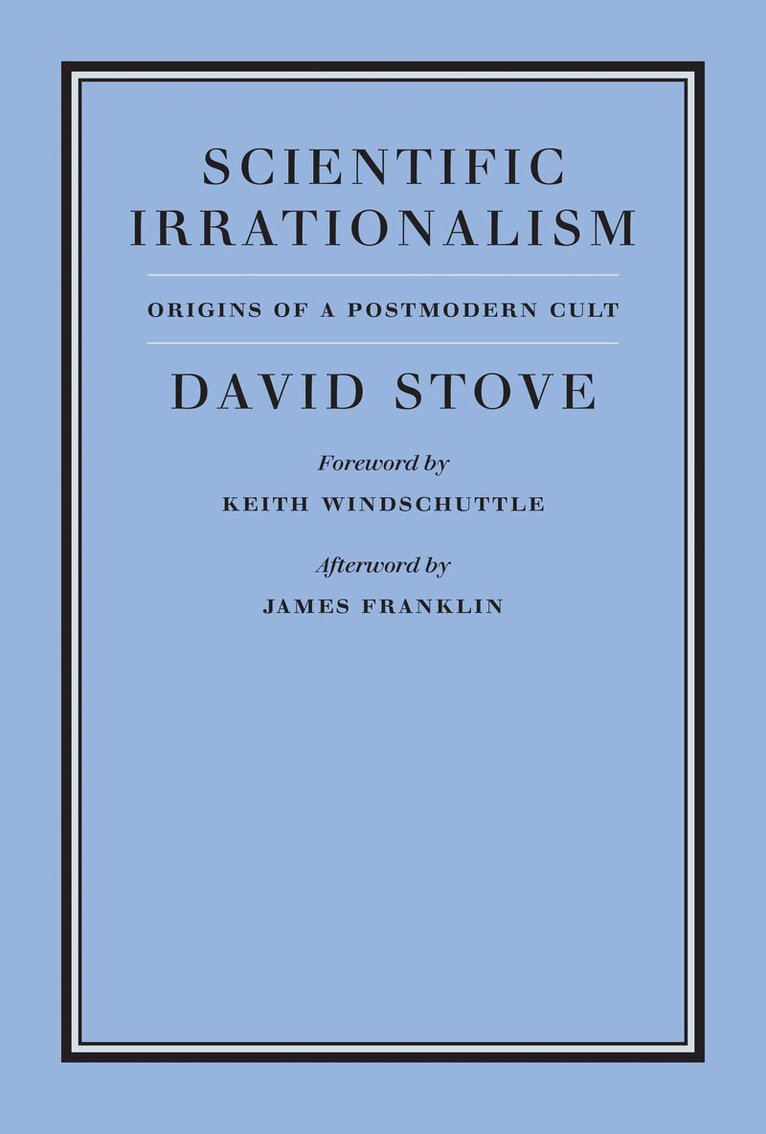
Little known outside his native Australia, David Stove was one of the most illuminating and brilliant philosophical essayists of his era. A fearless attacker of intellectual and cultural orthodoxies, Stove left powerful critiques of scientific irrationalism, Darwinian theories of human behavior, and philosophical idealism.Since its inception in the 1940s, the field of science studies, originally intended to bridge the gap between science and the humanities, has been the center of controversy and debate. The most notable figures in this debate are Thomas Kuhn and Karl Popper. In Scientific Irrationalism, now available in paperback, David Stove demonstrates how extravagant has been the verbiage wasted on this issue and how irrational the combatants have been. He shows that Kuhn and Popper share considerable common ground. Stove argues that the problems all reside in the reasoning of the critics. He identifies the logical mistakes and conceptual allusions made by Kuhn and Popper and their supporters, as well as their collective dependency on a single argument made by the philosopher of the Scottish Enlightenment, David Hume. He then demonstrates how little potency that argument actually has for the claims of science.In his foreword, Keith Windschuttle explains the debate surrounding the field of science studies and explores David Stove's contribution as well as his lack of recognition. In an afterword, James Franklin discusses reactions to Stove's work.
2 289 kr
Skickas inom 10-15 vardagar
Secession, State & Liberty examines history, political philosophy, ethics, and economic theory of secessionist movements in the United States, Canada, and Europe. It is based on a conference, sponsored by the Ludwig von Mises Institute, on the political economy of secession.
698 kr
Skickas inom 10-15 vardagar
Little known outside his native Australia, David Stove was one of the most illuminating and brilliant philosophical essayists of his era. A fearless attacker of intellectual and cultural orthodoxies, Stove left powerful critiques of scientific irrationalism, Darwinian theories of human behavior, and philosophical idealism.Since its inception in the 1940s, the field of science studies, originally intended to bridge the gap between science and the humanities, has been the center of controversy and debate. The most notable figures in this debate are Thomas Kuhn and Karl Popper. In Scientific Irrationalism, now available in paperback, David Stove demonstrates how extravagant has been the verbiage wasted on this issue and how irrational the combatants have been. He shows that Kuhn and Popper share considerable common ground. Stove argues that the problems all reside in the reasoning of the critics. He identifies the logical mistakes and conceptual allusions made by Kuhn and Popper and their supporters, as well as their collective dependency on a single argument made by the philosopher of the Scottish Enlightenment, David Hume. He then demonstrates how little potency that argument actually has for the claims of science.In his foreword, Keith Windschuttle explains the debate surrounding the field of science studies and explores David Stove's contribution as well as his lack of recognition. In an afterword, James Franklin discusses reactions to Stove's work.
685 kr
Skickas inom 10-15 vardagar
The idea of enlightenment entails liberty, equality, rationalism, secularism, and the connection between knowledge and well being. In spite of the setbacks of revolutionary violence, mass murder, and two world wars, the spread of enlightenment values is still the yardstick by which moral, political, and scientific advances are measured. In On Enlightenment, David Stove attacks the roots of enlightenment thought to define its successes, limitations, and areas of likely failures.Stove champions the use of reason and recognizes the falsity of religious claims as well as the importance of individual liberty. He rejects the enlightenment's uncritical optimism regarding social progress and its willingness to embrace revolutionary change. What evidence is there that the elimination of superstition will lead to happiness? Or that it is possible to accept Darwinism without Social Darwinism? Or that the enlightenment's liberal, rationalistic outlook will lead to the social progress envisioned by its advocates?Despite best intentions, says Stove, social reformers who attempt to improve the world inevitably make things worse. He advocates a conservative approach to change, pointing out that social structures are so large and complex that any widespread social reform will have innumerable unforeseen consequences. Writing in the tradition of Edmund Burke with the same passion for clarity and intellectual honesty as George Orwell, David Stove was one of the most articulate and insightful philosophers of his day.
Darwinian Fairytales
Selfish Genes, Errors of Heredity and Other Fables of Evolution
Inbunden, Engelska, 2006
228 kr
Skickas inom 5-8 vardagar
Whatever your opinion of 'Intelligent Design,' you'll find Stove's criticism of what he calls 'Darwinism' difficult to stop reading. Stove's blistering attack on Richard Dawkins' 'selfish genes' and 'memes' is unparalleled and unrelenting. A discussion of spiders who mimic bird droppings is alone worth the price of the book. Darwinian Fairytales should be read and pondered by anyone interested in sociobiology, the origin of altruism, and the awesome process of evolution. --Martin Gardner, author of Did Adam and Eve Have Navels?: Debunking Pseudoscience
Darwinian Fairytales
Selfish Genes, Errors of Heredity and Other Fables of Evolution
Häftad, Engelska, 2007
169 kr
Skickas inom 5-8 vardagar
Whatever your opinion of 'Intelligent Design,' you'll find Stove's criticism of what he calls 'Darwinism' difficult to stop reading. Stove's blistering attack on Richard Dawkins' 'selfish genes' and 'memes' is unparalleled and unrelenting. A discussion of spiders who mimic bird droppings is alone worth the price of the book. Darwinian Fairytales should be read and pondered by anyone interested in sociobiology, the origin of altruism, and the awesome process of evolution. --Martin Gardner, author of Did Adam and Eve Have Navels?: Debunking Pseudoscience
What's Wrong with Benevolence
Happiness, Private Property, andthe Limits of Enlightenment
Inbunden, Engelska, 2011
196 kr
Tillfälligt slut
Is benevolence a virtue? In many cases it appears to be so. But when it comes to the "enlarged benevolence" of the Enlightenment, David Stove argues that the answer is clearly no. In this insightful, provocative essay, Stove builds a case for the claim that when benevolence is universal, disinterested and external, it regularly leads to the forced redistribution of wealth, which in turn leads to decreased economic incentives, lower rates of productivity, and increased poverty. As Stove points out, there is an air of paradox in saying that benevolence may be a cause of poverty. But there shouldn't be. Good intentions alone are never sufficient to guarantee the success of one's endeavors. Utopian schemes to reorganize the world have regularly ended in failure. Easily the most important example of this phenomenon is twentieth-century communism. As Stove reminds us, the attractiveness of communism--the "emotional fuel" of communist revolutionaries for over a hundred years--has always been "exactly the same as the emotional fuel of every other utopianism: the passionate desire to alleviate or abolish misery."Yet communism was such a monumental failure that millions of people today are still suffering its consequences. In this most prescient of essays, Stove warns contemporary readers just how seductive universal political benevolence can be. He also shows how the failure to understand the connection between benevolence and communism has led to many of the greatest social miseries of our age.
241 kr
Skickas inom 5-8 vardagar
In fewer than two-hundred pages, David Stove leaves the well-established and widely regarded edifice of the academic philosophy of science in smoldering ruins.This book provides a modern history of scientific reasoning, from David Hume’s inductive skepticism to Karl Popper’s outright denial of induction, to the increasingly irrational and absurd scientific views that followed. When Popper untethered science from induction, Stove argues, he triggered a postmodernist nightmare of utter nonsense culminating in Paul Feyerabend’s summation that “anything goes” when it comes to defining or describing science. With undeniable logic, a deft analysis of the linguistic slight-of-hand that make absurd arguments seem reasonable, and regular displays of wit, Stove gives the reader a front row seat to one of the greatest unforced errors in the history of modern thought. Stove’s views are entirely consistent with the origins of scientific inference and logic, as well as modern advances in probability theory, and yet he remains largely unnoticed by most of the academic world. From Stove’s insider-outsider perspective, the train wreck that is academically accepted philosophy of science and “science studies” is a fascinating and thoroughly entertaining subject of study.Scientific Irrationalism is the perfect place to begin any examination of what science is—and what it is not.