David Waldner - Böcker
Visar alla böcker från författaren David Waldner. Handla med fri frakt och snabb leverans.
5 produkter
5 produkter
1 518 kr
Skickas inom 10-15 vardagar
Why does state building sometimes promote economic growth and in other cases impede it? Through an analysis of political and economic development in four countries—Turkey, Syria, Korea, and Taiwan—this book explores the origins of political-economic institutions and the mechanisms connecting them to economic outcomes.David Waldner extends our understanding of the political underpinnings of economic development by examining the origins of political coalitions on which states and their institutions depend. He first provides a political model of institutional change to analyze how elites build either cross-class or narrow coalitions, and he examines how these arrangements shape specific institutions: state-society relations, the nature of bureaucracy, fiscal structures, and patterns of economic intervention. He then links these institutions to economic outcomes through a bargaining model to explain why countries such as Korea and Taiwan have more effectively overcome the collective dilemmas that plague economic development than have others such as Turkey and Syria. The latter countries, he shows, lack institutional solutions to the problems that surround productivity growth.The first book to compare political and economic development in these two regions, State Building and Late Development draws on, and contributes to, arguments from political sociology and political economy. Based on a rigorous research design, the work offers both a finely drawn comparison of development and a compellingly argued analysis of the character and consequences of "precocious Keynesianism," the implementation of Keynesian demand-stimulus policies in largely pre-industrial economies.
541 kr
Skickas inom 10-15 vardagar
Why does state building sometimes promote economic growth and in other cases impede it? Through an analysis of political and economic development in four countries—Turkey, Syria, Korea, and Taiwan—this book explores the origins of political-economic institutions and the mechanisms connecting them to economic outcomes.David Waldner extends our understanding of the political underpinnings of economic development by examining the origins of political coalitions on which states and their institutions depend. He first provides a political model of institutional change to analyze how elites build either cross-class or narrow coalitions, and he examines how these arrangements shape specific institutions: state-society relations, the nature of bureaucracy, fiscal structures, and patterns of economic intervention. He then links these institutions to economic outcomes through a bargaining model to explain why countries such as Korea and Taiwan have more effectively overcome the collective dilemmas that plague economic development than have others such as Turkey and Syria. The latter countries, he shows, lack institutional solutions to the problems that surround productivity growth.The first book to compare political and economic development in these two regions, State Building and Late Development draws on, and contributes to, arguments from political sociology and political economy. Based on a rigorous research design, the work offers both a finely drawn comparison of development and a compellingly argued analysis of the character and consequences of "precocious Keynesianism," the implementation of Keynesian demand-stimulus policies in largely pre-industrial economies.
1 362 kr
Kommande
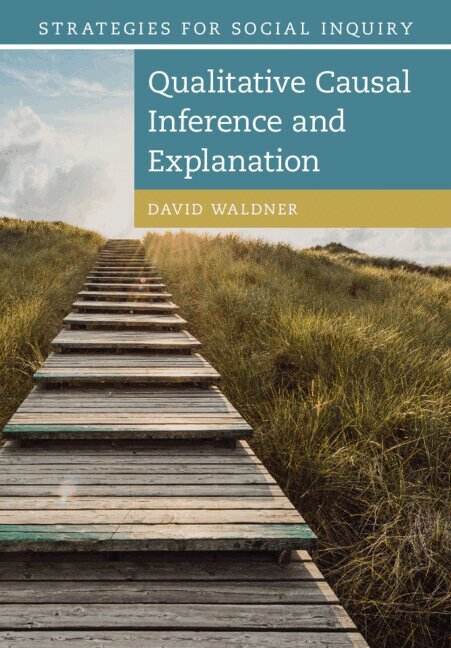
While existing qualitative, case-study methods deliver specific explanations, quantitative approaches to causal inference emphasize valid inferences at the expense of explanations. In this book, David Waldner presents a hybrid method drawing on both approaches to ensure that explanations are based on validly inferred causes and to avoid making valid inferences that have limited explanatory power. Qualitative Causal Inference and Explanation integrates a qualitative identification strategy based on graph-theoretic analysis into traditional process-tracing methods by introducing three novel methodological concepts: hypothetical interventions, invariant causal mechanisms, and event-history maps. This new approach provides clear and feasible standards for making valid, unit-level causal inferences. The result is a groundbreaking approach to explaining complex social and political phenomena, one that better avoids false positives while providing explanations that satisfy the criteria of explanatory depth, density, relevance, and unification.
410 kr
Kommande
While existing qualitative, case-study methods deliver specific explanations, quantitative approaches to causal inference emphasize valid inferences at the expense of explanations. In this book, David Waldner presents a hybrid method drawing on both approaches to ensure that explanations are based on validly inferred causes and to avoid making valid inferences that have limited explanatory power. Qualitative Causal Inference and Explanation integrates a qualitative identification strategy based on graph-theoretic analysis into traditional process-tracing methods by introducing three novel methodological concepts: hypothetical interventions, invariant causal mechanisms, and event-history maps. This new approach provides clear and feasible standards for making valid, unit-level causal inferences. The result is a groundbreaking approach to explaining complex social and political phenomena, one that better avoids false positives while providing explanations that satisfy the criteria of explanatory depth, density, relevance, and unification.
234 kr
Skickas inom 7-10 vardagar
This Element documents the diversity and dissensus of scholarship on the political resource curse, diagnoses its sources, and directs scholarly attention towards what the authors believe will be more fruitful avenues of future research. In the scholarship to date, there is substantial regional heterogeneity and substantial evidence denying the existence of a political resource curse. This dissensus is located in theory, measure, and research design, especially regarding measurement error and endogenous selection. The work then turns to strategies for reconnecting research on resource politics to the broader literature on democratic development. Finally, the results of the authors' own research is presented, showing that a set of historically contingent events in the Middle East and North Africa are at the root of what has been mistaken for a global political resource curse.