Dean John Champion - Böcker
Visar alla böcker från författaren Dean John Champion. Handla med fri frakt och snabb leverans.
8 produkter
8 produkter
687 kr
Skickas inom 5-8 vardagar
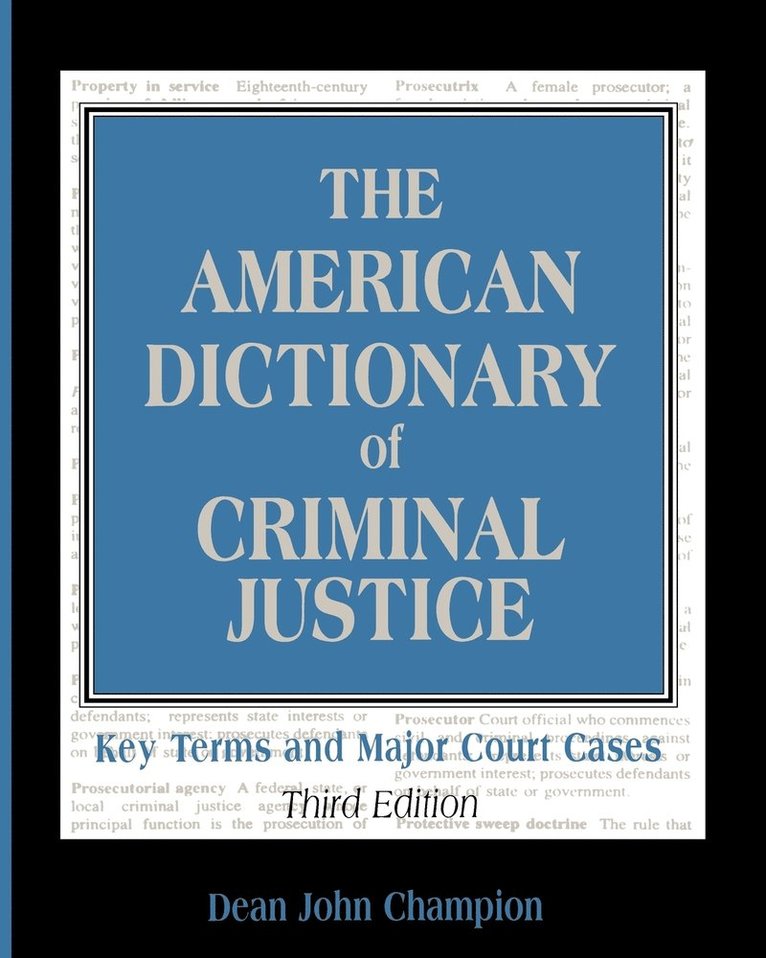
The Third Edition of The American Dictionary of Criminal Justice is a reference every student of the criminal justice system should own. Like any good dictionary, this resource will assist students in a variety of courses--as well as in writing papers and understanding terminology in journal articles. Over 5,000 terms, concepts, and names are included in the new edition, as well as over 125 new U.S. Supreme Court cases.The Terms SectionThe dictionary's interdisciplinary approach greatly enhances its effectiveness as a "one-stop" resource. Students will no longer need to waste precious study time seeking out definitions in numerous specialized sources. Many definitions are accompanied by examples from the research literature, illustrating how the terms apply in particular contexts.This dictionary is useful for any criminology or criminal justice course--with applications in sociology, public administration, political science, and the administration of justice.Key terms cut across the following areas: criminal law, criminal justice, forensics, gangs, computers and computer crime, criminal investigations, criminology, criminological theory, corrections, probation and parole, courts and sentencing, rules of criminal procedure, constitutional law, policing and police-community relations, jails and prisons, white-collar crime, sodomy laws, civil rights, tort law, victimization, juvenile law, Section 1983 actions, capital punishment, electronic surveillance, fines and asset forfeiture, deadly force, search and seizure, wrongful convictions, the Prison Litigation Reform Act of 1995, and the Antiterrorism and Effective Death Penalty Act of 1996.The dictionary includes numerous illustrations, figures, and tables that provide readers with visual portrayals of important criminal justice facts. A comprehensive listing of over 30 doctoral programs in criminal justice is provided, together with useful contact information.An extensive listing of Internet sites is provided for locating useful information regarding important topics associated with law enforcement, the courts, and corrections. Also featured are listings of all probation/parole and state corrections departments and relevant contact information.Finally, this section provides listings of leading criminological theorists, a summary of their major theoretical contributions, and brief synopses of their written works. Many theorists are cross-referenced with other scholars studying similar phenomena.The Supreme Court Cases SectionNine hundred and eighty of the most recent and significant leading U.S. Supreme Court cases have been abridged in a short paragraph format to highlight the major facts, holdings, and rationales. The complete case citations are boldfaced in brackets for more complete information about the case principals (e.g., Penry v. Johnson, 532 U.S. 782, 121 S.Ct. 1910 (2001) [Johnny Paul PENRY, Petitioner, v. Gary L. JOHNSON, Director, Texas Department of Criminal Justice, Institutional Division] (Habeas Corpus Petitions; Jury Instructions; Sentencing).All leading cases have major terms boldfaced to indicate case content. A sample of current cases includes:Bunkley v. Florida (2003) retroactive rulesChavez v. Martinez (2003) Section 1983 rulesEwing v. California (2003) habitual offender statutesIllinois v. Lidster (2004) sobriety checkpointsKaupp v. Texas (2003) confessionsKhanh Phuong Nguyen v. United States (2003) federal appellate judge qualificationsLawrence v. Texas (2003) sodomy lawsLockyer v. Andrade (2003) three-strike lawsMaryland v. Pringle (2003) vehicle searchesMassaro v. United States (2003) ineffective assistance of counselMiller v. Cockrell (2003) peremptory challengesMitchell v. Esparza (2004) death penalty and harmless error doctrineOverton v. Bazzetta (2003) civil rights, Section 1983 claimsPrice v. Vincent (2003) double jeopardySell v. United States (2003) forced medication of mentally ill patientsSmith v. Doe (2003) ex post facto lawsStogner v. California (2003) sex offender lawsUnited States v. Banks (2003) knock and announce and exigent circumstancesAll major criminal justice topics have been incorporated into the compilation of cases, including such topics as:Acceptance of ResponsibilityAggravating and Mitigating CircumstancesAmericans with Disabilities ActAntiterrorism and Effective Death Penalty Act of 1996Armed Career Criminal Act (ACCA) Asset ForfeitureBorder SearchesCivil Rights, Section 1983ClaimsConfessionsCustodial InterrogationsDeadly ForceDeath-Qualified JuriesDiscoveryDetainer WarrantsDNA ProfilingDouble JeopardyElectronic Surveillance, WiretappingEvidence PreservationExclusionary RuleExcessive ForceEx Post Facto LawsFinesForced Medication of Mentally Ill DefendantsFrivolous LawsuitsGood-Faith ExceptionGun Control BillHabeas Corpus PetitionsHabitual Offender StatutesHearsayImmigration CheckpointsIneffective Assistance of CounselIn Forma Pauperis MotionsInnocent-Owner DefenseJudicial MisconductJury Size, Trials, and VotingJuvenile LawKnock and AnnounceLineupsMandatory Death PenaltyMedia RightsMens ReaMotion DeadlinesNative American Tribal LawObscenity LawsParolee RightsPeremptory ChallengesPlea BargainingPolice MisconductPreventive DetentionPrison Litigation Reform ActRetroactive RulesSex Offender LawsSexual PredatorsSobriety CheckpointsSodomy LawsSterilizationStop and FriskSupervised Release RegulationsThermal Imaging EquipmentTrash SearchesVictim Impact StatementsWrongful ConvictionsMany of these cases are cross-cited to facilitate research. These cases are indexed according to over 140 topics and include page number references for easy usage. Champion provides explanations of citation protocol for referencing legal citations, including citing the U.S. Reports, Supreme Court Reporter, and regional state supreme court compilations and reporters such as the Pacific Reporter and Southwestern Reporter. Crucial U.S. Constitutional Amendments are cited whenever applicable in the compilation. A unique feature is the explanation of how to cite and interpret case materials.
809 kr
Skickas inom 10-15 vardagar
A distinguished scholar has responded to generic issues of probation's function during a period of growing emphasis on punishment and incarceration for criminal behavior. Primary concern is with present criminal justice perspectives on felons that affect probation activities. This thoughtful book reviews the literature, particularly Petersilia and Rand Corporation research, and poses critical correctional questions. . . . Sensitive to current conceptual ambiguity, Champion carefully defines key terms consistently used to develop perspectives on offenders' dispositions. Although the discussions may be too brief for some readers, the final chapter does focus attention on major issues, states fundamental problems, and provides a forward-looking vision for probation. The book has excellent organization. The bibliography offers a comprehensive listing of essential sources. ChoiceFelony probation as a solution to severe prison crowding is a moral, ethical, and legal problem, but as Champion notes, almost no alternatives exist. This volume assesses the pros and cons of the growing use of felony probation as a rehabilitative tool and as a functional alternative to alleviate prison overcrowding, and examines the models that provide a framework for understanding this pervasive problem. This comprehensive text will aid law enforcement officials, probation and parole officers, social workers, and teachers of probation-parole corrections courses. Champion's discussion begins with a detailed account of probation in the United States. Included are the history, philosophy, and function of probatiion, as well as an analysis of probation models. Next, the author explores U.S. courts and judges, covering topics such as felony trends in the U.S., plea bargaining, and sentencing. Prison overcrowding is discussed, including the measures and types of overcrowding. An analysis of the dangers of prison overcrowding follows which includes coverage of recidivism, selective incapacitation, and public risk. Finally, Champion explores the future of felony probation and assesses the moral, ethical, and legal issues surrounding felony probation.
805 kr
Skickas inom 10-15 vardagar
A distinguished group of noted criminal justice specialists here examines the impact of the new U.S. sentencing guidelines, imposed in 1987, on law enforcement, the prosecution and courts, and corrections. Although these guidelines were created with the expressed purpose of increasing judicial fairness and reducing prison overcrowding, the contributors argue that their long range effects will be to aggravate present overcrowding problems to intolerably high levels. To make their case, contributors address individually such issues as plea bargaining, the new role of parole and corrections officers, the likely effects of the scheduled abolition of the parole board in 1992, and more. Both students of criminal justice and practicing parole and corrections officers will find these chapters enlightening reading.Following an introductory overview that puts the U.S. sentencing guidelines in perspective, two chapters discuss their impact on law enforcement, officer discretion, and crime control and deterrence. Turning to an exploration of the courts, the contributors address prosecutorial discretion in plea bargaining, judicial discretion and sentencing disparities, case processing and sentencing alternatives, and how predictions of dangerousness affect the sentencing process. In their analysis of the relationship between the sentencing guidelines and corrections trends, the contributors examine issues such as community-based corrections and privatization, inmate litigation and constitutional issues, and recidivism. Finally, editor Dean Champion offers a perceptive synthesis of the volume by summarizing the serious problems posed by imposition of the U.S. sentencing guidelines. Four appendices provide additional related information for the student and researcher.
Transferring Juveniles to Criminal Courts
Trends and Implications for Criminal Justice
Inbunden, Engelska, 1991
928 kr
Skickas inom 10-15 vardagar
This is the first book to provide an in-depth study of the juvenile transfer process. Criminal justice's get tough policy has led to greater use of this process which, on the surface, transfers persistent juvenile offenders to criminal court jurisdiction in order to impose more serious penalties. The implications of this growing phenomenon are increasingly important for both the juvenile and criminal court systems. Champion and Mays' analysis includes descriptions of juvenile courts, types of offenders processed by these courts, and characteristic outcomes of transfers. Examining the transfer process in detail, they explore social and legal definitions of delinquency; goals and functions of transfers; legal rights of juveniles; and the implications of possible penalties, such as the death penalty. Questions such as whether transfers necessarily result in harsher punishment are discussed at length. Transferring Juveniles to Criminal Courts is designed for students majoring in criminal justice, public administration, political science, sociology, and psychology.Examining the transfer process, Chapter One provides a thorough discussion of the social and legal definitions of delinquency. Chapter Two is an overview of juvenile options, juvenile punishments, public policy, and the theme of deterring juvenile offenders. A description of transfers in different jurisdictions, including their goals and functions, is provided in Chapter Three. Chapter Four then explores the various implications of these transfers. Public policy is examined as it relates to the prevalent get tough policy. Chapter Five describes the criminal court and some of the varied functions served by these courts. Finally, Chapter Six summarizes several important trends relating to juvenile transfers. It includes male/female juvenile comparisons, the issue of selective certification, implications of prison overcrowding, and the emergence of a unified court system. An up-to-date bibliography is provided for further research.
875 kr
Skickas inom 10-15 vardagar
Champion, an expert on criminal behavior, paroling, and sentencing, assesses how the justice system makes critical decisions about offender risks and needs. This sourcebook evaluates the instruments and methods used by local, state, and federal authorities at different stages and in different environments to handle both adult and juvenile offenders. Criminologists, penologists, and law enforcement personnel will see ways to optimize institutional classifications and parole board decisions, and to deal appropriately with various types of offenders. Appendices and a comprehensive bibliography, along with a complete index, enhance the usefulness of this reference tool.
1 276 kr
Skickas inom 10-15 vardagar
The Third Edition of The American Dictionary of Criminal Justice in hardback is an ideal reference volume for libraries, agencies, and offices that serve those who need ready access to criminal justice information. Like any good dictionary, this resource will assist practitioners as well as students in writing reports and papers and understanding terminology in journal articles. Over 5,000 terms, concepts, and names are included in the new edition, as well as over 125 new U.S. Supreme Court cases.The dictionary's interdisciplinary approach greatly enhances its effectiveness as a "one-stop" resource. Students will no longer need to waste precious study time seeking out definitions in numerous specialized sources. Many definitions are accompanied by examples from the research literature, illustrating how the terms apply in particular contexts.Key terms cut across the following areas: criminal law, criminal justice, forensics, gangs, computers and computer crime, criminal investigations, criminology, criminological theory, corrections, probation and parole, courts and sentencing, rules of criminal procedure, constitutional law, policing and police-community relations, jails and prisons, white-collar crime, sodomy laws, civil rights, tort law, victimization, juvenile law, Section 1983 actions, capital punishment, electronic surveillance, fines and asset forfeiture, deadly force, search and seizure, wrongful convictions, the Prison Litigation Reform Act of 1995, and the Antiterrorism and Effective Death Penalty Act of 1996.The dictionary includes numerous illustrations, figures, and tables that provide users with visual portrayals of important criminal justice facts. A comprehensive listing of over 30 doctoral programs in criminal justice is provided, together with useful contact information.An extensive listing of Internet sites is provided for locating useful information regarding important topics associated with law enforcement, the courts, and corrections. Also featured are listings of all pr
675 kr
Skickas inom 10-15 vardagar
With just the right dose of academic pragmatism, Police Misconduct in America assesses the history of police excesses from 1900 to the present.At the dawn of the profession, police officers initially were hired based on physical strength, not personal skills. They did not understand the laws they were enforcing or how laws should be enforced. This extensive survey examines the context and types of police misconduct since the 1900s.Written by Dean J. Champion, Police Misconduct in America covers police history back to Mesopotamia, outlines controversies, provides a broad chronology of significant eras in police history and a timeline of specific events, and offers biographical sketches of key personalities from J. Edgar Hoover to Alice Stebbens Wells, the first American policewoman. It also includes are summaries of key Supreme Court cases, an extensive list of organizations concerned about police misconduct, government documents and agency publications, and other references.
621 kr
Skickas inom 10-15 vardagar
Sentencing: A Reference Handbook offers a complete overview of the complex sentencing procedures devised by the federal government and each of the 50 states.From the Code of Hammurabi (1800 BC) to the present, Sentencing: A Reference Handbook follows the historical evolution of the process of criminal punishment, then focuses on the U.S. judicial system to show how American sentencing laws have changed in response to surges of different types of crime, or to other factors such as prison overcrowding.To help readers understand the complex issue of criminal sentencing, this informative volume describes the major sentencing procedures used in American courts (determinate, indeterminate, guidelines-based, and mandatory), highlighting the merits and flaws of each with well-documented cases and examples. Coverage includes a range of contentious issues, including the disproportionate application of the death penalty, sex offender laws, punishing the addicted and the mentally ill, and balancing punishment with rehabilitation.