Debra D Andrist – Författare
Visar alla böcker från författaren Debra D Andrist. Handla med fri frakt och snabb leverans.
8 produkter
8 produkter
1 710 kr
Skickas inom 7-10 vardagar
Crossroads! Intersections physical and/or metaphorical demand processes of consideration, determination, decision and commitment. Stasis is no longer an option where convergence is poised before the unknown. Where categories such as gender, culture, ethnicity, socio-economic status, philosophy and religion clash, the multivariate process can reach such complexity that literary, sociological and psychological tools can have differing interpretations. Real-life intersections range from the mundane (choosing among food items on a menu according to taste preferences) to survival-determinants (evaluating the efficacy of various medical procedures). But such intersections are at the two ends of a very long continuum that takes in issues of form/function, and traditional vs.modern. For example, Home may be defined both as a physical place and/or a mental construct. In more esoteric contexts, artists chiefly known for visual production, representing their ideas with color and form, not infrequently cross media to paint with words. Philosophy, religion, art and literature cross paths via symbols and other visual and linguistic constructs. Writers deal with how and where their own or their characters multiple identities intersect. The Hispanic world is an extraordinarily vivid place to explore these crossroads. This collection of essays addresses a multitude of crossroads in numerous Hispanic contexts across the intersections of time & space/tradition & modernity. The contexts are wide-ranging; e.g., the visual, architectural: how Spains age-old oenological tradition meets modern technology, how the vestiges of long-term dictatorship lurk in the spaces of Spains democracy; and how space/architecture, and art/poetry cross in Latin America. Painters Pablo Picasso and Frida Kahlos productions cross the visual to the written; and magical realism products of the twentieth century Latin American artistic movement defy nature, science, time and space.
Death & Dying in Hispanic Worlds
The Nexus of Religions, Cultural Traditions, and the Arts
Inbunden, Engelska, 2020
1 710 kr
Skickas inom 7-10 vardagar
The dispassionate intellectual examination of the concepts of death & dying contrasts dramatically with the emotive grieving process experienced by those who mourn. Death & dying are binary concepts in human cultures. Cultural differences reveal their mutual exclusiveness in philosophical outlook, language, and much more. Other sets of binaries come into play under intellectual consideration and emotive behavior, which further divide and shape perceptions, beliefs, and actions of individuals and groups. The presence or absence of religious beliefs about life and death, and disposition of the body and/or soul, are prime distinctions. Likewise the age-old binary of reason vs. faith. To many observers, the topic of death and dying in the Hispanic cultural tradition is usually limited to that of Mexico and its transmogrified religious festival day of Dia de los Muertos. The studies presented in the ten chapters, and editorial introductions to the themes of the book, seek to widen this representation, and set forth the implications of the binary aspects of death and dying in numerous cultures throughout the so-called Hispanic world, including indigenous and European-derived beliefs and practices in religion, society, art, film & literature. Contributions include engagement with the pre-Hispanic world, Picassos poetry, cultural norms in Cuba, and the literary works of Jorge Luis Borges and Gabriel Garcia Marquez. Underlying the arguments presented is Saussurean structuralist theory, which provides a platform to disentangle cultural context in comparative settings.
Sustenance for the Body & Soul
Food & Drink in Amerindian, Spanish and Latin American Worlds
Inbunden, Engelska, 2021
1 761 kr
Skickas inom 7-10 vardagar
The food-secure and/or privileged worldwide no longer eat and drink simply to maintain life itself. They have the advantage and choice to regard "sustenance" not just as fuel for the body/machine but as a source of pleasure and entertainment for the mind/intellect. This enhanced concept of "sustenance" embraces all the senses: visual, auditory, olfactory, gustatory and tactile, thus including not just food & drink but ceremonies & art forms dealing with them. This book explores the substantive ways food & drink impact human existence. The work comprises five parts: medicine; ceremonies; literature & cinema; art & artists; space/architecture & advertising/art. Food & drink start with the physical, morph into nutrition, the most basic requirements for organic life, but progress from the beginning of physical process to ceremony and expression. The result and the experience highlight physiological and sensual concepts, and indeed, preference. Food & drink staples are determined by geographic availability and cuisine & beverage are closely associated with culture & ethnicity. Contributor exploration is wide-ranging: Aztec, Mexican & Spanish medicine; African & Roman Catholic rites; cookbook discourse and socio-gender influence; literature, including cultural comparisons of cooking and cooks; preparation & representation of food & drink as artistic endeavours, including by Latin American women, and types of inspirational "fodder", especially in the context of Picasso's art in Spain & France, & Spanish wine museums & labelling. Sustenance for the Body & Soul is the seventh book in the Hispanic Worlds series, details of which are available on the press website.
859 kr
Skickas inom 7-10 vardagar
Philosophers have contemplated the meaning of life, the who & the why, since nascent self-consciousness of the evolving hominid species. Yet practical efforts, i.e., control of life, have always transcended the philosophical: how to dominate what happens to the physical body itself, how to control the environment, and the interaction therefrom. Thus are born rites, rituals & religions. A rite can be a prescribed religious or other solemn ceremony or act it can be a social custom or practice, or even a mundane conventional act. A ritual can be the established form for a ceremony, the order of words used for example; a ritual observance can be either a system of ceremonial acts or actions, or an act or series of acts regularly repeated in a set precise manner. Religion generally encompasses a socio-cultural system of designated behaviors and practices, morals, beliefs, worldviews, texts, sanctified places, prophecies, ethics, or organizations, that relates humanity to supernatural, transcendental, and spiritual elements. Religion is a set of beliefs, especially when considered as the creation of a superhuman agency or agencies, usually involving devotional and ritual observances (rites and rituals). Control efforts highlighted in this volume range from prehistoric cave paintings, Amerindian ceremonies, Christian denominational (especially Roman Catholic), traditions & Afro-Caribbean syncretic rites, to crossovers, which deal with the more socio-cultural rites of passage like the quinceanera, and/or dance rites & rituals like the Southern Cone tango, African candombe, Cuban habanera and European waltzes and polkas and the corrida, from the public ritual known as tauromaquia. The premise behind this comparative volume is to discover how rites, rituals & religions are addressed in real life in these divergent societies by exploring the visual and literary representations of control. Rites, Rituals and Religions is eighth and final volume in the Hispanic Worlds series
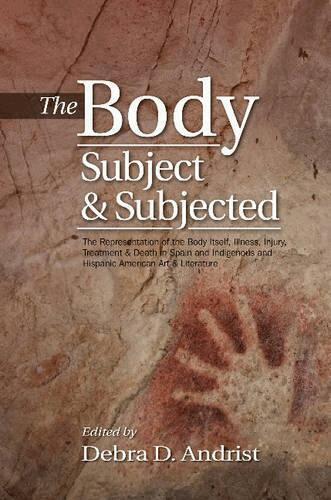
Body, Subject & Subjected
The Representation of the Body Itself, Illness, Injury, Treatment and Death in Spain and Indigenous and Hispanic American Art and Literature
Inbunden, Engelska, 2016
1 967 kr
Skickas inom 7-10 vardagar
Hominids have always been obsessed with representing their own bodies. The first "selfies" were prehistoric negative hand images and human stick figures, followed by stone and ceramic representations of the human figure. Thousands of years later, moving via historic art and literature to contemporary social media, the contemporary term "selfie" was self-generated. The book illuminates some "selfies". This collection of critical essays about the fixation on the human self addresses a multi-faceted geographic set of cultures -- the Iberian Peninsula to pre-Columbian America and Hispanic America -- analysing such representations from medical, literal and metaphorical perspectives over centuries. Chapter contributions address the representation of the body itself as subject, in both visual and textual manners, and illuminate attempts at control of the environment, of perception, of behaviour and of actions, by artists and authors. Other chapters address the body as subjected to circumstance, representing the body as affected by factors such as illness, injury, treatment and death. These myriad effects on the body are interpreted through the brushes of painters and the pens of authors for social and/or personal control purposes. The essays reveal critics' insights when "selfies" are examined through a focused "lens" over a breadth of cultures. The result, complex and unique, is that what is viewed -- the visual art and literature under discussion -- becomes a mirror image, indistinguishable from the component viewing apparatus, the "lens".
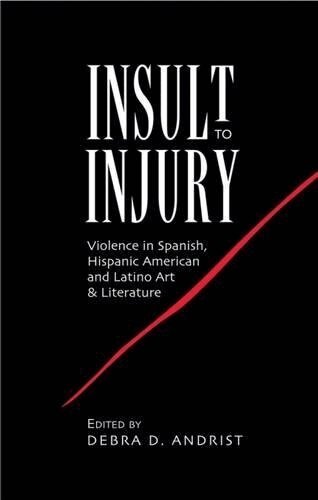
Insult to Injury
Violence in Spanish, Hispanic American and Latino Art and Literature
Inbunden, Engelska, 2016
1 967 kr
Skickas inom 7-10 vardagar
The stark reality of all life, from the biology of the food chain incorporating all living beings to the social stratification and hierarchies of human cultures, revolves around violence -- physical or psychological. That unavoidable, black-and-white, worldview of survival of the fittest with little if any grey to mitigate it is coloured only by the red lifeblood of the victims of the bigger, the stronger, the smarter, the wilier, who literally and/or figuratively 'eat' their victims -- overcoming, overwhelming, controlling, oppressing them. The premise behind the book focuses on the representation of the visual and literary artistic products of a group of seemingly alike yet divergent societies, with linguistic and cultural ties that reflect those societies' means of control. These representations socialise viewers and/or readers in personal or public situations, establishing ubiquitous hierarchies. French social anthropologist/literary critic/theorist René Girard maintains in Violence and the Sacred that 'the oldest means of social control is . . . violence.' While the incorporated violence itself is not the overweening theme of this work, the representation or threat of violence functions in reality in terms that imply its consequences to the viewer or reader. These consequences are discussed in terms of control-directed violence based on gender roles and politics, socio-cultural power, and environmental issues or eco-violence. The underlying message is that of the necessity to behave according to imposed norms, stated or implied, or suffer those consequences -- convincing leitmotif in works by Spanish, Hispanic American and Latino visual artists and writers in the Spanish language over the ages.
1 761 kr
Skickas inom 7-10 vardagar
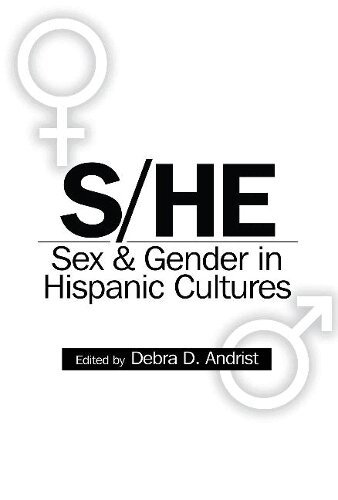
Hierarchies and disparities based on sex and gender have characterized nearly all hominid societies over almost the entire world of cultures since time immemorial. Nearly without exception, those disparities have created a hierarchy of male over female. Languages reflect that. For example, in the English language, the word for the fe/male sex is based on the word male; man is the root for wo/man; and indeed man is generally considered the generic for all members of the species. Spanish, on the other hand, does differentiate hombre from mujer, but the masculine is still considered the root and the generic. For the purposes of S/HE: Sex & Gender in Hispanic Worlds, sex refers to biological differences, i.e., reproductive organs and secondary sexual characteristics, which are perceived as oppositional yet collaborative, in the propagation of the species. Gender, on the other hand, refers to culturally-specific expectations and/or stereotypes in terms of an individuals or groups self (re)presentation and/or behaviors. The main title, S/HE, is a nod to the arguably-gender-neutral third-person singular pronoun from the 1960s inclusive English-language movement in the United States, which was concurrent with equal rights movements in terms of race, ethnicity, sex and gender. This book focuses on sex and gender issues in the Hispanic worlds, paying homage to all who do not fit within the strict parameters of previous definitions by including broadened descriptions of identity, both biological and social, and by highlighting aspects of traditional and non-traditional lifestyles as portrayed in art and literature.
1 967 kr
Skickas inom 7-10 vardagar
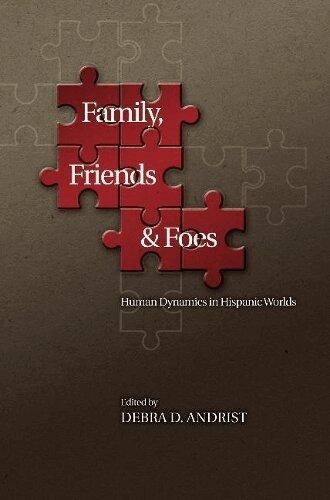
Jigsaw puzzles' notorious complexity and mega-multiple, amorphously-shaped pieces provide an appropriate metaphor for the navigating and maneuvering necessary throughout all aspects of human dynamics. Involvement comprises not only efforts by an individual personally trying to fit together a life of relationships with Family, Friends & Foes within complex categories and different levels, but the efforts by groups of individuals within those categories, progressively, by those groups within a larger society and/or societies, and then, across so many so-called boundaries: geographic, ethnic, linguistic, artistic and more. Such is the starting point for this particular collection of essays, which focuses on the human dynamics in cultures characterized, mostly linguistically, as Hispanic worlds, and those cultures both in real life and in terms of cultural productions such as movies, visual art and literature. Unlike jigsaw puzzles with their convenient guiding box-cover representation of the finished "product" once the pieces are correctly assembled, human dynamics' "pieces" are more like amoebas, ever changing size and shape, multiplying and dividing, sometimes fitting in with other pieces, sometimes not, sometimes overlappingin short, frequently unpredictable and always challenging for the would-be "assembler(s)." Thus, the title of this book could easily morph ad infinitum with the three elements of Family, Friends, Foes reflecting an enormous and unwieldy range of relationship, emotion and viewpoint. Mixed messages abound. And as can be seen from the individual chapter titles and content so-called successful relationships may be fleeting or unattainableor may match the imagined, hoped-for "picture" of a working relationship dynamic.