Debra Ferreday - Böcker
Visar alla böcker från författaren Debra Ferreday. Handla med fri frakt och snabb leverans.
4 produkter
4 produkter
2 088 kr
Skickas inom 10-15 vardagar
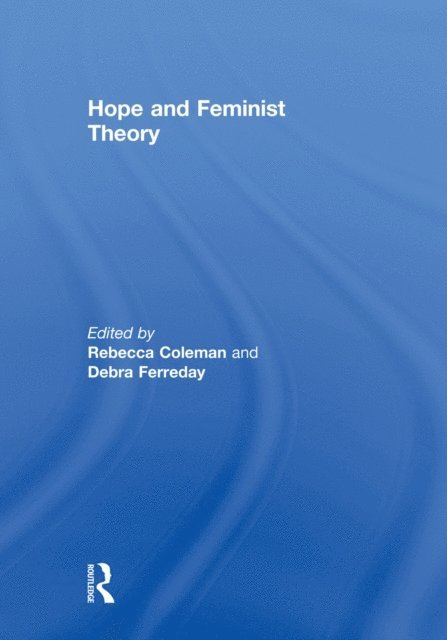
Hope is central to marginal politics which speak of desires for equality or simply for a better life. Feminism might be characterised as a politics of hope, a movement underpinned by a utopian drive for equality. This version of hope has been used, for example in Barack Obama’s phrase ‘the audacity of hope’ – a mobilisation of an affirmative politics which nevertheless implies that we are living in hopeless times. Similiarly, in recent years, feminism has seen the production of a prevailing mood of hopelessness around a generational model of progress, which is widely imagined to have ‘failed’. However, as a number of feminist theorists have pointed out, the temporality of feminism cannot be conceived as straightforwardly linear: feminism can only be imagined as having failed if it is understood as a particular set of relations and things.This collection grapples with the question of hope: how it figures and structures feminist theory as both a movement towards certain goals, and as inherently hopeful. Questions addressed include: Does hope necessarily imply a fantasy of perfectibility, a progression to a utopian future? Might it also be conceived in other ways: as an attachment?A lure? Does life tend towards hope, happiness, optimism? And, if so, what are the consequences when hope fails? Who decides which hopes are false? What is the cost of giving up hope?This book was published as a special issue of the Journal for Cultural Research.
752 kr
Skickas inom 10-15 vardagar
Hope is central to marginal politics which speak of desires for equality or simply for a better life. Feminism might be characterised as a politics of hope, a movement underpinned by a utopian drive for equality. This version of hope has been used, for example in Barack Obama’s phrase ‘the audacity of hope’ – a mobilisation of an affirmative politics which nevertheless implies that we are living in hopeless times. Similiarly, in recent years, feminism has seen the production of a prevailing mood of hopelessness around a generational model of progress, which is widely imagined to have ‘failed’. However, as a number of feminist theorists have pointed out, the temporality of feminism cannot be conceived as straightforwardly linear: feminism can only be imagined as having failed if it is understood as a particular set of relations and things.This collection grapples with the question of hope: how it figures and structures feminist theory as both a movement towards certain goals, and as inherently hopeful. Questions addressed include: Does hope necessarily imply a fantasy of perfectibility, a progression to a utopian future? Might it also be conceived in other ways: as an attachment?A lure? Does life tend towards hope, happiness, optimism? And, if so, what are the consequences when hope fails? Who decides which hopes are false? What is the cost of giving up hope?This book was published as a special issue of the Journal for Cultural Research.
1 563 kr
Skickas inom 5-8 vardagar
Though queer critics and queer theory tend to frame queer identities as marginal, this edited volume draws attention to a dynamic field in which a wide variety of queer identities can be put on display and consumed by audiences. Cementing a foundational understanding of queerness that is at odds with current shifts in media production, contributors present a broad variety of queer identities from across a range of televisual shows and genres to reconsider the marginalization of queerness in the twenty-first century. Doing so challenges preexisting notions that such “mainstreamification” necessitates being subsumed by the cisheteropatriarchy. This project argues the opposite, showing that heteronormative assumptions are outdated and that new queer representations lay the groundwork for filling gaps that queer criticism has left open.Thomas Brassington is a researcher whose work explores intersections of queerness and the Gothic in contemporary popular culture. Debra Ferreday is a feminist cultural theorist whose research concerns gender, feminist theory, sexuality, critical race theory, queer theory, and embodiment. Dany Girard is a queer researcher whose work primarily explores representations of gender, asexualities, and queer theory in television and film.
554 kr
Skickas inom 5-8 vardagar
What does it mean to ‘belong’ to an online community? What happens to the body in cyberspace? How has the Internet been theorised: as a site of liberation, duplicity, threat?In her reading of cyberculture studies after the affective turn, the author argues for a new cyberculture studies that goes beyond dominant cultural narratives of the Internet as dystopian or utopian space, and pays attention to the ways in which online culture has become embedded in everyday lives. The book intervenes in narratives of virtual reality to propose that the Internet can be re-read as a space of fantasy.This book draws on readings of the everyday, taken-for-granted sites of digital culture that have often been overlooked by cyberculture studies. Specific themes include religious fundamentalist sites and hate speech, online mourning, vampire homepages, virtual fashion and food shopping sites, and pro-anorexic communities. The book is attentive to the continuities and disruptions between online and offline experience. The author examines the ways in which bodies, subjects and communities are produced and reproduced through the stories we tell about online belongings.