Debra Satz – författare
Visar alla böcker från författaren Debra Satz. Handla med fri frakt och snabb leverans.
17 produkter
Economic Analysis, Moral Philosophy, and Public Policy
Av Debra Satz, Michael McPherson m. fl.
E-bok, 2016
772 kr
Lägg i varukorg
This book shows through argument and numerous policy-related examples how understanding moral philosophy can improve economic analysis, how moral philosophy can benefit from economists'' analytical tools, and how economic analysis and moral philosophy together can inform public policy. Part I …
Toward a Humanist Justice
The Political Philosophy of Susan Moller Okin
Av Rob Reich, Debra Satz
E-bok, 2009
1302 kr
Lägg i varukorg
The late Susan Moller Okin was a leading political theorist whose scholarship integrated political philosophy and issues of gender, the family, and culture. Okin argued that liberalism, properly understood as a theory opposed to social hierarchies and supportive of individual freedom and equality, …
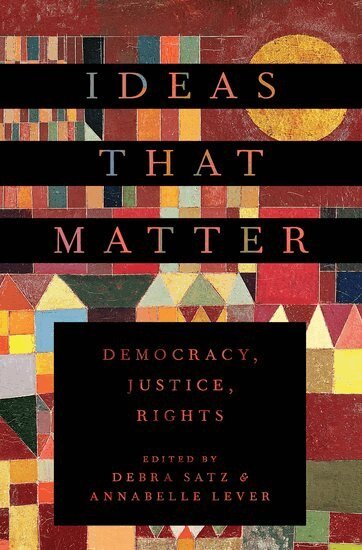
Ideas That Matter
Democracy, Justice, Rights
Av Satz, Debra Satz m. fl.
Inbunden, 2019
1262 kr
Lägg i varukorg
The essays in this volume take off from themes in the work of eminent philosopher and political scientist Joshua Cohen. Cohen is a deeply influential thinker who has written on deliberative democracy, freedom of expression, Rawlsian theory, global justice, and human rights. The essays gathered here …
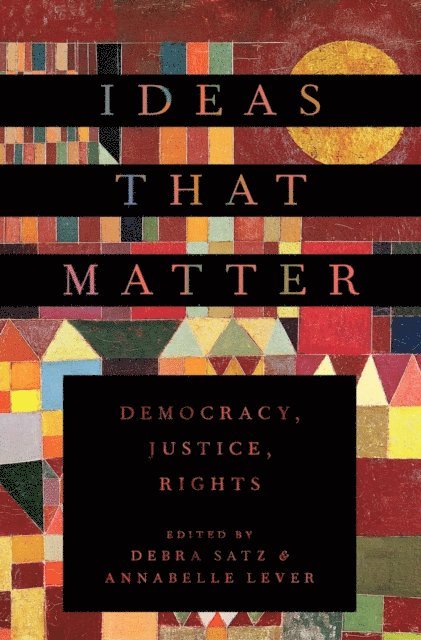
Ideas That Matter
Democracy, Justice, Rights
Av Annabelle Lever, Debra Satz
E-bok, 2019
1027 kr
Lägg i varukorg
The essays in this volume take off from themes in the work of eminent philosopher and political scientist Joshua Cohen. Cohen is a deeply influential thinker who has written on deliberative democracy, freedom of expression, Rawlsian theory, global justice, and human rights. The essays gathered here …
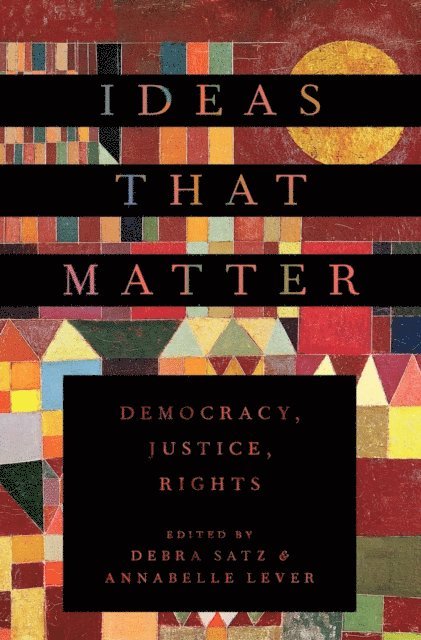
Ideas That Matter
Democracy, Justice, Rights
Av Annabelle Lever, Debra Satz
E-bok, 2019
1027 kr
Lägg i varukorg
The essays in this volume take off from themes in the work of eminent philosopher and political scientist Joshua Cohen. Cohen is a deeply influential thinker who has written on deliberative democracy, freedom of expression, Rawlsian theory, global justice, and human rights. The essays gathered here …
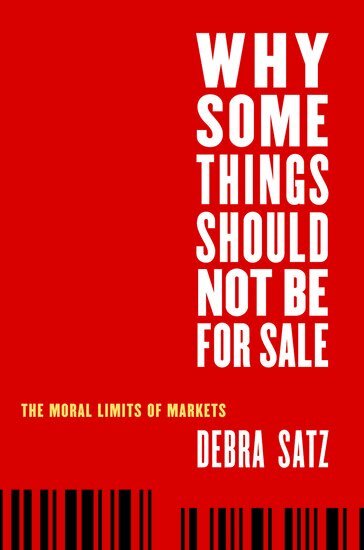
Why Some Things Should Not Be for Sale
The Moral Limits of Markets
Av Debra Satz
Inbunden, 2010
2167 kr
Lägg i varukorg
What's wrong with markets in everything? Markets today are widely recognized as the most efficient way in general to organize production and distribution in a complex economy. And with the collapse of communism and rise of globalization, it's no surprise that markets and the political theories …
Toward a Humanist Justice
The Political Philosophy of Susan Moller Okin
Av Debra Satz, Rob Reich
Inbunden, 2009
1576 kr
Lägg i varukorg
The late Susan Moller Okin was a leading political theorist whose scholarship integrated political philosophy and issues of gender, the family, and culture. Okin argued that liberalism, properly understood as a theory opposed to social hierarchies and supportive of individual freedom and equality, …
Toward a Humanist Justice
The Political Philosophy of Susan Moller Okin
Av Rob Reich, Debra Satz
E-bok, 2009
1302 kr
Lägg i varukorg
The late Susan Moller Okin was a leading political theorist whose scholarship integrated political philosophy and issues of gender, the family, and culture. Okin argued that liberalism, properly understood as a theory opposed to social hierarchies and supportive of individual freedom and equality, …
Why Some Things Should Not Be for Sale
The Moral Limits of Markets
Av Debra Satz
E-bok, 2010
326 kr
Lägg i varukorg
What''s wrong with markets in everything? Markets today are widely recognized as the most efficient way in general to organize production and distribution in a complex economy. And with the collapse of communism and rise of globalization, it''s no surprise that markets and the political theories …
Why Some Things Should Not Be for Sale
The Moral Limits of Markets
Av Debra Satz
E-bok, 2010
326 kr
Lägg i varukorg
What''s wrong with markets in everything? Markets today are widely recognized as the most efficient way in general to organize production and distribution in a complex economy. And with the collapse of communism and rise of globalization, it''s no surprise that markets and the political theories …
Why Some Things Should Not Be for Sale
The Moral Limits of Markets
Av Debra Satz
Häftad, 2012
474 kr
Lägg i varukorg
For many, markets are the most efficient way in general to organize production and distribution in a complex economy. But what about those markets we might label noxious--markets in addictive drugs, say, or in sex? In Why Some Things Should Not Be for Sale, philosopher Debra Satz takes a …
Occupy the Future
Av Debra Satz, Rob Reich m. fl.
E-bok, 2013
219 kr
Lägg i varukorg
How the Occupy movement has challenged the gap between American principles and American practice—and how we can realize our most cherished ideals. The Occupy Wall Street movement has ignited new questions about the relationship between democracy and equality in the United States. Are we also …
Economic Analysis, Moral Philosophy, and Public Policy
Av Daniel Hausman, Michael McPherson m. fl.
Inbunden, 2016
1362 kr
Lägg i varukorg
This book shows through argument and numerous policy-related examples how understanding moral philosophy can improve economic analysis, how moral philosophy can benefit from economists' analytical tools, and how economic analysis and moral philosophy together can inform public policy. Part I …
Economic Analysis, Moral Philosophy, and Public Policy
Av Daniel Hausman, Michael McPherson m. fl.
Häftad, 2016
731 kr
Lägg i varukorg
This book shows through argument and numerous policy-related examples how understanding moral philosophy can improve economic analysis, how moral philosophy can benefit from economists' analytical tools, and how economic analysis and moral philosophy together can inform public policy. Part I …
Economic Analysis, Moral Philosophy, and Public Policy
Av Debra Satz, Michael McPherson m. fl.
E-bok, 2016
756 kr
Lägg i varukorg
This book shows through argument and numerous policy-related examples how understanding moral philosophy can improve economic analysis, how moral philosophy can benefit from economists'' analytical tools, and how economic analysis and moral philosophy together can inform public policy. Part I …
Por qué algunas cosas no deberían estar en venta
Los límites morales del mercado
Av Debra Satz
E-bok, 2019
91 kr
Lägg i varukorg
Existe un amplio consenso según el cual los mercados son la forma más eficiente de organizar la producción y la distribución de bienes en economías complejas, el remedio mágico para todos los males de la burocracia y el control estatal. Sin embargo, a muchos les resulta inadmisible que el criterio …