• Fri frakt över 249 kr
  • •
  • Snabba leveranser
  • •
  • Billiga böcker
Kundservice

Du är på sajten för privatpersoner.

Företag, bibliotek eller offentlig verksamhet?

Du handlar på classic.bokus.com, där alla dina funktioner finns intakta.
Till classic.bokus.com
Bokus logotyp. Gå till startsidan.
  • Erbjudanden
  • Nyheter
  • Student
  • Topplistor
  • Barn & ungdom
  • Bokus Play
  • E-böcker
  • Pocketböcker
  • Spel & pussel

10% rabatt på allt med kod: NYSTART10 →

Sidfot

Mina sidor

    Hjälp

    • Kundservice
    • Vanliga frågor och svar
    • Frakt och leverans
    • Retur vid ångerrätt
    • Reklamera vara
    • Betalning
    • Köpvillkor
    • Allmänna villkor
    • Information om webbplatsens tillgänglighet

    Om Bokus

    • Om oss
    • Pressrum
    • För studenter
    • För företag
    • För bibliotek och offentlig verksamhet
    • För leverantörer
    • Hållbarhet

    Populärt

    • Aktuella erbjudanden
    • Presentkort
    • Studentlitteratur
    • Nya böcker
    • Topplistor
    • Signerade böcker
    • Engelska böcker

    Inspiration

    • Boktips
    • BookTok
    • Populära bokserier
    • Barnbokskaraktärer
    • Populära författare
    Logotyp för Bokus
    Följ oss på Facebook (extern länk)Följ oss på Instagram (extern länk)Följ oss på YouTube (extern länk)Följ oss på TikTok (extern länk)
    bokus @ CookiesAnpassa cookiesIntegritetspolicyKöpvillkor
    Till Citymail hemsida (extern länk)Till Budbee hemsida (extern länk)Till Postnord hemsida (extern länk)Till Schenker hemsida (extern länk)Till Early Bird hemsida (extern länk)Till Walleys hemsida (extern länk)
    1. Ekonomi och Ledarskap
    2. Nationalekonomi

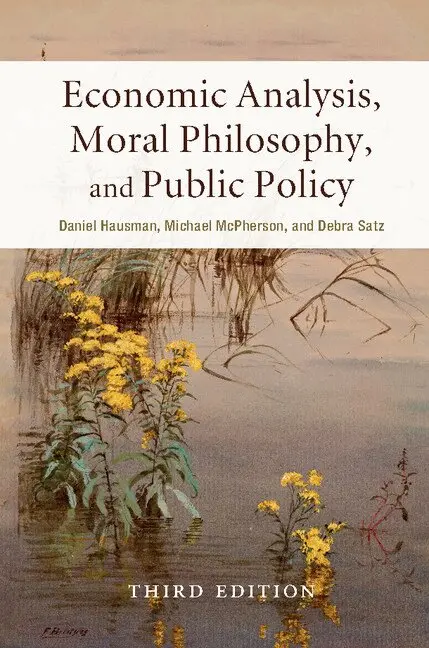
    Economic Analysis, Moral Philosophy, and Public Policy

    AvDaniel Hausman,Michael McPherson

    Häftad, Engelska, 2016

    633 kr

    Beställningsvara. Skickas inom 10-15 vardagar. Fri frakt över 249 kr.

    Fler format och utgåvor

    Inbunden

    1 123 kr

    Beskrivning

    This book shows through argument and numerous policy-related examples how understanding moral philosophy can improve economic analysis, how moral philosophy can benefit from economists' analytical tools, and how economic analysis and moral philosophy together can inform public policy. Part I explores the idea of rationality and its connections to ethics, arguing that when they defend their formal model of rationality, most economists implicitly espouse contestable moral principles. Part II addresses the nature and measurement of welfare, utilitarianism and cost-benefit analysis. Part III discusses freedom, rights, equality, and justice - moral notions that are relevant to evaluating policies, but which have played little if any role in conventional welfare economics. Finally, Part IV explores work in social choice theory and game theory that is relevant to moral decision making. Each chapter includes recommended reading and discussion questions.

    Produktinformation

    • Utgivningsdatum:2016-12-15
    • Mått:152 x 228 x 22 mm
    • Vikt:600 g
    • Format:Häftad
    • Språk:Engelska
    • Antal sidor:414
    • Upplaga:3
    • Förlag:Cambridge University Press
    • ISBN:9781316610886

    Utforska kategorier

    • Nationalekonomi inom Ekonomi och Ledarskap

    Mer om författaren

    Daniel M. Hausman is the Herbert A. Simon and Hilldale Professor of Philosophy at the University of Wisconsin, Madison. A founding editor of the journal Economics and Philosophy (with Michael McPherson), his research has centered on epistemological, metaphysical, and ethical issues at the boundaries between economics and philosophy. He is the author of Capital, Profits, and Prices (1981), The Inexact and Separate Science of Economics (1992), Causal Asymmetries (1998), Preference, Value, Choice, and Welfare (2012), and Valuing Health: Well-Being, Freedom, and Suffering (2015). Michael S. McPherson is President of the Spencer Foundation and Past President of MacAlester College, Minnesota. He co-founded the journal Economics and Philosophy with Daniel Hausman and has worked on problems on the borders of economics and philosophy. He is co-author of six books on higher education policy and economics, including Lesson Plan: An Agenda for Change in Higher Education (with William G. Bowen, 2016), Crossing the Finish Line: Completing College in America's Public Universities (2009), and The Student Aid Game: Meeting Need and Rewarding Talent in American Higher Education (1998). Debra Satz is the Marta Sutton Weeks Professor of Philosophy and Ethics in Society at Stanford University, California, where she is also the Senior Associate Dean for Humanities and Arts. Her research interests include the moral limits of the market, the nature of equality, and the public/private boundary. She is the author of Why Some Things Should Not Be for Sale: The Moral Limits of Markets (2010), and the co-editor of Toward a Humanist Justice: The Political Philosophy of Susan Moller Okin (with Rob Reich, 2009) and Occupy the Future (with David Grusky, Doug McAdam and Rob Reich, 2013) and is the author of numerous articles.

    Recensioner i media

    'The new edition of the book by Hausman, McPherson, and Satz is a rich and needed reading of economic analysis from the viewpoint of moral philosophy. Economists, if they reflect on these issues at all, think of their work as akin to physics; we find the pre-existing laws which govern the economic world. They can be considered simply as factual relations interesting in their own right; they can be used, as electricity, to serve human ends. What the authors demonstrate by detailed examination is that the analysis itself is shot through with normative and philosophical considerations. Any thoughtful reader will find his or her presuppositions challenged.' Kenneth J. Arrow, Stanford University, California, and Winner of the 1972 Nobel Prize in Economic Sciences

    Innehållsförteckning

    • 1. Ethics and economics?; 2. Ethics in welfare economics; 3. Ethics in positive economics: two examples; Part I. Rationality, Morality, and Markets: 4. Rationality and utility theory; 5. Rationality and morality in positive economics; 6. The ethical limits to markets; Part II. Welfare and Consequences: 7. Utilitarianism, consequentialism, and justice; 8. Welfare; 9. Welfare economics; Part III. Liberty, Rights, Equality and Justice: 10. Liberty, rights and libertarianism; 11. Equality and egalitarianism; 12. Justice and contractualism; Part IV. Moral Mathematics: 13. Social choice theory; 14. Game theory; Conclusions: 15. Putting economics and ethics to work; 16. Economics and ethics, hand in hand; Appendix.