Dennis E. Gale - Böcker
Visar alla böcker från författaren Dennis E. Gale. Handla med fri frakt och snabb leverans.
4 produkter
4 produkter
1 738 kr
Skickas inom 3-6 vardagar
Mob violence--often an interracial expression of the urban poverty found in major cities in the United States--is a phenomenon that has plagued this country repeatedly in the 20th century. From Reverend King to Rodney King, historical figures and incidents have shed new light on circumstances that bring about violence and the political context in which federal policy responds to the seemingly intractable social and economic problems that underlie the violence. In Understanding Urban Unrest, author Dennis E. Gale compares the federal programs that have been tested since 1966 and makes observations about the probable political response to urban interracial violence and poverty in the future. In addition, he contends that place-based patchwork policies are not effective and that only fundamental changes in the United States's economic structure and federal policy agenda can offer any real solutions for the nation's cities and its poor. Students and professionals in urban studies, political science, and sociology will find Understanding Urban Unrest both engaging and extremely accessible. "Understanding Urban Unrest is an outstanding example of effective political science. Dennis E. Gale takes a major public phenomenon--contemporary American urban riots from Newark to Los Angeles--and shows the interaction between tragic events and legislative response. He provides an authoritative history of the struggle to provide a workable national urban policy. This is a book that general audiences will find instructive and professional and academic readers will find essential." --Robert Wood, University of Massachusetts, Boston
314 kr
Skickas inom 10-15 vardagar
Living within the influence of one of the largest and most important cities in the world, how does New Jersey define itself? Is it simply a region of commuters, or have communities created effective local governments and satisfying cultural activities for one of the most diverse populations in the country?In the state with the country's densest population, the region known as North Jersey has sacrificed more than 30 percent of its land area to the vast web of roads and highways that carry more than 300,000 commuters to work in New York. Greater New Jersey probes challenges posed to the identity of New Jersey by the New York-centered mass media, professional sports, and organized crime families, while examining pressures internal to the state itself, including extraordinary social diversity, high population, fragmented governments, extensive political corruption, and diminishing land and natural resources.Greater New Jersey sets itself apart from other works about the state by virtue of the scope of its inquiry. While contemporary in outlook, the book underscores the role of history in shedding light on the Manhattan and New Jersey of today. Dennis E. Gale examines the complex interactions that knit together a region that has dual citizenship and argues that northern New Jersey is undergoing a gradual transformation to become symbolic of a new kind of suburban area, one that borrows culture, image, and economy from a metropolis but also maintains the day-to-day living patterns of heartland America in the face of rapid social change. Readers interested in the puzzling intricacies of modern life will find much to interest them in this account of a regional identity asserting itself in the face of a looming megalopolis.
Misunderstood History of Gentrification
People, Planning, Preservation, and Urban Renewal, 1915-2020
Inbunden, Engelska, 2021
1 145 kr
Skickas inom 7-10 vardagar
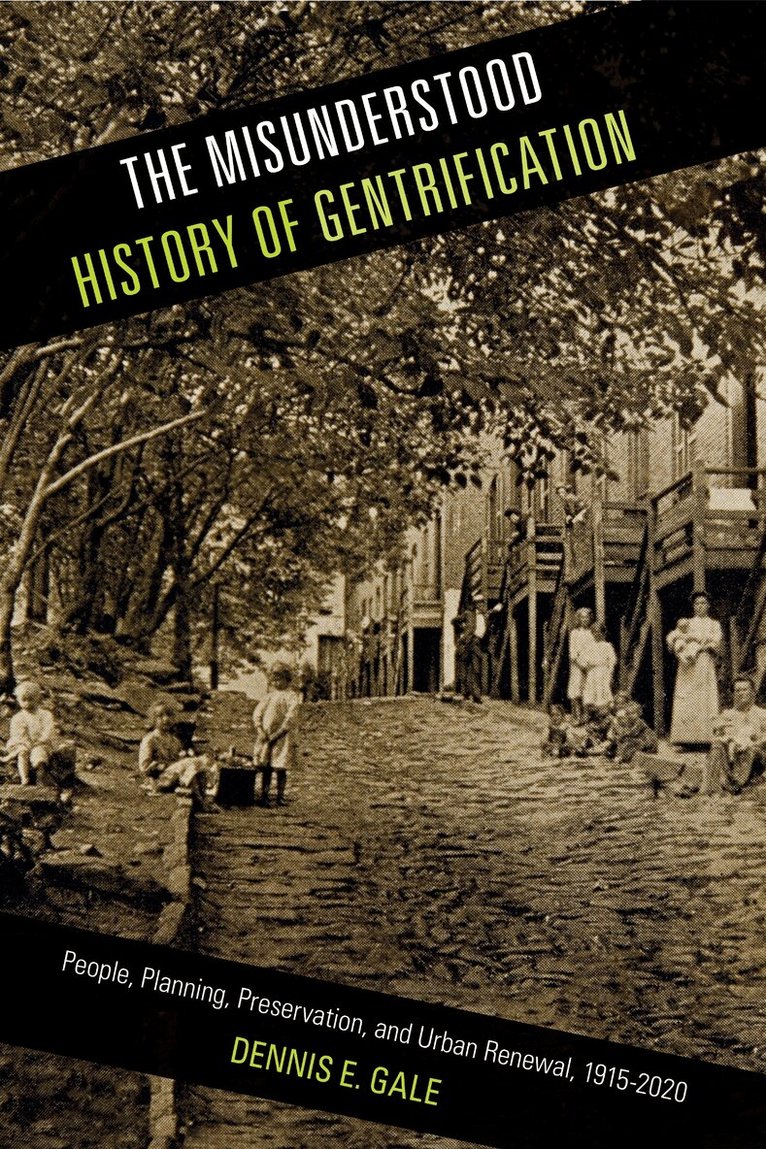
The origins of gentrification date back to World War I-only it was sometimes known as “remodeling” then. Dennis Gale’s insightful book, TheMisunderstood History of Gentrification, provides a recontextualization of American gentrification, planning, and policymaking. He argues that gentrification must be understood as an urban phenomenon with historical roots in the very early twentieth century. Gale uses solid empirical evidence to trace the embryonic revitalization of Georgetown, Greenwich Village, Beacon Hill, and elsewhere back to 1915. He shows how reinvestment and restoration reversed urban decline and revitalized neighborhoods. The Misunderstood History of Gentrification also explains how federal policies such as the Urban Redevelopment Program (later named Urban Renewal), which first emerged in 1949, razed urban slums and created an “urban crisis” that persisted in the 1960s and ‘70s. This situation soon prompted city gentrifiers and historic preservationists to reuse and rehabilitate existing structures.Within a more expansive historical framework, Gale offers a fresh perspective on and debunks misperceptions about gentrification in America.
Misunderstood History of Gentrification
People, Planning, Preservation, and Urban Renewal, 1915-2020
Häftad, Engelska, 2021
346 kr
Skickas inom 7-10 vardagar
The origins of gentrification date back to World War I-only it was sometimes known as “remodeling” then. Dennis Gale’s insightful book, TheMisunderstood History of Gentrification, provides a recontextualization of American gentrification, planning, and policymaking. He argues that gentrification must be understood as an urban phenomenon with historical roots in the very early twentieth century. Gale uses solid empirical evidence to trace the embryonic revitalization of Georgetown, Greenwich Village, Beacon Hill, and elsewhere back to 1915. He shows how reinvestment and restoration reversed urban decline and revitalized neighborhoods. The Misunderstood History of Gentrification also explains how federal policies such as the Urban Redevelopment Program (later named Urban Renewal), which first emerged in 1949, razed urban slums and created an “urban crisis” that persisted in the 1960s and ‘70s. This situation soon prompted city gentrifiers and historic preservationists to reuse and rehabilitate existing structures.Within a more expansive historical framework, Gale offers a fresh perspective on and debunks misperceptions about gentrification in America.