Derek Charles Catsam - Böcker
Visar alla böcker från författaren Derek Charles Catsam. Handla med fri frakt och snabb leverans.
5 produkter
5 produkter
497 kr
Skickas inom 3-6 vardagar
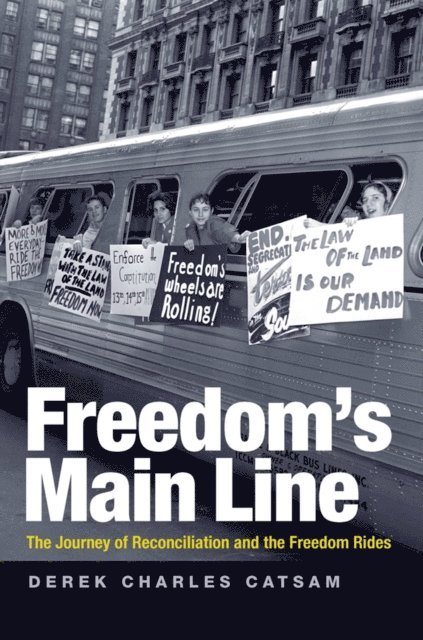
In 1961, the Congress of Racial Equality (CORE) and other civil rights groups began organizing the Freedom Rides. The Freedom Riders were volunteers of different backgrounds who travelled on buses throughout the American South to help enforce the Supreme Court ruling that had declared racial segregation on public transportation illegal. In Freedom's Main Line: The Journey of Reconciliation and the Freedom Rides, Derek Catsam shows how the Freedom Rides were crucial in raising awareness among decision makers and in bringing the realities of racial segregation into American homes through national media coverage.
Struggle for a Free South Africa
Campus Anti-Apartheid Movements in Africa and the United States, 1960–1994
Inbunden, Engelska, 2024
2 044 kr
Skickas inom 10-15 vardagar
This book explores anti-apartheid movements on university and college campuses across Africa and the United States in the 1970s and 1980s.In the wake of the March 1960 Sharpeville Massacre in South Africa, the country’s apartheid policies drew increasing critical international attention. By the 1970s, South Africa found itself isolated due to growing sporting, economic and cultural boycotts. Africans across the continent showed solidarity with Black South Africans through a range of boycotts and protests, by hosting South Africans exiled from their home country, and by vilifying the apartheid government at every turn. This volume looks at elite institutions as well as state colleges and universities in the United States, and the actions of university students in Nigeria, Kenya, Ghana, and South Africa during the anti-apartheid movements in the 1970s and 1980s, revealing the local manifestations of a global struggle. The chapters showcase how vibrant campus anti-apartheid movements were, what universal problems emerged, and where unique concerns manifested at a wide range of institutions.Taking innovative approaches and offering case studies, Struggle for a Free South Africa reveals the myriad ways the anti-apartheid struggle manifested in a range of academic environments and how those campaigns have been remembered and documented. This book was originally published as a special issue of Safundi.
Struggle for a Free South Africa
Campus Anti-Apartheid Movements in Africa and the United States, 1960–1994
Häftad, Engelska, 2025
611 kr
Skickas inom 10-15 vardagar
This book explores anti-apartheid movements on university and college campuses across Africa and the United States in the 1970s and 1980s.In the wake of the March 1960 Sharpeville Massacre in South Africa, the country’s apartheid policies drew increasing critical international attention. By the 1970s, South Africa found itself isolated due to growing sporting, economic and cultural boycotts. Africans across the continent showed solidarity with Black South Africans through a range of boycotts and protests, by hosting South Africans exiled from their home country, and by vilifying the apartheid government at every turn. This volume looks at elite institutions as well as state colleges and universities in the United States, and the actions of university students in Nigeria, Kenya, Ghana, and South Africa during the anti-apartheid movements in the 1970s and 1980s, revealing the local manifestations of a global struggle. The chapters showcase how vibrant campus anti-apartheid movements were, what universal problems emerged, and where unique concerns manifested at a wide range of institutions.Taking innovative approaches and offering case studies, Struggle for a Free South Africa reveals the myriad ways the anti-apartheid struggle manifested in a range of academic environments and how those campaigns have been remembered and documented. This book was originally published as a special issue of Safundi.
Flashpoint
How a Little-Known Sporting Event Fueled America's Anti-Apartheid Movement
Inbunden, Engelska, 2021
420 kr
Skickas inom 10-15 vardagar
Forty years ago, a South African rugby tour in the United States became a crucial turning point for the nation’s burgeoning protests against apartheid and a test of American foreign policy.In Flashpoint: How a Little-Known Sporting Event Fueled America's Anti-Apartheid Movement, Derek Charles Catsam tells the fascinating story of the Springbok’s 1981 US tour and its impact on the country’s anti-apartheid struggle. The US lagged well behind the rest of the Western world when it came to addressing the vexing question of South Africa’s racial policies, but the rugby tour changed all that. Those who had been a part of the country’s tiny anti-apartheid struggle for decades used the visit from one of white South Africa’s most cherished institutions to mobilize against both apartheid sport and the South African regime more broadly. Protestors met the South African team at airports, chanted outside their hotels, and courted arrests at matches, which ranged from the bizarre to the laughable, with organizers going to incredible lengths to keep their locations secret.In telling the story of how a sport little appreciated in the United States nonetheless became ground zero for the nation’s growing anti-apartheid movement, Flashpoint serves as a poignant reminder that sports and politics have always been closely intertwined.
365 kr
Skickas inom 10-15 vardagar
A significant examination of how athletes have fought for inclusion and equality on and off the playing field, despite calls for them to “stick to sports.” The claim that sports are—or ought to be—apolitical has itself never been an apolitical position. Rather, it is a veiled attempt to control which politics are acceptable in the athletic realm, a designation intricately linked to issues of race, gender, ethnicity, and more.In Don't Stick to Sports: The American Athlete’s Fight against Injustice, Derek Charles Catsam carefully explores this disparity. He looks at how, throughout recent sports history in the United States, minority athletes have had to fight every step of the way for their right to compete, and how they continue to fight for equity today. From African Americans and women to LGBTQ+ and religious minorities, Catsam shows how these athletes have taken a stand to address the underlying injustices in sports and society despite being told it’s not their place to do so. While it’s impossible for a single book to tell the entire history of exclusion in the sporting world, Don’t Stick to Sports looks at key moments from the World War I era to the present to shatter the myth of sports as a meritocracy, of sports-as-equalizer, highlighting the reality as something far more complicated—of sports as a malleable world where exclusion and inclusion are rarely straight-forward.