Derek Keene - Böcker
Visar alla böcker från författaren Derek Keene. Handla med fri frakt och snabb leverans.
8 produkter
8 produkter
Urban Achievement in Early Modern Europe
Golden Ages in Antwerp, Amsterdam and London
Häftad, Engelska, 2008
631 kr
Skickas inom 7-10 vardagar
This innovative work in comparative urban history explores why outstanding achievements in material and intellectual culture in early modern Europe tended to cluster in certain maritime cities. Patrick O'Brien and his co-editors have assembled a team of eighteen distinguished historians from Belgium, the Netherlands, Britain and North America, who have collaborated to make detailed comparisons of economic, architectural, artistic, publishing and scientific achievements in three renowned mercantile and imperial cities during their golden ages: Antwerp (c. 1492-1585), Amsterdam (c. 1585-1659) and London (c. 1660-1730). The book examines growth and fluctuations in the fortunes of all three cities in the context of broader trends in the growing urbanization of Europe's populations, cultures, societies and economies. The study is located in the histories of politics, warfare and culture in early modern Europe and offers fascinating insights to scholars and students of economic, social and cultural history.
Urban Achievement in Early Modern Europe
Golden Ages in Antwerp, Amsterdam and London
Inbunden, Engelska, 2001
1 485 kr
Skickas inom 7-10 vardagar
This innovative work in comparative urban history explores why outstanding achievements in material and intellectual culture in early modern Europe tended to cluster in certain maritime cities. Patrick O'Brien and his co-editors have assembled a team of eighteen distinguished historians from Belgium, the Netherlands, Britain and North America, who have collaborated to make detailed comparisons of economic, architectural, artistic, publishing and scientific achievements in three renowned mercantile and imperial cities during their golden ages: Antwerp (c. 1492-1585), Amsterdam (c. 1585-1659) and London (c. 1660-1730). The book examines growth and fluctuations in the fortunes of all three cities in the context of broader trends in the growing urbanization of Europe's populations, cultures, societies and economies. The study is located in the histories of politics, warfare and culture in early modern Europe and offers fascinating insights to scholars and students of economic, social and cultural history.
Cities into Battlefields
Metropolitan Scenarios, Experiences and Commemorations of Total War
Inbunden, Engelska, 2011
2 235 kr
Skickas inom 10-15 vardagar
Cities have always had a key role in warfare, as strategic centres which periodically suffered the horrors of siege and sack. With industrialisation, however, they were drawn ever closer to the front line and to direct and continuous experience of fighting and destruction. 'Cities into Battlefields: Metropolitan Scenarios, Experiences and Commemorations of Total War' explores the cultural imprint of military conflict on metropolises world wide in the era of the First and Second World Wars. It brings together cultural and urban historians and scholars of related disciplines including anthropology, education, and geography. The volume examines how the emergence of 'total' warfare blurred the boundaries between home and front and transformed cities into battlefields. The logic of total mobilisation turned the social and cultural fabric of urban life upside down. Arranged so as to bring out the evolution of experience over time, the essays explore Eastern and Central Europe, Britain and Western Europe, and Japan and address several key themes. The first strand - scenarios - explores the apocalyptic imagination of intellectuals and experts in peacetime. Artists and writers anticipating doom presented the coming upheaval as an urban event - a commonplace of late-Victorian and post-1918 pessimism. On a different plane, civil servants and engineers materialised visions of urban chaos and devised countermeasures in case of emergencies. Both groups helped to furnish a repertoire of cultural forms which channelled and encoded the actual experience of war. The second strand deals with metropolitan experiences, notably mobilisation, deprivation, and destruction in wartime. Ruins and the repercussions of war is the central theme of the third strand - commemorations - which investigates post-war efforts to remember and forget. The quest for meaningful forms of commemoration was hard enough after the First World War; the Second World War, which saw whole cities disappear in flames, raised the possibility that the limits of representation had been reached. The central contention of this volume - that total war in the twentieth century has a significant but often overlooked metropolitan dimension - is fully addressed, thereby filling a conspicuous gap in the currently available literature.
Segregation – Integration – Assimilation
Religious and Ethnic Groups in the Medieval Towns of Central and Eastern Europe
Inbunden, Engelska, 2009
2 235 kr
Skickas inom 10-15 vardagar
There is a widespread concern today with the role and experiences of ethnic and religious minorities, and their potential for conflict and harmony with 'host communities' and with each other, especially in towns. Interest in historical aspects of these phenomena is growing rapidly, not least in studies of the long and complex history of the towns of Central and Eastern Europe. Most such studies focus on particular places or on particular groups, but this volume offers a broader view covering the period from the tenth to the sixteenth century and regions from Germany to Dalmatia and from Epirus to Livonia, with an emphasis on the territory of medieval Hungary. The focus is on the changing nature of identity, perception and legal status of groups, on relations within and between them, and on the ways in which these elements were affected by the external political regimes and ideologies to which the towns were subjected. Many of the places examined were notable for the complexity of their ethnic and religious composition, and for their exposure to a wide range of external influences, including long-distance trade and tensions between settled and semi-nomadic ways of life. Overall the volume illustrates the variety of ways in which minorities found a place in towns - as citizens, outsiders, or in some other role - and how that could vary according to local circumstances and over time. Dealing with the formative period for modern European towns, this volume not only reveals much about medieval society and urban history, but poses questions still relevant today.
Segregation – Integration – Assimilation
Religious and Ethnic Groups in the Medieval Towns of Central and Eastern Europe
Häftad, Engelska, 2016
794 kr
Skickas inom 10-15 vardagar
There is a widespread concern today with the role and experiences of ethnic and religious minorities, and their potential for conflict and harmony with 'host communities' and with each other, especially in towns. Interest in historical aspects of these phenomena is growing rapidly, not least in studies of the long and complex history of the towns of Central and Eastern Europe. Most such studies focus on particular places or on particular groups, but this volume offers a broader view covering the period from the tenth to the sixteenth century and regions from Germany to Dalmatia and from Epirus to Livonia, with an emphasis on the territory of medieval Hungary. The focus is on the changing nature of identity, perception and legal status of groups, on relations within and between them, and on the ways in which these elements were affected by the external political regimes and ideologies to which the towns were subjected. Many of the places examined were notable for the complexity of their ethnic and religious composition, and for their exposure to a wide range of external influences, including long-distance trade and tensions between settled and semi-nomadic ways of life. Overall the volume illustrates the variety of ways in which minorities found a place in towns - as citizens, outsiders, or in some other role - and how that could vary according to local circumstances and over time. Dealing with the formative period for modern European towns, this volume not only reveals much about medieval society and urban history, but poses questions still relevant today.
Cities into Battlefields
Metropolitan Scenarios, Experiences and Commemorations of Total War
Häftad, Engelska, 2016
794 kr
Skickas inom 10-15 vardagar
Cities have always had a key role in warfare, as strategic centres which periodically suffered the horrors of siege and sack. With industrialisation, however, they were drawn ever closer to the front line and to direct and continuous experience of fighting and destruction. 'Cities into Battlefields: Metropolitan Scenarios, Experiences and Commemorations of Total War' explores the cultural imprint of military conflict on metropolises world wide in the era of the First and Second World Wars. It brings together cultural and urban historians and scholars of related disciplines including anthropology, education, and geography. The volume examines how the emergence of 'total' warfare blurred the boundaries between home and front and transformed cities into battlefields. The logic of total mobilisation turned the social and cultural fabric of urban life upside down. Arranged so as to bring out the evolution of experience over time, the essays explore Eastern and Central Europe, Britain and Western Europe, and Japan and address several key themes. The first strand - scenarios - explores the apocalyptic imagination of intellectuals and experts in peacetime. Artists and writers anticipating doom presented the coming upheaval as an urban event - a commonplace of late-Victorian and post-1918 pessimism. On a different plane, civil servants and engineers materialised visions of urban chaos and devised countermeasures in case of emergencies. Both groups helped to furnish a repertoire of cultural forms which channelled and encoded the actual experience of war. The second strand deals with metropolitan experiences, notably mobilisation, deprivation, and destruction in wartime. Ruins and the repercussions of war is the central theme of the third strand - commemorations - which investigates post-war efforts to remember and forget. The quest for meaningful forms of commemoration was hard enough after the First World War; the Second World War, which saw whole cities disappear in flames, raised the possibility that the limits of representation had been reached. The central contention of this volume - that total war in the twentieth century has a significant but often overlooked metropolitan dimension - is fully addressed, thereby filling a conspicuous gap in the currently available literature.
956 kr
Skickas
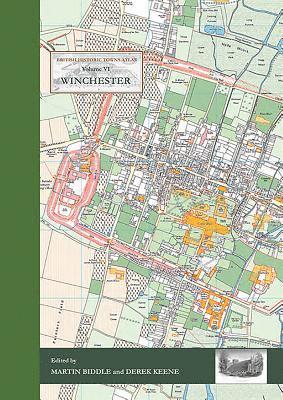
The volume is co-published by the Winchester Excavations Committee and forms Volume 11 of the Winchester Studies series. Following the success of volumes IV (Windsor and Eton) and V (York) in the series of Historic Towns Atlases, the new volume maps and explains the history of Winchester – a city which has played such an important part in English history from Roman times onwards. Combining many full-colour maps with an authoritative but very readable text, the atlas shows how the Roman city of Venta Belgarum became the second-most important city in England for several centuries: a walled town, the seat of kings and an ecclesiastical centre almost unparalleled in the country, before gently declining into a judicial centre and county town. The Atlas is centred on a detailed map of the city at the scale of 1:2500, showing Winchester's historic buildings and structures on a map of the city as it was in 1800. A series of maps show how Winchester was at key points in its history, charting its development and changing shape. The Atlas includes an early OS map, modern maps and historic aerial photographs, as well as colour illustrations, many of which have never been published before. The introduction offers a full history of how and why Winchester developed from prehistoric times onwards, in a series of chapters written by historians but aimed at the general reader. It also includes a comprehensive reference gazetteer listing every place shown on the maps, with a map location, a brief history, and further reading for those interested in finding out more. Like its companion volumes, the maps, text, gazetteer and illustrations are presented in an A3 stiff card binder, and the format allows for maps of different date to be compared side-by-side.
5 318 kr
Kommande
By the fourteenth century Winchester had lost its former eminence, but in trades, manufactures, and population, as well as by virtue of its administrative and ecclesiastical role, the city was still one of the major provincial centres in England. This Survey is based on a reconstruction of the histories of the houses, plots, gardens, and fields in the city and suburbs between c. 1300 and c. 1540, although in many instances both earlier and later periods are also covered. The reconstruction takes the form of a gazetteer (Part ii) of 1,128 histories of properties, together with accounts of 56 parish churches and the international fair of St. Giles, all illustrated by detailed maps. There is also a biographical register (Part iii) concerning more than 8,000 property-holders, most of whom lived in Winchester. This is the first time that it has been possible to piece together such a precise and detailed picture of both the topography and the inhabitants of a medieval town. Part i of the book contains a full discussion of the significance of this material and, in a manner relevant to an understanding of life in medieval towns in general, describes and defines such matters as the evolution of the physical environment, housing, land-tenure, property values, the parochial structure, the practice and organization of trades, and the ways in which the citizens of Winchester adapted to the declining status of their city.