Dhanaraj,Rajesh Kuma - Böcker
1 898 kr
Skickas inom 7-10 vardagar
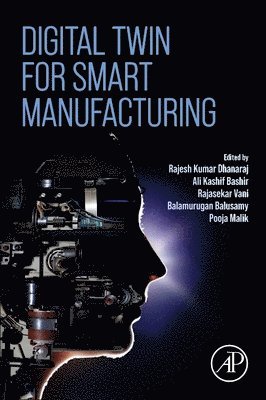
Digital Twin for Smart Manufacturing: Emerging Approaches and Applications provides detailed descriptions on how to integrate and optimize novel digital technologies for smart manufacturing. The book discusses digital twins, which combine the industrial internet of things, artificial intelligence, machine learning and software analytics with spatial network graphs to create living digital simulation models that update and change as their physical counterparts change. In addition, they provide an effective way to integrate technologies like cyber-physical systems into a smart manufacturing system, potentially optimizing the entire business process and operating procedure of the manufacturing firm.
Drawing on the latest research, the book addresses the topics and technologies key to successful implementation of a smart manufacturing system, including augmented and virtual reality, big data and energy management. Broader subjects such as additive manufacturing and robotics are also covered in this context, covering every aspect of production.
Includes detailed case studies that show how digital twins have been successfully implemented Shows how digital twins can be used to improve sustainability through superior energy usage management Outlines potential future uses of the digital twin, thus pointing the way for future research directions2 288 kr
Skickas inom 7-10 vardagar
The global race to develop and deploy automated vehicles is still hindered by significant challenges, with the related complexities requiring multidisciplinary research approaches. Knowledge Graph-Based Methods for Automated Driving offers sought-after, specialized know-how for a wide range of readers both in academia and industry on the use of graphs as knowledge representation techniques which, compared to other relational models, provide a number of advantages for data-driven applications like automated driving tasks. The machine learning pipeline presented in this volume incorporates a variety of auxiliary information, including logic rules, ontology-informed workflows, simulation outcomes, differential equations, and human input, with the resulting operational framework being more reliable, secure, efficient as well as sustainable. Case studies and other practical discussions exemplify these methods’ promising and exciting prospects for the maturation of scalable solutions with potential to transform transport and logistics worldwide.
Systematically covers knowledge graphs for automated driving processesIncludes real-life case studies, facilitating an understanding of current challengesAnalyzes the impact of various technological aspects related to automation across a range of transport modes, networks, and infrastructures