Diarmuid Ó'Mathúna - Böcker
Visar alla böcker från författaren Diarmuid Ó'Mathúna. Handla med fri frakt och snabb leverans.
3 produkter
3 produkter
536 kr
Skickas inom 10-15 vardagar
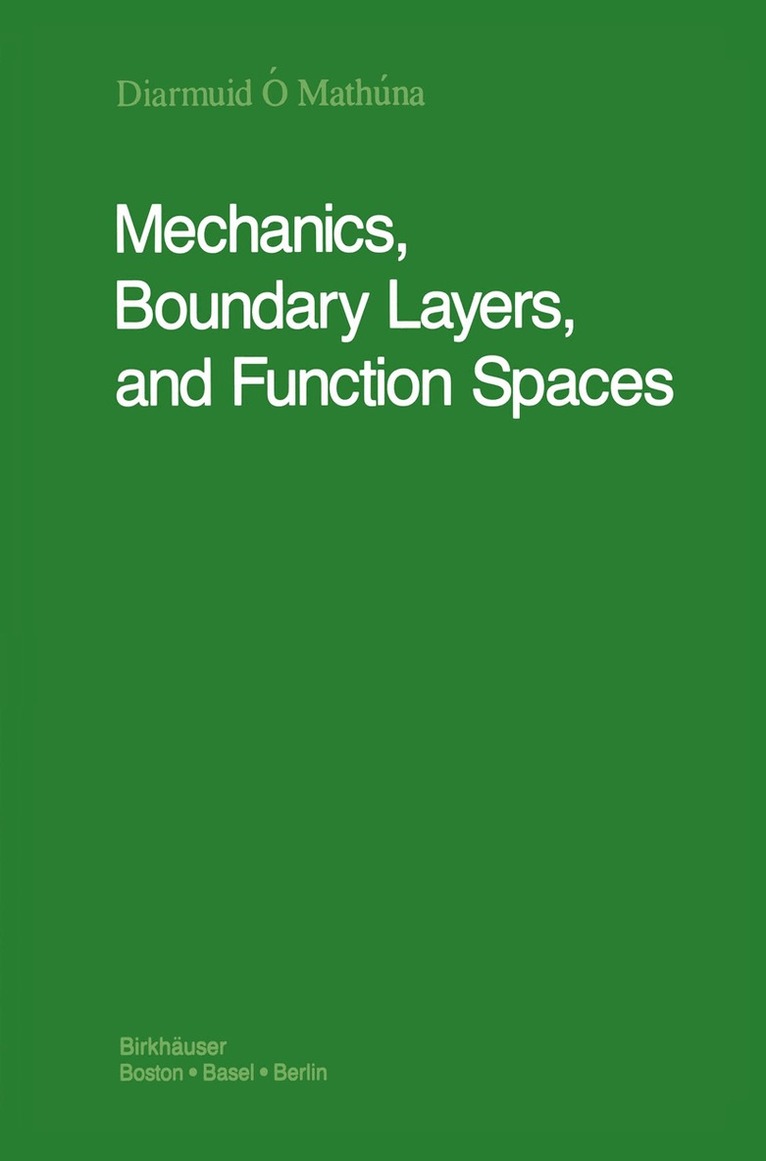
Concern with the class of problems investigated in this monograph began for me as a graduate student at MIT (1958-62) when serving as research assistant to Professor Eric Reissner who initiated me into the subject and whose influence - whether directly or dialectically - is probably discernable in the contours of the work. My fIrst attempt at a systematic derivation of the equations of shell theory was made while on a summer assistantship with Professor Norman Levinson in 1960. Beyond gaining a sobering reali- zation of the complexities involved, I made little progress at that time. In 1962-64 while a Temporary Member at the Courant Institute of Mathematical Sciences (NYU) I made a fresh start, while benefIting from my association and discus- sions with Professor Fritz John. With the conviction that the full integration of the equations with respect to the thickness coordinate, by means of the Legendre repre- sentations, must lead to a clarifIcation of the position of the two-dimensional theory in its three-dimensional context, the necessary computations were completed during that period.Several years passed while I became reconciled with the thought that the material needed to be organized as a monograph. This was done during 1969-70 while at the NASA Electronics Research Center in Cambridge, MA.
1 064 kr
Skickas inom 10-15 vardagar
Direct involvement with the subject area of the present work dates from my years with NASA at its Electronics Research Center (ERC) in Cambridge, M- sachusetts, in the 1960s. However, my approach to the problems of mathem- ical physics had been shaped earlier in my time as a graduate student in the Mathematics Department at MIT. The passage of time tends merely to further enhance my appreciation of that graduate study program, where I had the b- e?t of the intensive courses from Norman Levinson, C.-C. Lin, Jurgen ¨ Moser, and Eric Reissner. In the case of Reissner, my years as research assistant were a formative apprenticeship — one could say on the “shop-?oor”. The stimulus to organize my convictions in book form came from my friends at Birkh¨ auser Boston, and I wish to thank Ann Kostant for providing me with the opportunity and support in producing it; a special thanks goes to Edwin Beschler, formerly of Birkh¨ auser, for his consistent encouragement over the years. In the course of writing, I had the good-humored support and invaluable help from my one-time teacher and long-time friend, Vincent Hart. He read each chapter as it was written and his sharp eye picked up my many slips and errors. More signi?cantly, his persistent questioning on the original form of Chapter 3 forced me to address all parameter ranges and provide solution forms to cover all possibilities for the case of negative energy.
536 kr
Skickas inom 10-15 vardagar
Concern with the class of problems investigated in this monograph began for me as a graduate student at MIT (1958-62) when serving as research assistant to Professor Eric Reissner who initiated me into the subject and whose influence - whether directly or dialectically - is probably discernable in the contours of the work. My fIrst attempt at a systematic derivation of the equations of shell theory was made while on a summer assistantship with Professor Norman Levinson in 1960. Beyond gaining a sobering reali- zation of the complexities involved, I made little progress at that time. In 1962-64 while a Temporary Member at the Courant Institute of Mathematical Sciences (NYU) I made a fresh start, while benefIting from my association and discus- sions with Professor Fritz John. With the conviction that the full integration of the equations with respect to the thickness coordinate, by means of the Legendre repre- sentations, must lead to a clarifIcation of the position of the two-dimensional theory in its three-dimensional context, the necessary computations were completed during that period.Several years passed while I became reconciled with the thought that the material needed to be organized as a monograph. This was done during 1969-70 while at the NASA Electronics Research Center in Cambridge, MA.