Dingxin Zhao - Böcker
Visar alla böcker från författaren Dingxin Zhao. Handla med fri frakt och snabb leverans.
6 produkter
6 produkter
489 kr
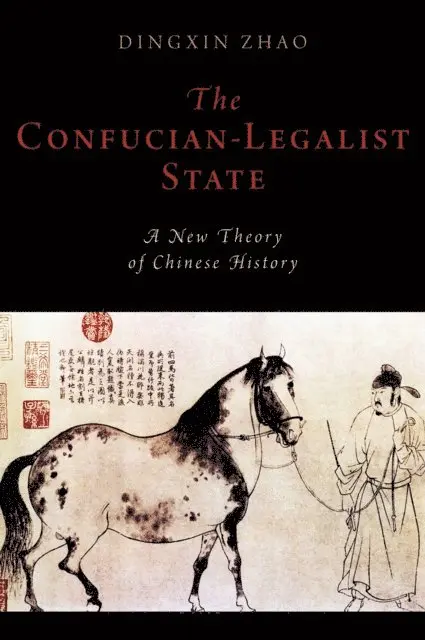
In The Confucian-Legalist State, Dingxin Zhao offers a radically new analysis of Chinese imperial history from the eleventh century BCE to the fall of the Qing dynasty. This study first uncovers the factors that explain how, and why, China developed into a bureaucratic empire under the Qin dynasty in 221 BCE. It then examines the political system that crystallized during the Western Han dynasty, a system that drew on China's philosophical traditions of Confucianism and Legalism. Despite great changes in China's demography, religion, technology, and socioeconomic structures, this Confucian-Legalist political system survived for over two millennia. Yet, it was precisely because of the system's resilience that China, for better or worse, did not develop industrial capitalism as Western Europe did, notwithstanding China's economic prosperity and technological sophistication beginning with the Northern Song dynasty. In examining the nature of this political system, Zhao offers a new way of viewing Chinese history, one that emphasizes the importance of structural forces and social mechanisms in shaping historical dynamics. As a work of historical sociology, The Confucian-Legalist State aims to show how the patterns of Chinese history were not shaped by any single force, but instead by meaningful activities of social actors which were greatly constrained by, and at the same time reproduced and modified, the constellations of political, economic, military, and ideological forces. This book thus offers a startling new understanding of long-term patterns of Chinese history, one that should trigger debates for years to come among historians, political scientists, and sociologists.
1 505 kr
Skickas inom 5-8 vardagar
The Confucian-Legalist State analyzes the history of China between the 11th century BCE and 1911 under the guidance of a new theory of social change. It centers on two questions. First, how and why China was unified and developed into a bureaucratic empire under the state of Qin in 221 BCE? Second, how was it that, until the nineteenth century, the political and cultural structure of China that was institutionalized during the Western Han dynasty (206 BCE - 8 CE) showed great resilience, despite great changes in demography, socioeconomic structure, ethnic composition, market relations, religious landscapes, technology, and in other respects brought by rebellions or nomadic conquests? In addressing these two questions, author Dingxin Zhao also explains numerous other historical patterns of China, including but not limited to the nature of ancient China's interstate relations, the logics behind the rising importance of imperil Confucianism during the Western Han dynasty and behind the formation of Neo-Confucian society during the Song dynasty (960-1279 CE), the changing nature of China's religious ecology under the age of Buddhism and Neo-Confucianism, the pattern of interactions between nomads and sedentary Chinese empires, the rise and dominance of civilian government, and China's inability to develop industrial capitalism without the coercion of Western imperialism.
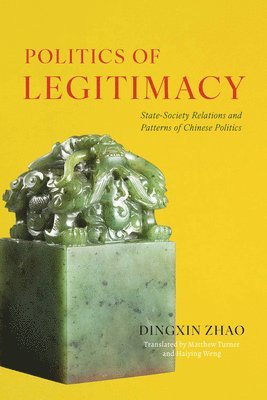
Politics of Legitimacy
State-Society Relations and Patterns of Chinese Politics
Inbunden, Engelska, 2026
1 343 kr
Skickas inom 11-20 vardagar
A sweeping work on China that interrogates how states gain, maintain, and lose legitimacy. The Chinese communist state has survived massive social changes, including the introduction of capitalist markets, an ongoing explosion of technological innovation, and an unprecedented jump in wealth and education, accompanied by a major cultural transformation. How has China managed to maintain its power even as the ground has so profoundly shifted? In Politics of Legitimacy, Dingxin Zhao argues that state power can be legitimized in three ideal-typical ways: a set of values upheld by the state (ideological legitimacy), recognized political processes such as regular competitive elections (procedural legitimacy), and the state’s capacity to provide public goods (performance legitimacy). Building on this theoretical framework, Zhao analyzes different aspects of Chinese politics, including the tragic ending of the 1989 pro-democracy movement, the weak development of mass-based nationalism in post-Mao China, the reasons behind China’s economic success, the anti-establishment tendency of the Chinese mass media and social media, and the sources of political tension in China, despite a superb economy. Moreover, Zhao’s innovative framework is widely applicable beyond China, shifting our attention from regime-type categories to the tools and relationships that determine their survival or collapse, and illuminating the current global emergence of conservatism and religious nationalism.
Politics of Legitimacy
State-Society Relations and Patterns of Chinese Politics
Häftad, Engelska, 2026
414 kr
Kommande
A sweeping work on China that interrogates how states gain, maintain, and lose legitimacy. The Chinese communist state has survived massive social changes, including the introduction of capitalist markets, an ongoing explosion of technological innovation, and an unprecedented jump in wealth and education, accompanied by a major cultural transformation. How has China managed to maintain its power even as the ground has so profoundly shifted? In Politics of Legitimacy, Dingxin Zhao argues that state power can be legitimized in three ideal-typical ways: a set of values upheld by the state (ideological legitimacy), recognized political processes such as regular competitive elections (procedural legitimacy), and the state’s capacity to provide public goods (performance legitimacy). Building on this theoretical framework, Zhao analyzes different aspects of Chinese politics, including the tragic ending of the 1989 pro-democracy movement, the weak development of mass-based nationalism in post-Mao China, the reasons behind China’s economic success, the anti-establishment tendency of the Chinese mass media and social media, and the sources of political tension in China, despite a superb economy. Moreover, Zhao’s innovative framework is widely applicable beyond China, shifting our attention from regime-type categories to the tools and relationships that determine their survival or collapse, and illuminating the current global emergence of conservatism and religious nationalism.
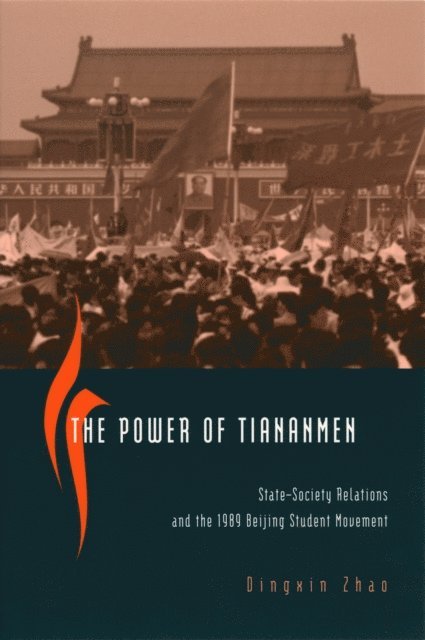
Power of Tiananmen
State-Society Relations and the 1989 Beijing Student Movement
Inbunden, Engelska, 2001
808 kr
Skickas inom 7-10 vardagar
In the spring of 1989 over 100,000 students in Beijing initiated the largest student revolt in human history. Television screens across the world filled with searing images from Tiananmen Square of protesters thronging the streets, massive hunger strikes, tanks set ablaze, and survivors tending to the dead and wounded after a swift and brutal government crackdown.Dingxin Zhao's award-winning The Power of Tiananmen is the definitive treatment of these historic events. Along with grassroots tales and interviews with the young men and women who launched the demonstrations, Zhao carries out a penetrating analysis of the many parallel changes in China's state-society relations during the 1980s. Such changes prepared an alienated academy, gave rise to ecology-based student mobilization, restricted government policy choices, and shaped student emotions and public opinion, all of which, Zhao argues, account for the tragic events in Tiananmen.
Power of Tiananmen
State-Society Relations and the 1989 Beijing Student Movement
Häftad, Engelska, 2004
331 kr
Skickas inom 7-10 vardagar
In the spring of 1989 over 100,000 students in Beijing initiated the largest student revolt in human history. Television screens across the world filled with searing images from Tiananmen Square of protesters thronging the streets, massive hunger strikes, tanks set ablaze, and survivors tending to the dead and wounded after a swift and brutal government crackdown.Dingxin Zhao's award-winning The Power of Tiananmen is the definitive treatment of these historic events. Along with grassroots tales and interviews with the young men and women who launched the demonstrations, Zhao carries out a penetrating analysis of the many parallel changes in China's state-society relations during the 1980s. Such changes prepared an alienated academy, gave rise to ecology-based student mobilization, restricted government policy choices, and shaped student emotions and public opinion, all of which, Zhao argues, account for the tragic events in Tiananmen.