Don C. Skemer - Böcker
Visar alla böcker från författaren Don C. Skemer. Handla med fri frakt och snabb leverans.
4 produkter
4 produkter
631 kr
Skickas inom 11-20 vardagar
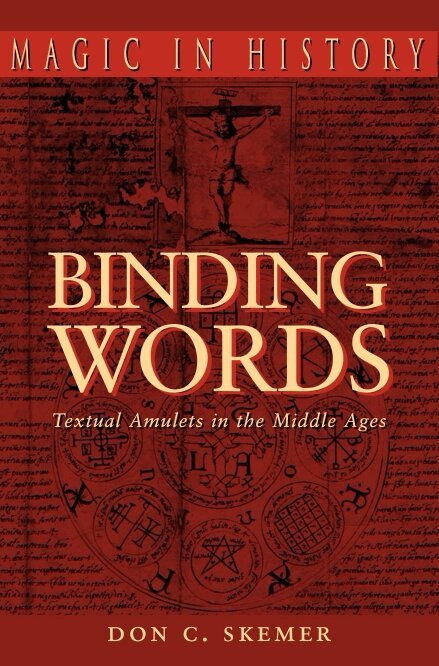
In the Middle Ages, textual amulets—short texts written on parchment or paper and worn on the body—were thought to protect the bearer against enemies, to heal afflictions caused by demonic invasions, and to bring the wearer good fortune. In Binding Words, Don C. Skemer provides the first book-length study of this once-common means of harnessing the magical power of words. Textual amulets were a unique source of empowerment, promising the believer safe passage through a precarious world by means of an ever-changing mix of scriptural quotations, divine names, common prayers, and liturgical formulas. Although theologians and canon lawyers frequently derided textual amulets as ignorant superstition, many literate clergy played a central role in producing and disseminating them. The texts were, in turn, embraced by a broad cross-section of Western Europe. Saints and parish priests, physicians and village healers, landowners and peasants alike believed in their efficacy. Skemer offers careful analysis of several dozen surviving textual amulets along with other contemporary medieval source materials. In the process, Binding Words enriches our understanding of popular religion and magic in everyday medieval life.
Medieval and Renaissance Manuscripts in the Princeton University Library (Two-Volume Set)
Inbunden, Engelska, 2013
2 428 kr
Tillfälligt slut
This two-volume catalogue is the first comprehensive scholarly description of the Western medieval and Renaissance manuscripts in the Princeton University Library, one of the finest collections in America. The rich holdings comprise more than 420 manuscripts in the Robert Garrett, Grenville Kane, Robert Taylor, Cotsen Library, and Princeton collections; manuscripts bound with incunables in the Rare Books Division; hundreds of single leaves and cuttings; and about 5,000 original documents in six other collections. The catalogue offers full textual, paleographic, codicological, art-historical, and iconographical descriptions; detailed provenance notes; and full bibliographies. About a third are illuminated manuscripts, which are selectively illustrated in the catalogue's 128 color plates, which contain nearly 400 images. Princeton's manuscripts range in date from the Carolingian era to the Italian Renaissance, with particular strength in late medieval holdings. They come chiefly from England, France, Italy, Germany and the deutscher Sprachraum, the Low Countries, and the Iberian Peninsula.There are more than thirty manuscripts in Middle English, and a nearly equal number in French (including Anglo-Norman), with smaller numbers in Italian, Spanish, Portuguese, German, Dutch or Flemish, Hebrew, and Icelandic. Among the highlights of the collection are Hrabanus Maurus's Commentary on Matthew (Fulda, ca. 840-60); William of Waddington's Manuel des peches (1280s); a Chretien de Troyes miscellany (France, ca. 1295); the Tollemache Chaucer (ca. 1420-60); an illustrated copy of Kyrillos's Fables in German (1425-30); a Suetonius with sumptuous full-page miniatures (Milan, 1433); a richly illustrated copy of Giovanni Marcanova's Antiquitates (Bologna, ca. 1473); the Hours of Marguerite de Rohan, countess of Angouleme (ca. 1480); and the Sanvito Virgil (Padua, ca. 1507). Some twenty years in the making, this catalogue identifies virtually all the manuscripts' texts on an encyclopedic range of subjects. Classical Latin authors, medieval scholastic texts, scripture, liturgy, and devotional books are most prominent, but history, law, music, medicine, astronomy, magic, and especially vernacular literature are also represented.Medieval and Renaissance Manuscripts in the Princeton University Library has a fully integrated approach that gives equal emphasis to text and image and their historical context, offering insights into countless aspects of intellectual and artistic life.
1 115 kr
Skickas inom 7-10 vardagar
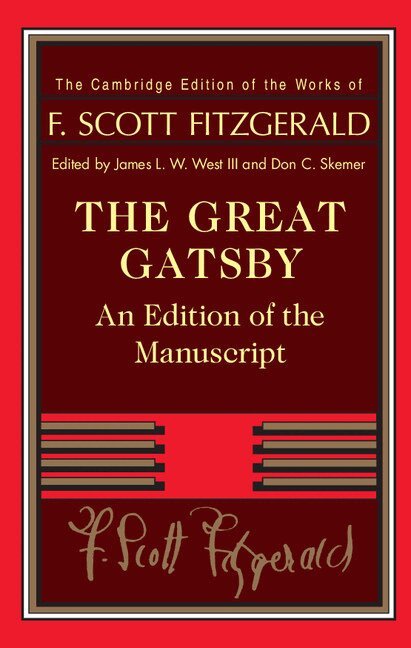
This edition presents the manuscript of F. Scott Fitzgerald's The Great Gatsby, the earliest full version of the novel that survives. Study of this manuscript reveals much about the composition of the novel - about the development of its characters and themes and the revision of its language. Fitzgerald reworked the manuscript, putting it through several drafts and continuing to edit until a few weeks before publication. The period of its creation was an amalgamation of his talent, inspiration, and self-discipline which resulted in a masterpiece. An introduction by James L. W. West, III, the general editor of the series, gives the compositional history of the novel; a bibliographical commentary by Don C. Skemer, Curator of Manuscripts at Princeton University Library, describes the manuscript and gives the story of its preservation, acquisition, and restoration. The reading text is presented without emendation and with a minimum of editorial apparatus. This edition will allow critics, teachers, and students to study The Great Gatsby as a fluid text, evolving and progressing toward its final form from its very earliest incarnation.
367 kr
Skickas inom 7-10 vardagar
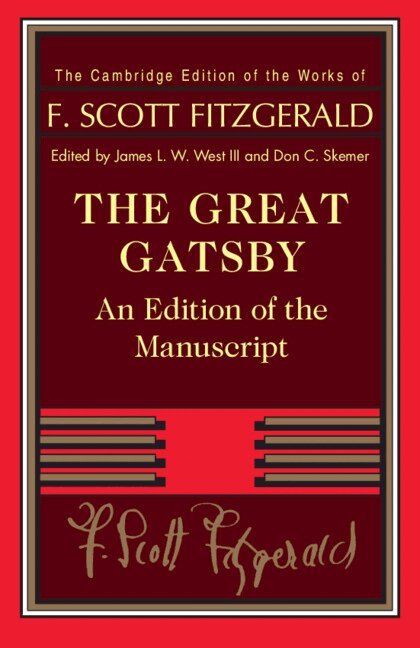
This edition presents the manuscript of F. Scott Fitzgerald's The Great Gatsby, the earliest full version of the novel that survives. Study of this manuscript reveals much about the composition of the novel - about the development of its characters and themes and the revision of its language. Fitzgerald reworked the manuscript, putting it through several drafts and continuing to edit until a few weeks before publication. The period of its creation was an amalgamation of his talent, inspiration, and self-discipline which resulted in a masterpiece. An introduction by James L. W. West, III, the general editor of the series, gives the compositional history of the novel; a bibliographical commentary by Don C. Skemer, Curator of Manuscripts at Princeton University Library, describes the manuscript and gives the story of its preservation, acquisition, and restoration. The reading text is presented without emendation and with a minimum of editorial apparatus. This edition will allow critics, teachers, and students to study The Great Gatsby as a fluid text, evolving and progressing toward its final form from its very earliest incarnation.