Donald A. Nielsen – författare
Visar alla böcker från författaren Donald A. Nielsen. Handla med fri frakt och snabb leverans.
3 produkter
3 produkter
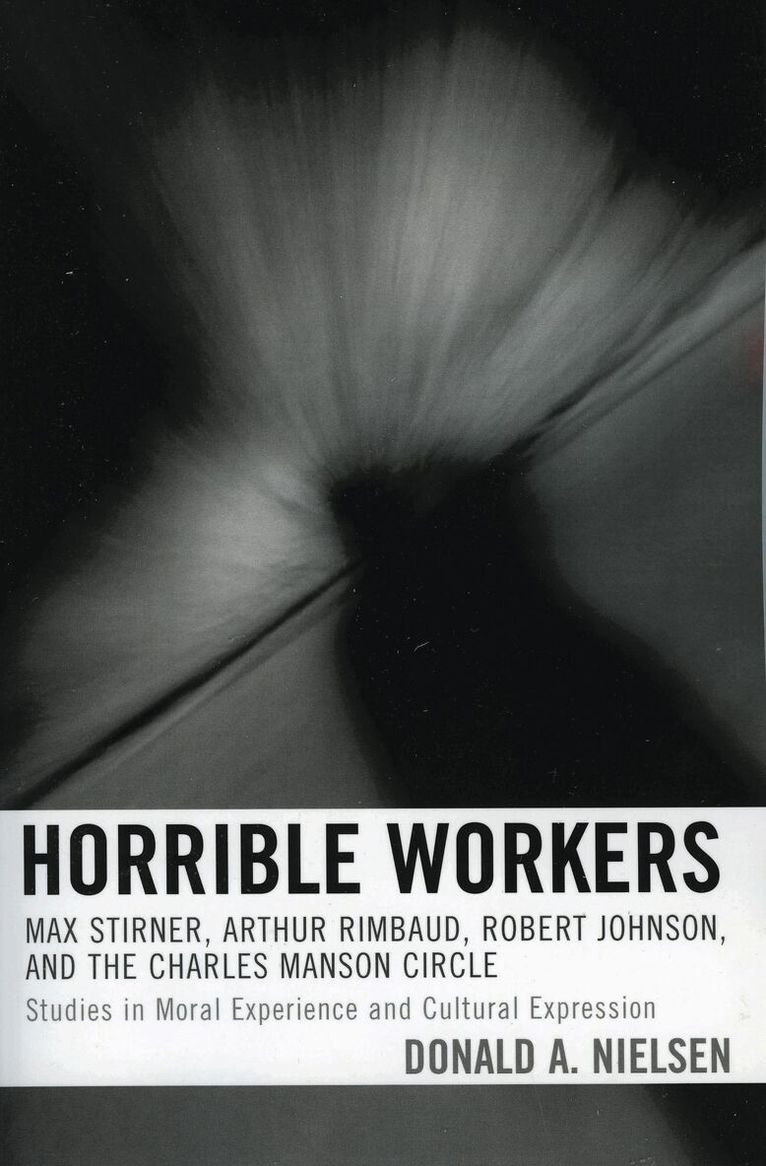
Horrible Workers
Max Stirner, Arthur Rimbaud, Robert Johnson, and the Charles Manson Circle
Häftad, Engelska, 2005
534 kr
Skickas inom 10-15 vardagar
The poet makes himself a seer by a long, boundless, and systematic derangement of all the senses…. What if he is destroyed in his flight through things unheard of and unnamed: other horrible workers will come; they will begin at the horizons where the other has fallen. In Arthur Rimbaud's letter to Paul Demeny Rimbaud describes the poet's role as being something like a trickster. But the poet's trick, or joke, is self-directed. A long dissociation of the senses from reality creates, for the poet, a new relationship to reality. But the poet's work with reality is always something like a play at what is real. Play becomes necessary so that the poet doesn't just change his or her relationship to reality but, in playing, creates a space for poetics; a space for work. The French poet Arthur Rimbaud, American blues musician Robert Johnson, German anarchist intellectual Max Stirner, and the phenomena of the Manson family circle have all appeared as forms and figures on the invisible horizon described by Rimbaud above. Through a reading of Emilé Durkheim's Suicide Donald Nielsen demonstrates how, in each case, one can locate hitherto unnoticed similarities in the social experiences of each subject featured in these four cases. Nielsen demonstrates how social experience can lead to forms of cultural expression that are contrary to the logic of the originating experience. In his discussion of experience and expression Nielsen creates a truly unique text that sheds new light on sociological theory, modernism and modernist thought, ethics and religious thought, and new and burgeoning methodologies in cultural studies. Sociologists, anthropologists, psychologists, philosophers of the social sciences, and adherents to cultural studies will find much of interest in Nielsen's excellent study.
Three Faces of God
Society, Religion, and the Categories of Totality in the Philosophy of Emile Durkheim
Häftad, Engelska, 1998
380 kr
Tillfälligt slut
A fresh interpretation of the work of Emile Durkheim, which argues that in addition to being a pioneer in sociological theory and research, Durkheim was also a major social philosopher concerned with religion, metaphysics, and knowledge.Three Faces of God offers a new interpretation of Emile Durkheim's social philosophy. It challenges the current view of him as primarily a scientific sociologist who identified sociology with the study of collective representations. Nielsen argues that Durkheim was a sociological monist who developed a concept of social substance and a theory of society, religion and the categories of understanding strikingly similar to Spinoza's philosophy. The book provides a comprehensive examination of Durkheim's major and minor writings, especially his theory of religion and the categories, and compares his work with Aristotle, Bacon, Kant, and Renouvier. The author places Durkheim's thought in the context of an encounter between traditional religious ideals, especially Judaism, and modernizing scientific and philosophical currents.
Structures of Consciousness and Civilizational Processes
A Critical Reconstruction of Benjamin Nelson’s Sociology of Civilizations
Inbunden, Engelska, 2026
1 480 kr
Kommande
As societies around the globe undergo rapid change, Benjamin Nelson’s theories help explain how and why civilizations evolve.This book offers a full-length, comprehensive analysis of Benjamin Nelson’s ideas and historical studies, exploring his civilization-analytic perspective, its intricate ties to Max Weber’s theories, and Nelson’s arguments about the major historical phases shaping Western European civilization. Donald A. Nielsen argues that Nelson’s work centers on religious and cultural universalism, reconstructing Nelson’s thesis that 12th-century Europe experienced an axial shift in consciousness toward more rationalized, universalistic cultural orientations. Rather than focusing on the origins of modernity, Nelson examined revolutionary changes in structures of consciousness and civilizations, including six ongoing “revolutions” he identified. Nielsen unpacks Nelson’s view of civilizational crises and demonstrates that his theories are rooted in a vision of human life that values lived experience and expression within changing historical contexts. By highlighting how Nelson’s theories illuminate the dynamics of cultural universalism and structural transformations across historical contexts, this book provides readers a conceptual framework for analyzing civilizational change.