
Donald R. Kirsch – författare
Visar alla böcker från författaren Donald R. Kirsch. Handla med fri frakt och snabb leverans.
2 produkter
2 produkter
210 kr
Skickas inom 11-20 vardagar
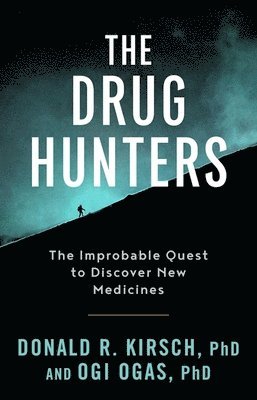
The surprising, behind-the-scenes story of how our medicines are discovered, told by a veteran drug hunter.The search to find medicines is as old as disease, which is to say as old as the human race. Through serendipity by chewing, brewing, and snortingsome Neolithic souls discovered opium, alcohol, snakeroot, juniper, frankincense, and other helpful substances. Ötzi the Iceman, the five-thousand-year-old hunter frozen in the Italian Alps, was found to have whipworms in his intestines and Bronze-age medicine, a worm-killing birch fungus, knotted to his leggings. Nowadays, Big Pharma conglomerates spend billions of dollars on state-of the art laboratories staffed by PhDs to discover blockbuster drugs. Yet, despite our best efforts to engineer cures, luck, trial-and-error, risk, and ingenuity are still fundamental to medical discovery.The Drug Hunters is a colorful, fact-filled narrative history of the search for new medicines from our Neolithic forebears to the professionals of today, and from quinine and aspirin to Viagra, Prozac, and Lipitor. The chapters offer a lively tour of how new drugs are actually found, the discovery strategies, the mistakes, and the rare successes. Dr. Donald R. Kirsch infuses the book with his own expertise and experiences from thirty-five years of drug hunting, whether searching for life-saving molecules in mudflats by Chesapeake Bay or as a chief science officer and research group leader at major pharmaceutical companies.
Innovators
16 Visionary Scientists and Their Struggle for Recognition—From Galileo to Barbara McClintock and Rachel Carson
Inbunden, Engelska, 2024
242 kr
Skickas inom 11-20 vardagar
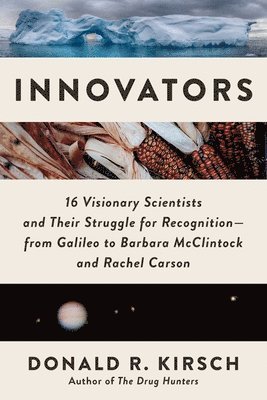
Scientific breakthroughs that changed the way we understand the world—and the fascinating stories of the scientists behind themSome of the most significant breakthroughs in science don’t receive widespread recognition until decades later, sometimes after their author’s death. Nobel Prize–winner Max Planck, whose black-body radiation law established the discipline of quantum mechanics, stated this as what has become known as Planck’s principle, commonly summarized as “Science progresses one funeral at a time.” In other words, for some truly groundbreaking discoveries, a new consensus builds only when proponents of the old consensus die off. Breakthrough discoveries require a paradigm shift, and it takes time and new minds for the new paradigm to be adopted. In Innovators, Donald Kirsch tells the stories of sixteen visionary scientists who suffered this fate, some now famous like Max Planck himself, Galileo, and Gregor Mendel, and some less well known. Among them are Barbara McClintock who, working with Indian corn, discovered transposons, also known as jumping genes, which provide a major mechanism driving biological evolution; Rachel Carson, catalyst for the environmental movement; and Roger Revelle, the climatologist whose findings were the first to be described by the term “global warming.” The breakthroughs cover fields from biology to medicine to physics and earth sciences and include the discovery of prions, life-changing treatments such as drugs for high blood pressure, ulcers, and organ transplantation; the process of continental drift; and our understanding of how molecules form matter.